HIRE DEVELOPERS  /  CHROME EXTENSION DEVELOPERS

Chrome extensiondevelopers built forwhat's next.

Most Chrome extensions get built once and slowly break — a permissions change here, a service worker timeout there, a Manifest V3 requirement nobody planned for. We build extensions for enterprise clients and consumer products that keep working past launch, not just past the demo.

Vetted senior talent
Flexible engagement models
Founder-direct delivery
Why Entalogics

Why teams hire
Chrome extension developers from us.

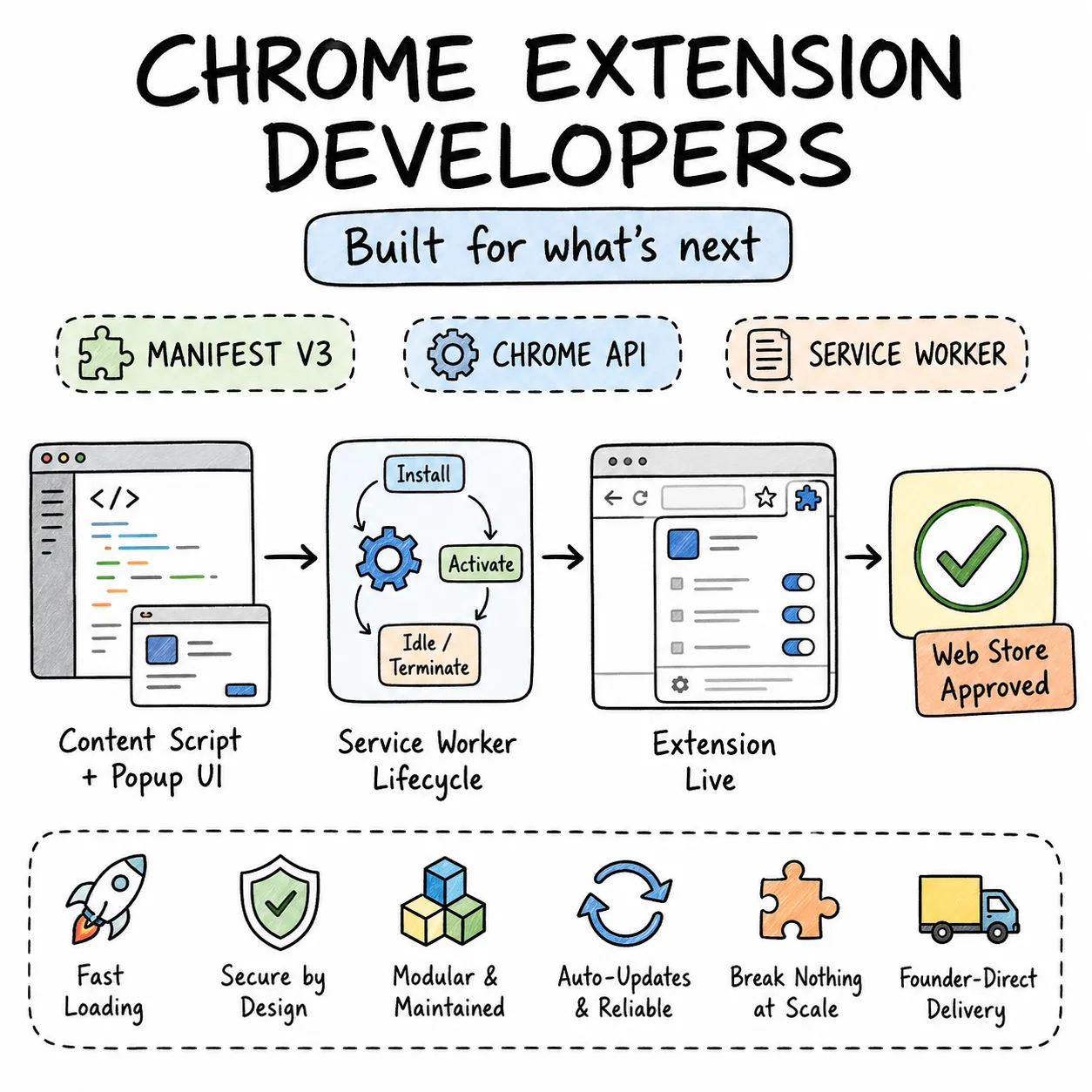
Background service workers, content scripts, popup UIs, options pages, cross-origin messaging — the full architecture, not just the popup. Manifest V3 by default, Web Store submission handled end to end, built to pass Google's policy review the first time.

EXPERT BENCH01

Chrome extension developers, vetted on the hard parts.

Manifest V3 architecture, service worker lifecycle, content script injection, Chrome APIs — every developer we vet gets tested on all of it, plus a track record of extensions that actually cleared Web Store review.

FAST HIRING02

No week of interviews before you get a name.

A short match process gets a developer embedded in days — the rest of the six-week hiring cycle just doesn't happen here.

FLEXIBLE ENGAGEMENT03

Sized to what you're actually facing.

A full product extension needs full-time. Ongoing Chrome updates need part-time. A Web Store rejection or an MV3 migration needs a few billed hours. Whichever one it is, that's the model.

Hiring model

Three ways
to staff your build.

Manifest V3 migration, service worker limits, cross-origin restrictions, CSP, Web Store rejection — extension development gets hard exactly where most teams haven't looked yet. Ours have already been through all of it on real, published extensions.

M01160h / mo

Full-time hiring

One Chrome extension developer, full-time, owning everything from architecture to Web Store submission inside your standups. Right for a team where the extension is the product, not a side feature.

M0280h / mo

Part-time hiring

Twenty hours a week, sized for a published extension that needs Chrome version updates, maintenance, and the occasional new feature — not a full-time seat.

M0340h blocks

Hourly hiring

Web Store rejection, an MV3 migration, a service worker bug, a content script question — billed by the hour, for exactly the problem in front of you.

Engagement models

Who runs
the project.

Match this to how your team already builds extensions, or tell us and we'll pick.

01

Entalogics managed team

MV3 architecture, build, testing, Web Store submission — all ours to run. You review progress and steer what features come next.

  • PM + senior extension devs on staff
  • We own the Web Store listing
  • Build + review status weekly
02MOST COMMON

Client managed team

You've already got the product. What's missing is a Chrome extension developer who slots straight into your existing workflow to build or maintain it.

  • Developer in your Slack & GitHub
  • Reports into your product lead
  • Same hiring bar — you direct
03

Hybrid model

Backend APIs and product calls stay with your team. Service workers, content scripts, permissions, and store review become ours.

  • Specialists from us, generalists from you
  • Shared standups + async reviews
  • Clear DRI per layer
Stack & tooling

The stack our Chrome
extension development team ships with.

Strong web and systems engineering backgrounds, not just JavaScript hobbyists — here's what actually goes into a secure, maintainable extension.

Chrome Extension API

Core APIs for tabs, storage, scripting, and the extension lifecycle itself.

Manifest V3

The current manifest standard: service workers, declarativeNetRequest, and the permission model Google now requires.

WebExtensions API

The cross-browser standard behind extensions that run on Chrome, Firefox, and Edge alike.

Firefox Add-ons

Firefox packaging and review, for teams distributing beyond Chrome.

Edge Extensions

Microsoft Edge publishing through Partner Center, riding on the same Chromium compatibility.

Related work

You might
also need.

Adjacent services we often ship together with Chrome extension work — same bench, same standard.

COMMON QUESTIONS

Straight answers.

Six questions we get on every first call about hiring Chrome extension developers. Not here? It's the first thing we'll cover.

Productivity tools, AI-powered page assistants, enterprise browser management (Group Policy and MDM deployment included), content blockers, developer utilities, SaaS companion extensions — from a simple popup to something running content scripts, service workers, and external APIs together.
Exclusively. Google now enforces Manifest V3 for anything new, so every build uses MV3 service workers, declarativeNetRequest, and the current permission model — and we migrate existing MV2 extensions across when that's the job.
Yes — the WebExtensions API standard gets us most of the way there, with Chrome-specific APIs polyfilled or abstracted for Firefox and Edge. One codebase, several browser targets.
Yes, start to finish — listing, screenshots, privacy policy, permission justifications. We already know the usual rejection reasons (permissions that are too broad, an unclear purpose, missing privacy disclosures) and head them off before submission, not after.
Yes. A service worker talks to external APIs over fetch; native app integration goes through Chrome's Native Messaging API; anything real-time uses a WebSocket with reconnection logic built in for MV3's idle termination behavior.
A simple popup extension: 2–4 weeks. Something with content scripts, service workers, and backend integration: 6–10 weeks. An MV2-to-MV3 migration: 4–8 weeks, depending on how many deprecated APIs are in play.
Founder-direct

Ready to build
something amazing?

Discuss your Chrome extension project and see how we can help you build a secure, performant extension that passes Web Store review — at fair pricing.