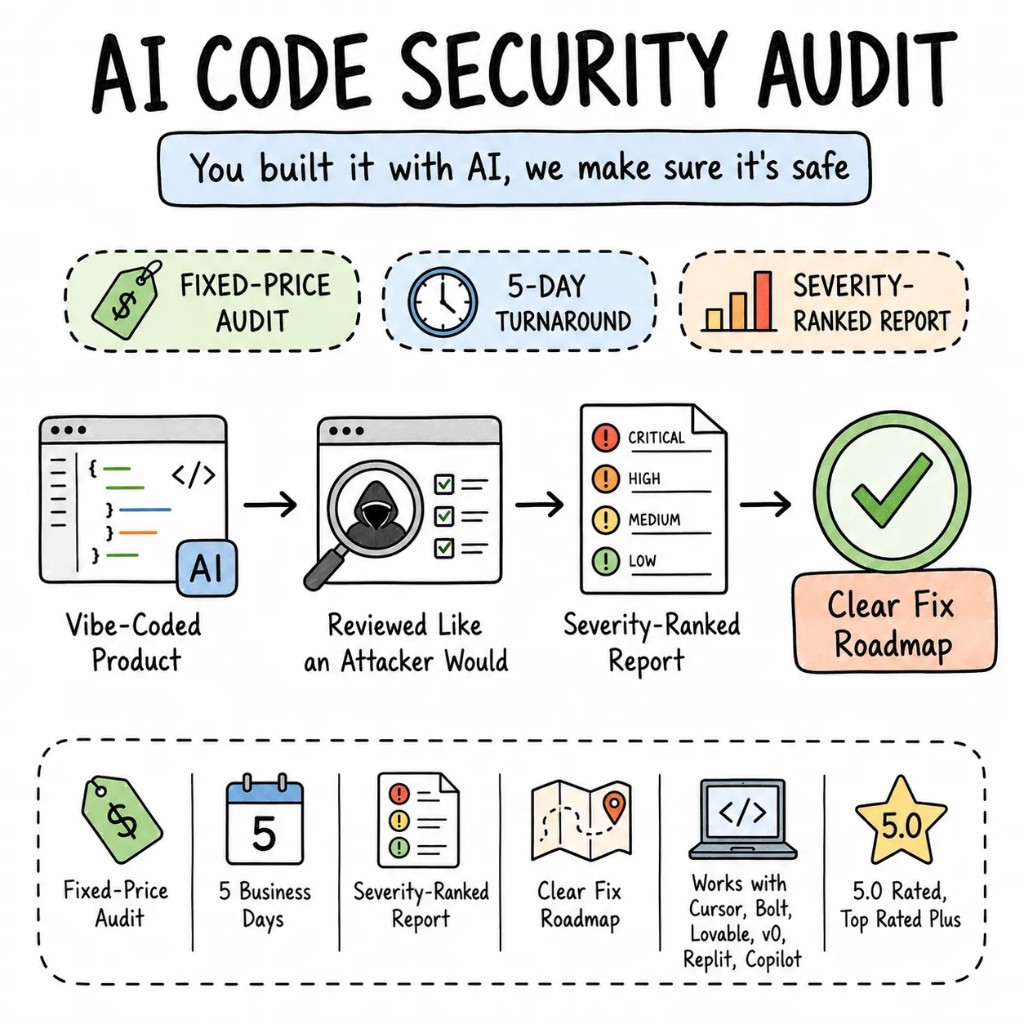
AI Code Security Audit -you built it with AI,we make sure it's safe.

A fixed-price AI code security audit for AI-built and vibe-coded products. In 5 business days we review your AI-generated code the way an attacker would — hallucinated dependencies, hardcoded secrets, broken auth — and hand you a severity-ranked report with a clear fix roadmap. Built with Cursor, Claude Code, Copilot, Bolt, Lovable, v0, or ChatGPT? This is for you.

5.0

Based on 100+ Reviews

TOP RATED PLUS

100+ Reviews

TRUSTED BY TEAMS AT

The problem

AI writes code fast.
It also writes holes fast.

Four patterns we find in almost every AI codebase we audit. None of them show up in a demo — all of them show up in an attack.

01
Exposed secrets.
API keys, database credentials, and tokens sitting in client-side code or public repos. AI assistants hardcode them because that's the fastest way to make the feature work — and the fastest way for an attacker to find them with browser dev tools.
02
Missing auth checks.
Endpoints that work in the demo but let anyone access anyone's data. A client-side isAdmin flag is not access control, but AI-generated code treats it like one.
03
Injection and unsafe inputs.
SQL injection, XSS, and unvalidated inputs that AI tools reproduce from outdated patterns in their training data. Functional code, wide open.
04
Hallucinated dependencies.
AI assistants import packages that are outdated, abandoned, vulnerable — or don't exist at all. Hallucinated packages are a real attack vector: squatters publish malicious code under the names AI tools invent. Nobody checked, because nobody wrote the import.

We've seen every one of these in real audits. Five days is all it takes to know where you stand.

Self-check

You probably need this audit if.

Your app was built mostly with AI tools and is heading to production
An investor, enterprise customer, or app store asked about security
You have real users — or real payment data — and no security review so far
You can't confidently explain what every dependency in your lockfile does
No one except the AI has ever reviewed the auth logic
You're about to hand the codebase to a new developer or team

Three or more? Get the AI code audit before the incident, not after.

Sample results

What a real audit
looks like.

Anonymized findings from actual AI code security audits we've delivered.

4/10

Project type

AI-built SaaS dashboard (Cursor + Supabase)

  • Service-role database key exposed in client bundle
  • No row-level security — any user could read all tenants' data
  • 3 critical, 5 high, 9 moderate findings

6/10

Project type

Vibe-coded marketplace MVP (Bolt)

  • Payment webhook accepted unsigned requests
  • Admin routes protected only by frontend routing
  • 1 critical, 4 high, 7 moderate findings

8.5/10

Project type

AI-powered internal tool (Next.js + LLM APIs)

  • Prompt injection could exfiltrate other users' context
  • Otherwise solid — hardened in 2 days of fixes
  • 0 critical, 2 high, 3 moderate findings

What we check

The full audit
checklist.

Every check maps to the OWASP Top 10 and the vulnerability patterns specific to AI-generated code.

C01

Secrets & credentials.

Exposed API keys, tokens, and credentials in code, config, git history, and client bundles — entropy analysis plus manual review.

C02

Injection surfaces.

SQL and NoSQL injection, command injection, XSS, and unsafe input handling across the app — the OWASP injection class, tested against your real routes.

C03

Dependency & supply chain risks.

Vulnerable, outdated, and abandoned packages checked against live CVE databases — plus hallucinated dependencies that AI tools invented and no registry should trust.

C04

Infrastructure & config.

Cloud misconfigurations, open buckets, permissive CORS, debug mode in production, missing security headers.

C05

Authentication & authorization.

Every endpoint tested for broken access control and privilege escalation — the single most common failure in vibe-coded apps.

C06

API security.

Rate limiting, data exposure, over-verbose responses returning whole records, and abuse paths on every public endpoint.

C07

Data handling & privacy.

Storage, encryption, and data flows checked against GDPR-relevant handling — where personal data actually goes.

C08

AI-specific patterns.

Prompt injection paths, unsafe LLM output handling, and model API key exposure in apps that ship AI features of their own.

The cost of waiting

Ignoring it now means
paying for it later.

An AI code security audit is a rounding error next to any of these.

01
A breach costs more than 100 audits.
Incident response, legal exposure, customer notifications, and reputation damage — versus five days of review.
02
Failed due diligence kills deals.
Investors and enterprise buyers now run technical due diligence on AI-generated code. Security findings discovered by their team, not yours, cost negotiations.
03
A forced rewrite costs 6 months.
Security debt compounds. Caught at MVP stage it's a patch; caught at scale it's an architecture rewrite.

An audit at the MVP stage costs a fraction of what a forced fix costs six months later.

Pricing

The audit: what it costs.

Audit reportFixed price

From $499

Fixed price, small codebases

A full severity-ranked AI code security audit of your AI-built or vibe-coded product, delivered in 5 business days.

  • Full code + dependency + secrets review
  • Severity-ranked findings report with proof of concept
  • Fix roadmap, prioritized by real risk
  • 30-minute walkthrough call included
Get your audit
Larger codebasesCustom

Custom fixed quote

For products past the MVP stage

For products past the MVP stage — multiple services, larger teams, compliance requirements.

  • Everything in the fixed-price audit
  • Deeper manual review and targeted testing on real attack paths
  • SOC2-oriented and enterprise-questionnaire-ready documentation
  • Optional monthly re-audit retainer
Get a fix quote

Deliverables

What you walk
away with.

01
Findings report
Every issue severity-ranked with proof of concept, in plain language your team can act on — technical enough for your CTO, readable enough for your investors.
02
Risk map
A one-page view of your exposure: what's critical, what's cosmetic, what's fine.
03
Remediation roadmap
Prioritized fix plan — what to fix first, what can wait — your AI tools or your team can implement directly.
04
Fixed-price fix proposal
An exact quote to implement everything, no hourly drift.
05
Debrief call
30 minutes live with the engineer who did the audit. Ask anything.

Process

Five days,
start to report.

A typical AI code security audit engagement, end to end. Fix and verify is optional — plenty of clients just want the findings.

Day 1
Scope & access
You give us read-only repo access. We NDA first, map the codebase and tech stack, and confirm scope.
Day 2–4
Audit
Automated SAST and dependency scanning across the whole codebase, then manual review of everything the scanners can't judge — auth logic, business logic, AI-specific patterns. Static analysis finds the known classes; human review finds the contextual ones.
Day 5
Report & walkthrough
You get the severity-ranked report and fix roadmap, plus a live 30-minute walkthrough with the auditing engineer.
Optional
Fix & verify
Fixed-price remediation by the same team that found the issues, with a re-test at the end.

Definition

What is a vibe coding audit?

A vibe coding audit — also called an AI Code Security Audit - is a structured security and quality review of software written largely by AI tools: Cursor, Claude Code, GitHub Copilot, ChatGPT, Bolt, Lovable, v0, Replit, and similar assistants. It combines automated static analysis (SAST) and supply chain scanning with expert manual review, targeting the vulnerability patterns specific to AI-generated code: exposed secrets, missing authorization, injection flaws, unsafe LLM integrations, and hallucinated dependencies. AI-generated code is functional by default and secure by accident — the audit closes that gap before your users, your investors, or an attacker finds it first.

FAQ

Straight answers.

Don't see yours here? Ask directly.

A structured review of AI-generated code combining automated scanning with expert manual review, focused on the vulnerability patterns AI coding tools produce — exposed secrets, broken auth, injection flaws, and hallucinated dependencies. Findings map to the OWASP Top 10 and come severity-ranked with a fix roadmap.
A pentest attacks your running application from the outside. Our audit reviews the code itself — including the parts a pentest never reaches — and then applies targeted testing on the real attack paths we find. For a fast-changing AI-built codebase, code-level review catches more, earlier. If you specifically need a formal external pentest for compliance, we'll tell you so on the scoping call.
All of them. Cursor, Claude Code, GitHub Copilot, ChatGPT, Windsurf, Bolt, Lovable, v0, Replit — the vulnerability patterns are consistent across tools, so the methodology is tool-agnostic.
From $499, fixed price, for small codebases. Larger products get a custom fixed quote after a short scoping call. No hourly billing either way.
Yes — read-only repo access, under NDA, revoked the moment the audit ends. We never need production access or customer data.
The fixed-price audit covers typical MVP-scale products. Bigger codebases get scoped honestly: we quote a fixed price for what a thorough review actually takes, or we scope down to your highest-risk surfaces first.
For an MVP-scale codebase, yes — the timeline is built around automated coverage first, deep manual review second. Larger scopes get longer timelines stated upfront, not rushed reviews.
Yes. Every report comes with a fixed-price fix proposal. Same team, no handover loss, re-test included.

Founder-direct

Five days from now, you'll knowexactly where you stand.

Send us your stack and repo size — you'll have a fixed quote within 24 hours, and a severity-ranked AI code security audit within a week of starting.