HIRE DEVELOPERS  /  .NET DEVELOPERS

.NET engineering

.NET backendsbuilt for enterprise,not demos.

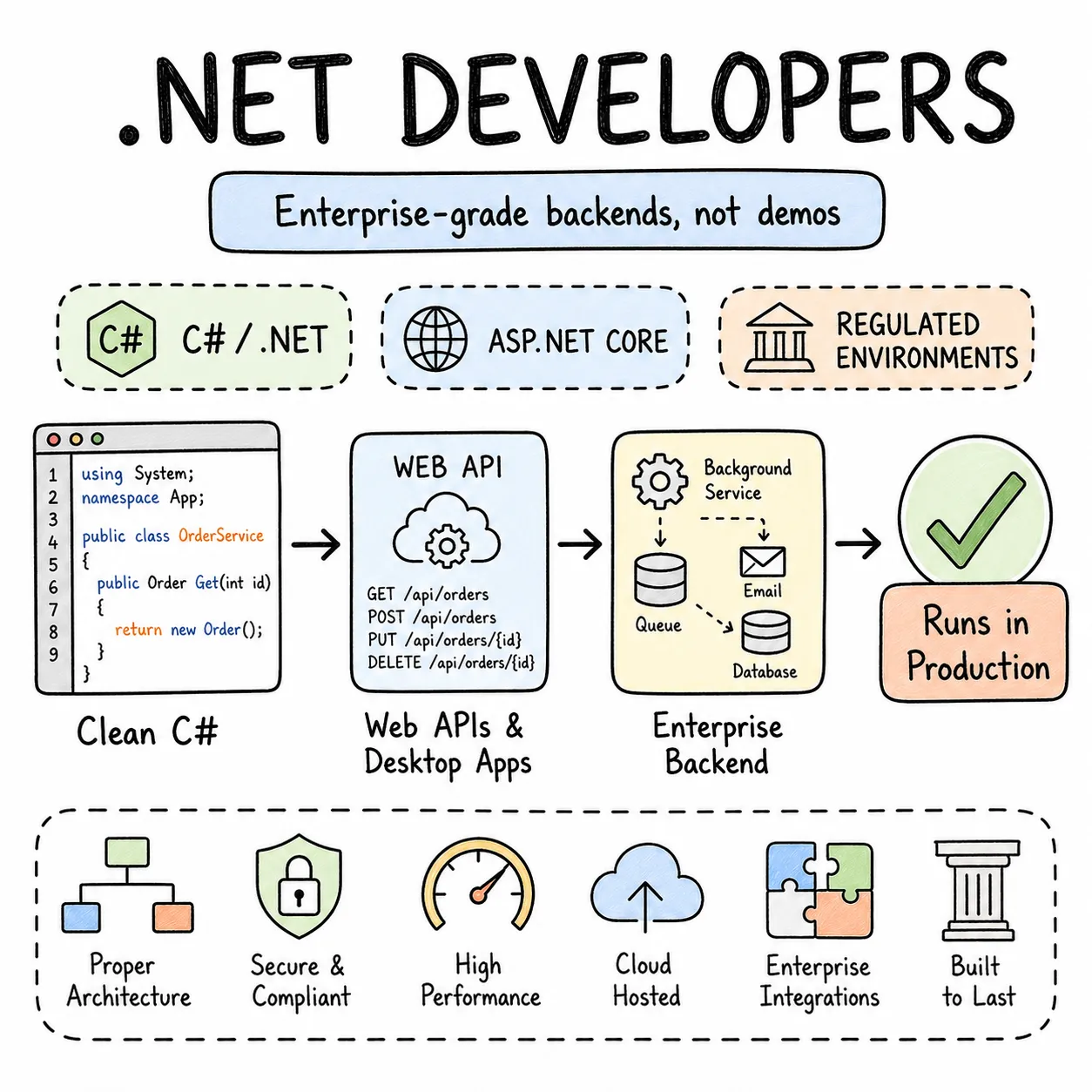
.NET is the backbone of enterprise Windows development — web APIs, desktop apps, background services, and cloud-hosted backends. Our .NET developers write clean C# with proper architecture, and have built production ASP.NET Core APIs, WPF desktop applications, and enterprise integrations that run in regulated environments.

Vetted senior talent
Flexible engagement models
Founder-direct delivery
Why Entalogics

Why teams hire
.NET developers from us.

Our .NET developers work with modern .NET 6/7/8 — ASP.NET Core for web APIs and MVC applications, Entity Framework Core for database access, SignalR for real-time features, and WPF or MAUI for desktop. They understand dependency injection, clean architecture, CQRS patterns, and writing testable C# code.

EXPERT BENCH01

Expert .NET developers, only.

Vetted for .NET production depth — ASP.NET Core middleware, Entity Framework migrations at scale, background services with hosted workers, Azure integration, and real experience deploying to enterprise Windows environments. Not bootcamp graduates who built one MVC project.

FAST HIRING02

Fast hiring process.

C# developers are common. .NET developers who understand Azure Service Bus, can tune EF Core queries on a 50 million row database, and have deployed to regulated enterprise environments are not. We keep the second group ready.

FLEXIBLE ENGAGEMENT03

Flexible engagement.

Dedicated developer for a long-term enterprise platform. Part-time specialist for .NET Framework to .NET 10 migration. Hourly consultant for an architecture review or EF Core performance audit. You choose.

Hiring model

Three ways
to staff your build.

.NET enterprise development requires more than knowing C# syntax. It requires understanding the full Microsoft ecosystem — Azure hosting, SQL Server optimisation, Windows Server deployment, Active Directory integration, and the compliance requirements that come with enterprise software. Our developers have worked in these environments on real enterprise projects, not just startup MVPs.

M01160h / mo

Full-time hiring

A dedicated .NET developer embedded in your team full-time — owning API architecture, building services, integrating with Azure, and shipping to production. Best for teams building or maintaining an enterprise platform over multiple quarters.

M0280h / mo

Part-time hiring

20 hours per week of focused .NET work. Ideal for teams migrating from .NET Framework to .NET 10, refactoring a legacy monolith into clean architecture, or adding features to a stable enterprise application on a maintenance schedule.

M0340h blocks

Hourly hiring

Targeted .NET consulting — EF Core query performance audit, Azure deployment architecture review, .NET Framework migration assessment, or SignalR scaling analysis. Scoped, delivered, done.

Engagement models

Who runs
the project.

Pick the engagement model that fits how your team runs .NET work — or talk to us and we'll suggest the right one.

01

Entalogics managed team

We own delivery end-to-end — API architecture, C# development, Azure deployment, and release management. You review weekly and steer the roadmap. Best when you need an enterprise backend shipped without an in-house .NET lead.

  • PM + senior .NET devs on staff
  • We own the CI/CD pipeline
  • Status reports every Friday
02MOST COMMON

Client managed team

Your technical lead sets priorities. Our .NET developer joins your Azure DevOps, your standups, your repo. They write C#, handle deployments — you direct the work.

  • Embedded in your Azure DevOps & Teams
  • Reports into your engineering lead
  • Same hiring bar — you direct
03

Hybrid model

Your team handles product decisions and frontend. Our .NET specialist handles the backend — API design, EF Core data layer, Azure integration, background services, and enterprise authentication.

  • Specialists from us, generalists from you
  • Shared standups + code reviews
  • Clear DRI per layer
Stack & tooling

Technologies our
.NET developers use competently.

Full Microsoft ecosystem expertise. Here's what our .NET engineers work with daily.

C#

Primary language for APIs, services, and enterprise application logic.

.NET 10

Current LTS runtime for cloud-native and Windows enterprise workloads.

ASP.NET Core

Web APIs, MVC, minimal APIs, and middleware pipelines.

Entity Framework Core

Migrations, LINQ queries, and data access at scale.

SignalR

Real-time hubs for dashboards, chat, and live updates.

Blazor

Interactive web UIs with shared C# business logic.

WPF

Enterprise Windows desktop applications with MVVM.

MAUI

Cross-platform .NET apps when mobile targets share backend teams.

COMMON QUESTIONS

Straight answers.

Six questions we get on every first call about hiring .NET developers. If yours isn't here, we'll cover it first.

Web APIs, enterprise backends, microservices, background processing services, real-time applications with SignalR, WPF desktop apps, and Blazor web applications. Most of our .NET work is ASP.NET Core APIs powering enterprise platforms, SaaS products, and internal tools.
Modern .NET (6/8/10) for all new development. We also maintain and migrate legacy .NET Framework 4.x applications — upgrading to .NET 10 incrementally, project by project, without a feature freeze.
Yes. Entity Framework Core for ORM-based access, Dapper for performance-critical queries, or both in the same project. We work with existing database schemas and add migrations incrementally — no rip-and-replace.
Both. Azure App Service, AKS, or Azure Functions for cloud. IIS on Windows Server for on-premises. Docker for containerised deployments. CI/CD via Azure DevOps or GitHub Actions — automated, tested, repeatable.
Yes. Azure AD (Entra ID) for authentication and authorisation. Microsoft Graph API for calendar, email, SharePoint, and Teams integration. Windows Authentication for on-prem Active Directory. Standard enterprise identity patterns our developers handle routinely.
Yes. Project by project, assembly by assembly. The app stays deployable throughout. BinaryFormatter removal, deprecated API shims, and EF Core migration handled incrementally. Most migrations take 8–14 weeks depending on codebase size.
Founder-direct

Ready to build
something amazing?

Discuss your .NET needs with Entalogics — quality delivery at fair pricing.