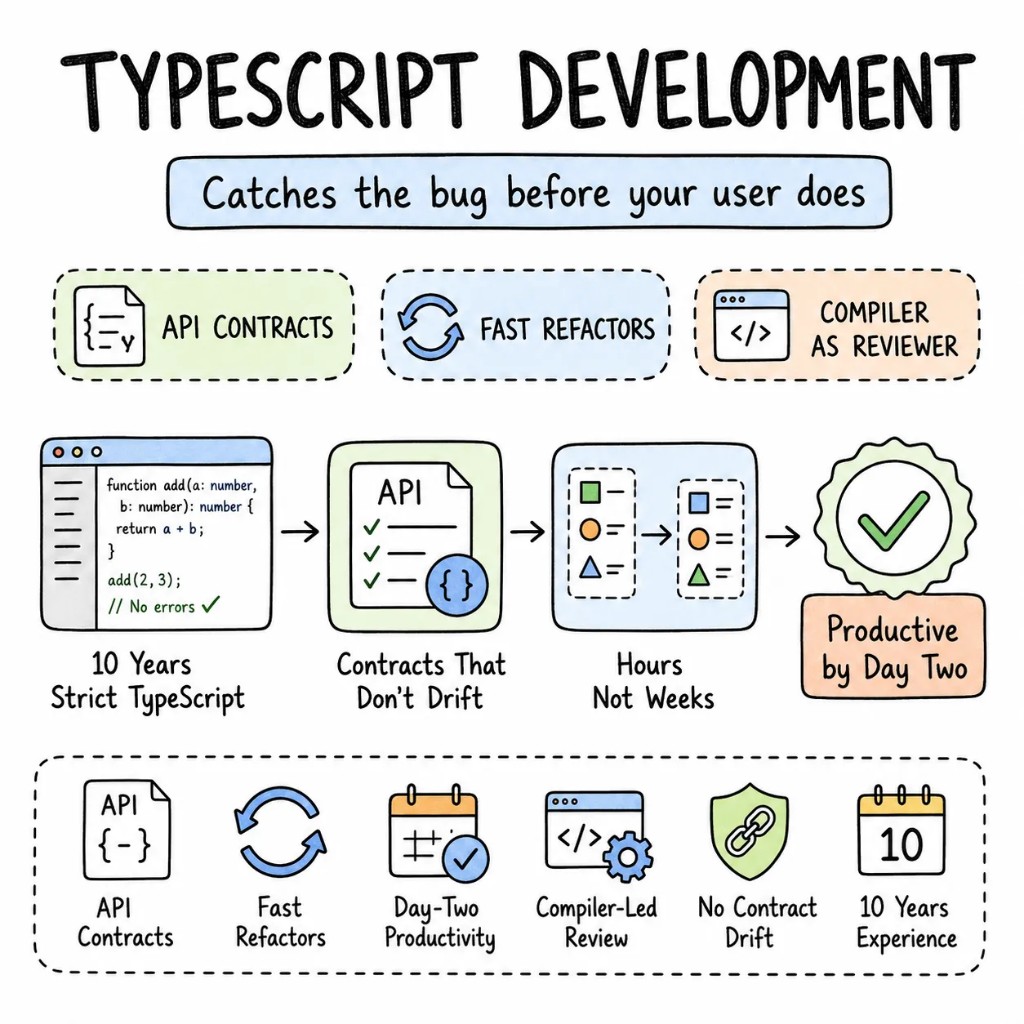
TypeScript bolted on after the fact isn't TypeScript development services — it's JavaScript with extra steps. Ten years running strict TypeScript in production: contracts that don't drift, refactors measured in hours not weeks, a new engineer productive on day two instead of month two. The compiler catching the boring half of code review isn't a bonus. It's the entire point.
Four things every TypeScript codebase actually needs.
Most teams turn on TypeScript and keep writing JavaScript with type annotations. Real TypeScript development services bring the discipline that makes the compiler your best engineer, not your most ignored one.
Performance01
A compiler that earns its build time.
TypeScript only pays off in proportion to how strictly it's enforced. Strict mode, noUncheckedIndexedAccess, exactOptionalPropertyTypes — the flags most teams quietly turn off get enabled from day one, so the compiler surfaces bugs before production does.
Architecture02
One source of truth from database to UI.
Schema drift is how bugs actually sneak in — an API returns a string, the frontend expects a number, nobody notices until a customer calls. We build one source of truth instead: Drizzle or Prisma generates the DB types, Zod owns the API boundary, tRPC or generated GraphQL types carry that contract through to the UI. Nothing gets synced by hand.
State03
Typed state that can't lie to you.
Discriminated unions instead of boolean flags. Result types instead of thrown exceptions. A real state machine instead of isLoading && !isError && data !== null scattered through the codebase. TypeScript's type system can make illegal states unrepresentable — most teams never actually use that power.
Refactorability04
A codebase where rename actually works.
The real test of TypeScript arrives eighteen months in, when a product requirement changes a core type. If tsc --noEmit catches every downstream break in five seconds, the codebase is healthy. If your team is scared to rename a field, that's not TypeScript — it's a typing system held together with as casts.
When TypeScript, when not
TypeScript is a tool. Not a religion.
An honest decision matrix. We'll tell you on the first call whether stricter TypeScript is your actual problem, or whether something else is blocking your team.
USE STRICT TYPESCRIPT WHEN
More than three engineers write against the same codebase
The domain is complex — finance, healthcare, logistics — where a wrong type means a wrong transaction
The code will live for years, touched by contributors who weren't there at the start
Refactors happen often, and manual regression testing can't keep up
CONSIDER LOOSENING WHEN
It's a throwaway prototype — validate the idea first, type it after
A one-off script read by exactly one person — JSDoc comments might cover it
A solo founder with a four-week runway — ship first, type once the shape settles
WE SAY NO WHEN
"Add TypeScript to our JavaScript codebase this weekend." Done right, that's weeks, not a sprint.
"We already have TypeScript, we just use any everywhere." That's a migration project wearing a TypeScript badge.
"Type it after we launch." The launch never actually slows down enough for that to happen.
What we build with TypeScript
Six product surfaces. One quality bar.
The shapes of TypeScript development we ship most often. Each integrates cleanly with your existing stack if you already have one.
S01
Full-stack SaaS products
Full-stack SaaS products
Type safety runs unbroken from the Drizzle schema to the Next.js App Router — one contract, no API drift, no runtime surprises on the happy path or the error path.
NEXT.JSTRPCDRIZZLEZOD
S02
TypeScript API services
TypeScript API services
Hono or Fastify with fully typed request/response contracts, Zod middleware validation, and real-time or chat-capable endpoints where the product needs them. OpenAPI docs get generated as a byproduct, not maintained separately.
HONOFASTIFYZODOPENAPI-TS
S03
Shared type libraries & monorepos
Shared type libraries & monorepos
One shared @company/types package that every frontend and backend team imports from, built on Turborepo or Nx. The schema lives in a single place, so consumers get a type error at build time instead of a surprise in production.
TURBOREPONXTSCCHANGESETS
S04
TypeScript migrations
TypeScript migrations
JavaScript migrated to TypeScript, or any-ridden TypeScript tightened into strict TypeScript — file by file, never a flag-day cutover. The team keeps shipping while the types get tightened underneath them.
TYPESCRIPTTS-MIGRATEJSCODESHIFTZOD
S05
Internal tooling & CLIs
Internal tooling & CLIs
Typed Node.js scripts, internal CLIs, and data pipelines — the tooling quietly running your business that nobody ever budgeted time to build properly.
NODE.JSCOMMANDERZODVITEST
S06
Design system type contracts
Design system type contracts
Component props that encode real design decisions instead of accepting any string. Variant maps, token types, polymorphic generics — wrong usage becomes a compile error instead of a visual bug in production.
STORYBOOKCVARADIXTOKENS-STUDIO
The playbook
Patterns we ship on repeat.
The TypeScript patterns that show up on almost every engagement. Not invention — convention, applied with precision.
P01
Strict mode from day one
strict: true, plus the flags most teams skip entirely. Fixing the compiler's complaints up front costs far less than inheriting a codebase where any is quietly load-bearing.
P02
Zod at every boundary
Runtime validation at every point untrusted data enters — API responses, form inputs, environment variables, query parameters. Zod schemas become the types themselves, so there's no drift between what's expected and what actually arrives.
P03
Discriminated unions over boolean flags
A single discriminated union instead of isLoading, isError, and data all independently nullable. Illegal states stop being representable at the type level at all.
P04
End-to-end typed contracts
tRPC for full-stack TypeScript projects. Generated types from GraphQL or OpenAPI when the contract crosses a third-party boundary. Either way, the API contract gets checked at compile time — not discovered by a user in production.
P05
Typed tests
Vitest with strict type assertions and no as any hiding in the test setup. If a test can't be written without casting, that's a sign the type design has a problem — better to find it there than in production.
P06
Incremental migration
allowJs: true, checkJs: true, and strict adoption file by file. The TypeScript compiler handles large JavaScript migrations better than most teams expect — we've done enough of these to know exactly which shortcuts don't actually work.
Signature case
A fintech platform, migrated from any-first to strict TypeScript..
A B2B payments platform with 120,000 lines of TypeScript — technically. In practice: any cast at every API boundary, no runtime validation, three separate type definitions for Transaction that had quietly diverged. A data bug was causing incorrect invoice amounts for 2% of transactions and nobody could trace it because the types were lying. We audited, consolidated, and enforced strict types across the stack in 8 weeks. Without a feature freeze.
Before
847 any casts · 3 conflicting Transaction types · 0 API boundary validation · 2% invoice error rate
After
0 any in product code · single TransactionSchema (Zod) · full API validation · invoice errors resolved
any eliminated−100%
Type-related bugs (90d)−94%
to fully strict8wk
shipped regressions0
Engagement shape
Eight to ten weeks to a measurable ship.
A typical TypeScript engagement, end-to-end. Types get tightened incrementally, never flag-day.
W01
Audit + RFC
Two senior engineers go through the entire codebase — an any inventory, boundary validation gaps, divergent type definitions, a compiler flag audit. Week one ends with a ranked RFC and a clear map of exactly where the types have been lying to you.
W02–03
Foundation + first boundary
Strict mode gets enabled, Zod goes on the highest-risk API boundary, and one core domain type gets consolidated end-to-end. Compiler coverage shows up in your actual CI, not a local demo.
W04–08
Migrate boundary by boundary
Every remaining surface migrates one at a time, under feature flags where needed, old untyped code and new strict code coexisting. Your roadmap keeps moving — fixing your types was never going to require a freeze.
W09+
Cleanup + handoff
The any scaffolding gets deleted, the type library gets documented, Vitest coverage lands on the critical paths. The runbook goes to your team directly, or we stay on retainer and keep the type safety compounding.
Stack
Tools we Tools we reach reach for for first.
Picked by problem, not by resume. Happy to slot into your stack — but greenfield, this is the default.
Verified feedback from Upwork, Clutch, and reference calls we're happy to set up before you sign anything.
Evan Kanouse
CEO, Modestly
Entalogics has successfully delivered extension prototypes on time, and we are impressed with their project management and the finished product. The client communicates with Entalogics via virtual meetings, email, and messaging apps.
Adam Strock
Founder, Flourish Schools
Collaborating with Entalogics was a great experience. Communication was clear, we aligned quickly, and their team delivered high-quality code on time with thoughtful technical decisions.
Giles Whitman
CTO, SentryBay
Their Chromium expertise helped us ship a hardened browser with live threat controls and enterprise rollout support. Security operations became significantly faster.
George Irvin
Founder, G3 Ventures LLC
Entalogics delivered our custom Electron browser in six months with isolated profile workflows and stable policy sync. Agent onboarding improved by 55% after rollout.
Dani Keo
Project Manager, Sociall
Entalogics built our iOS Chromium-based mobile app with a smooth native feel, stable media rendering, and reliable sync. We shipped faster and improved engagement after launch.
Project Manager
RozmeriGPT
The web dashboard and Chrome extension now share prompts, billing, and analytics in one platform. Our content turnaround improved 4x after launch.
Ilya Khodakovsky
Project Manager, Omni Browser
Entalogics built our Omni Browser on top of Chromium with deep product-level execution. They implemented an integrated VPN and Omni Crypto Wallet directly in the browser, made strong architectural decisions, and delivered quality code on schedule with clear communication.
Sherzod Khabibullayev
Project Manager, Digital Office: Aura
Entalogics built Digital Office: Aura as a custom Chromium-based authentication platform. Their team modified Chromium internals and integrated our manual custom authentication flow with reliable implementation, fast delivery, and consistent communication.
Engagement
Three ways to work with us.
No hourly retainer billing for "thinking time." Every path is fixed-quote or transparently rated.
FIXED SCOPEone-off build
Ship a typed product, end-to-end.
One product, scoped and priced once, built entirely by senior engineers. RFC to launch in 8–14 weeks.
Contracts, migrations, strict mode — the questions we get on every TypeScript discovery call.
tRPC when frontend and backend are both TypeScript in the same monorepo — the type safety is immediate and hard to beat. REST with generated types (openapi-typescript or GraphQL Code Generator) when you're crossing a team boundary, serving multiple clients, or working against an API contract you don't own. It's a team-topology decision, not a technical superiority contest.
Yes. allowJs: true and checkJs: true bring TypeScript into the project without touching existing files, then we migrate file by file, highest-risk modules first. Your team keeps shipping the entire time. A full migration on a large codebase typically runs 8–12 weeks, depending on size and how load-bearing the existing any usage is.
Yes, and the pain is front-loaded rather than ongoing. Strict mode surfaces real bugs that loose TypeScript quietly lets through. Teams that enable it from day one barely notice the cost; teams retrofitting it onto an existing loose codebase feel it sharply, because that's accumulated debt coming due. Enable it early, or pay the interest later.
Yes. Whoever writes the RFC is writing the production code — no handoff to a junior team mid-engagement, no account manager standing between you and the people doing the work.
Yes. On Zod, we build directly on top of it — it's our default anyway. On Yup, we work within it and flag honestly where Zod would meaningfully cut complexity, without asking you to rewrite working validation just to match our preference.
Senior engineers
Tell us whatyou're building.
Thirty minutes with a senior TypeScript engineer, the relevant playbook, and a candid read on whether strict types are the real problem, or a symptom of something upstream.