Tiny bundles,Rust backend.Shipped in Tauri.

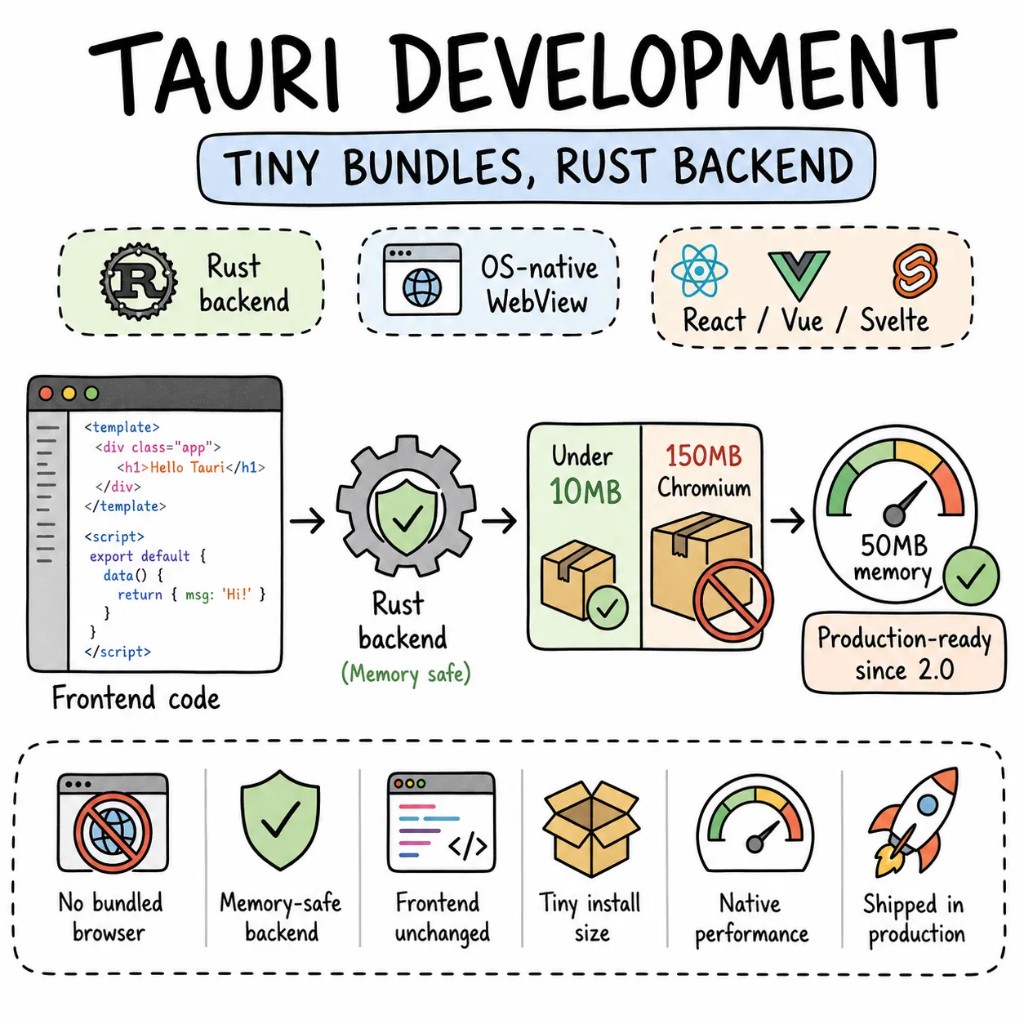
Tauri development services for teams that refuse to ship 150MB of Chromium with every install. Rust backend for memory safety and performance. Your React, Vue, or Svelte frontend unchanged. OS-native WebView instead of a bundled browser. The result: desktop apps under 10MB that use 50MB of memory — not 300MB. Tauri 2.0 is production-ready. We've been shipping it since it was.

  • Tauri 2.0
  • Rust backend
  • Sub-10MB bundle
  • Desktop + mobile

Why Entalogics for Tauri

Four things every
Tauri app
actually needs.

Tauri's promise — tiny bundles, low memory, native security — only holds if the architecture behind it is right. The Tauri apps we audit usually have Rust commands doing too much, untyped IPC, no permission scoping, and WebView inconsistencies across platforms nobody tested. We fix the architecture before users find the bugs.

Performance01

Small binary is the starting point, not the finish line.

A minimal Tauri app is under 3MB. A production one with assets, fonts, and Rust dependencies can bloat to 40MB if nobody's watching. We tree-shake Rust crates, compress assets, and profile the binary with `cargo bloat` from day one.

Architecture02

Rust commands do the heavy lifting. The frontend stays dumb.

File I/O, database queries, encryption, AI inference — all in Rust. The frontend invokes typed commands and renders the result. No business logic in TypeScript. No filesystem access from the WebView.

State03

Capability-based permissions, not open access.

Tauri 2.0's permission model works like mobile — the frontend can't touch anything unless explicitly granted. We scope every command, every plugin, every file path. The attack surface stays as small as the bundle.

Type safety04

Typed IPC between Rust and TypeScript.

`tauri-specta` or hand-rolled typed bindings. When a Rust command signature changes, the TypeScript frontend fails to compile. No runtime `invoke` errors. No untyped JSON passing between languages.

When Tauri, when not

Tauri is a tool.
Not always the right one.

Tauri is the lightest way to ship a cross-platform desktop app. It also uses OS-native WebViews — which means CSS that works in Chrome might not work in WebKit. We'll tell you on the first call if that trade-off works for your product.

PICK TAURI WHEN

  • Bundle size and memory footprint are hard requirements — under 10MB, under 50MB RAM
  • Security posture demands a small attack surface — no bundled Chromium, capability-scoped permissions
  • You need desktop and mobile from one Rust core — Tauri 2.0 ships iOS and Android
  • Local-first, privacy-first products where data processing stays on the device

PICK ELECTRON WHEN

  • Your app needs consistent Chromium rendering — no WebView differences across platforms
  • The npm ecosystem has packages you depend on that don't exist in Tauri's plugin ecosystem
  • Build speed matters more than bundle size — Rust compilation is slower than JavaScript bundling

WE SAY NO WHEN

  • "Tauri because Electron is bloated." That's a meme, not a spec. We'll tell you if Electron fits better.
  • "We want Tauri but nobody on the team knows Rust." Tauri's JS API covers a lot — but complex backends need Rust skills.
  • "Ship to three platforms in two weeks." That ship has sailed.

What we build with Tauri

Six product surfaces.
One quality bar.

The shapes of Tauri app development we deliver most. Each ships signed, auto-updating, and production-ready.

  • S01

    Developer tools & utilities

    Code editors, database GUIs, API clients, clipboard managers. Apps developers live in all day — where 42MB idle memory and 1-second startup matter.

    TAURIREACTRUSTSQLITE
  • S02

    AI-native desktop apps

    Local LLM inference via ONNX Runtime in Rust, on-device embeddings, privacy-first AI assistants. Data never leaves the machine. Memory left for the model, not the framework.

    TAURIONNXRUSTWEBGPU
  • S03

    Privacy-first productivity tools

    Encrypted vaults, local-only note apps, offline password managers. Tauri's capability model means the frontend physically cannot access what it shouldn't.

    TAURIRUST CRYPTOSQLITETAURI STORE
  • S04

    Internal enterprise tools

    Lightweight signed apps deployed without app stores. SSO, certificate pinning, local cache. 8MB installer instead of 150MB — IT deployment loves this.

    TAURIRUSTSQLITESSO
  • S05

    Cross-platform desktop + mobile

    Tauri 2.0 ships iOS and Android from the same Rust core. One backend, one frontend, five platforms.

    TAURI 2SWIFTKOTLINRUST
  • S06

    Electron to Tauri migrations

    Shrink the bundle from 150MB to 10MB. Replace Node.js backend with Rust commands. Migrate IPC layer. The app keeps shipping during migration.

    TAURI 2RUSTREACTAUTO-UPDATE

The playbook

Patterns we
ship on repeat.

Tauri patterns from production desktop apps — not cargo init demos.

  • P01

    Typed IPC with tauri-specta

    Auto-generated TypeScript types from Rust command signatures. When the backend changes, the frontend fails to compile. Zero runtime IPC errors.

  • P02

    Capability-scoped permissions

    Every command, plugin, and file path explicitly allowed. The frontend can't access anything by default. Security by denial, not by trust.

  • P03

    Rust for I/O, TypeScript for UI

    Database, filesystem, networking, encryption — all in Rust. The frontend renders and invokes. Clean boundary. Testable on both sides.

  • P04

    Binary size auditing

    `cargo bloat` and `cargo tree` in CI. Unused crates caught before release. A production Tauri app stays under 10MB — not just the Hello World.

  • P05

    Cross-WebView testing

    WebKit on macOS, WebView2 on Windows, WebKitGTK on Linux — each has different CSS and JS behaviour. We test on all three in CI. Write once, test three times.

  • P06

    Auto-update with built-in updater

    Tauri's native updater with signed JSON manifest. Delta updates where possible. Rollback on failure. No electron-updater dependency.

Signature case

A developer tool,
built from scratch on Tauri 2.0.

A database GUI for PostgreSQL — the team had evaluated Electron but the 180MB bundle and 300MB idle memory were unacceptable for a tool that competes with native apps like TablePlus. Built on Tauri 2 with Rust backend for query execution and React frontend in 10 weeks. 8MB installer. 42MB idle. Users can't tell it's not native.

Before

180MB bundle · 300MB idle · 4.2s cold start · Chromium CVE surface (Electron prototype)

After

8MB bundle · 42MB idle · 0.9s cold start · capability-scoped, audited (Tauri 2 production)

  • Bundle size−96%
  • Idle memory−86%
  • Cold start−79%
  • Shipped on schedule

Engagement shape

Eight to ten weeks
to a measurable ship.

A typical Tauri development engagement. We build feature by feature — signed test builds from week two.

  • W01

    Audit + RFC

    Two senior Tauri developers. Rust architecture review, permission scoping, WebView compatibility check, binary size audit. A ranked, dollarized RFC.

  • W02–03

    Foundation + first window

    Tauri 2 baseline, Rust commands wired, typed IPC, auto-updater configured, one production window end-to-end. Signed build on all three platforms.

  • W04–08

    Feature by feature

    Command by command under feature flags. Signed beta releases weekly. Your roadmap keeps moving.

  • W09+

    Release + handoff

    Signed production release. Auto-update verified. Runbook handed to your team — or we stay on retainer.

Stack

Tools we
reach for first.

Our default Tauri development stack — picked for production, not Rust playground experiments.

  • FrameworkTauri 2.0 · Rust · tauri-specta
  • FrontendReact · Vue · Svelte · Tailwind · shadcn/ui
  • DataSQLite (via Tauri plugin) · tauri-plugin-store · serde
  • Rusttokio · serde · reqwest · sqlx · tauri-plugin-*
  • TestingPlaywright · Vitest · cargo test · tauri-driver
  • InfraGitHub Actions · tauri-action · Sentry · CrabNebula Cloud

Engagement

Three ways
to work with us.

No hourly retainer that bills for "thinking time." Pick a lane that matches your stage; everything is fixed-quote or transparently rated.

FIXED SCOPEone-off build

Ship a Tauri app, end-to-end.

A defined product, a fixed price, a senior-only team. From RFC to signed release on all platforms in 8–14 weeks.

$15k–$30k

FIXED SCOPE

  • Senior engineers only
  • Fixed quote in week 1
  • Code, infra, runbook — yours
Plan a fixed build
DEDICATED TEAMmonthly

Hire dedicated Tauri developers.

Embedded engineers in your Slack, your Linear, your standups. Senior Rust + frontend engineers. Pause, resize, end with 30 days' notice.

$5k / eng / mo

PER ENGINEER

  • Same senior bar as fixed-scope
  • Embedded in your team
  • Founder-direct escalation
Hire dedicated Tauri devs
ENGAGEMENTcustom

Strategic Tauri partnership.

A long-term partner for product orgs shipping desktop + mobile from Tauri — architecture, Rust mentoring, Electron migration, hiring help.

custom

PROCUREMENT-FRIENDLY

  • Multi-quarter roadmap
  • Architecture & hiring partner
  • Procurement-friendly paper
Speak to the founder
FAQ

Sharp questions,
straight answers.

Tauri vs Electron, Rust skills, migrations, existing codebases — the questions we get on every Tauri discovery call.
Tauri if bundle size, memory, and security posture are hard requirements. Electron if you need the deepest npm ecosystem and consistent Chromium rendering. For most new projects in 2026 where the team can handle some Rust, Tauri is the stronger default.
For simple apps — no. Tauri's JavaScript API and plugin ecosystem cover most needs. For custom backend logic — file processing, encryption, AI inference, database queries — yes, Rust skills are needed. We handle the Rust side for teams that don't have it in-house.
Yes. We replace the Node.js main process with Rust commands, migrate IPC, and adapt for WebView differences across platforms. The app keeps shipping during migration. Most migrations take 8–12 weeks.
Yes. The engineers who write the RFC ship the code. No handoff mid-engagement. Direct access throughout.
Yes. We adapt to your Rust architecture, frontend framework, and CI pipeline. If something needs changing, we flag it in the RFC. If it works, we build on top of it.

Founder-direct

Tell us whatyou're building.

Thirty minutes with the founder. We'll bring a senior Tauri developer, the relevant playbook, and a candid read on whether Tauri is the right call — or whether Electron or a different approach fits your product better.