
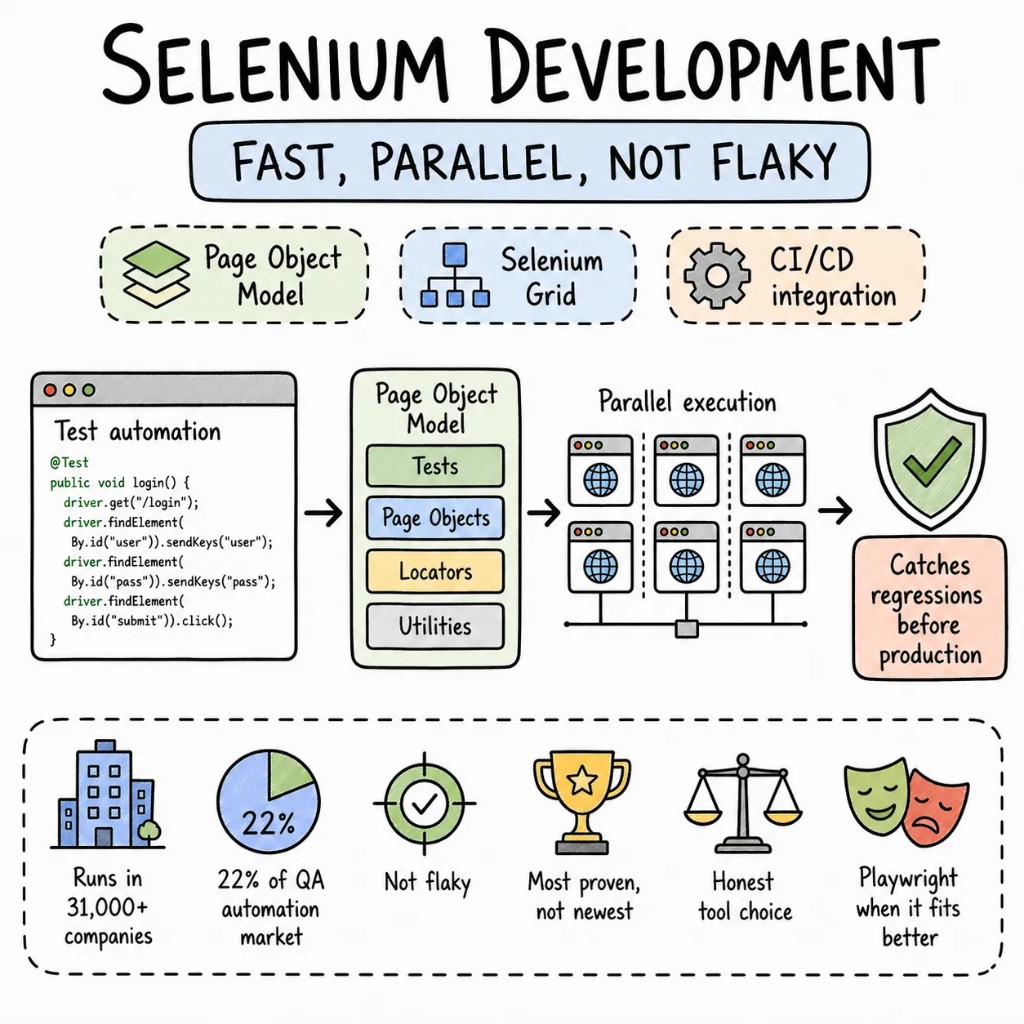
Build or fix a Selenium framework, end-to-end.
A defined scope, a fixed price, a senior-only team. From audit to stable CI-integrated suite in 6–10 weeks.
$15k–$30k
FIXED SCOPE
- Senior engineers only
- Fixed quote in week 1
- Code, infra, runbook — yours
Selenium still runs inside 31,000+ companies and holds 22% of the QA automation market. It's not the newest tool — it's the most proven. We build Selenium test automation frameworks with Page Object Model architecture, parallel execution on Selenium Grid, and CI/CD integration that catches regressions before they reach production. And when Playwright is the honest answer, we'll tell you that too.
Why Entalogics for Selenium
The Selenium suites we inherit always have the same problems — 5,000 tests with a 35% flaky rate, hard-coded waits instead of explicit ones, no Page Object Model, and a Grid nobody maintains. Selenium works. Most test suites built on it don't.
`Thread.sleep(3000)` is the single biggest source of flaky Selenium tests. We use WebDriverWait with expected conditions on every interaction. Tests wait for the element — not for a guess.
Every page gets a class. Every interaction gets a method. Tests read like user stories, not CSS selector soup. When the UI changes, you update one page object — not 200 test files.
Selenium Grid with Docker nodes for parallel browser execution. A 2-hour sequential suite runs in 15 minutes across 8 nodes. CI feedback fast enough to actually block a merge.
Strongly typed page objects with typed return values. `loginAs()` returns a `DashboardPage`, not a void. The compiler catches navigation mistakes before the test runner does.
When Selenium, when not
Selenium is the most battle-tested browser automation framework. It's also showing its age against Playwright's speed and auto-waiting. We'll tell you on the first call which tool fits your team and your existing investment.
STAY ON SELENIUM WHEN
CONSIDER PLAYWRIGHT WHEN
WE SAY NO WHEN
What we build with Selenium
The shapes of Selenium test automation services we deliver most. Each leaves you with a test suite that CI actually trusts.
Page Object Model architecture, data-driven tests, multi-browser coverage, Selenium Grid for parallel execution. The framework that scales to 5,000+ tests without breaking.
Selenium tests running in Jenkins, GitHub Actions, or GitLab CI. Docker-based Grid nodes. Test results reporting to Allure or ReportPortal. Failures that block the merge — not an email nobody reads.
Chrome, Firefox, Edge, Safari — tested in parallel. Selenium Grid or cloud providers like BrowserStack for device coverage. One test suite, consistent results across browsers.
Flaky test triage, explicit wait migration, Page Object refactoring, test data isolation. Turn a 35% flaky suite into one CI actually trusts.
When the honest answer is to move on. Test by test migration with shared Page Object patterns. Selenium keeps running until every test earns its migration.
Selenium's WebDriver protocol extended to mobile. Real device testing on iOS and Android via Appium. Same Page Object Model, same team skills.
The playbook
Selenium patterns from real test automation — not a Udemy course.
P01
Every page a class. Every action a method. Tests never touch selectors directly. UI changes update one file — not the entire suite.
P02
`WebDriverWait` with `ExpectedConditions` on every interaction. Zero `Thread.sleep`. Zero implicit waits. Flaky rate drops by 60% from this change alone.
P03
Selenium Grid with Docker Compose or Kubernetes. Chrome and Firefox nodes scaling with demand. A 2-hour suite runs in 15 minutes.
P04
Each test creates its own data, runs in isolation, cleans up after itself. No shared test data. No test order dependency. No "it passes when I run it alone."
P05
Screenshots on failure. Step-by-step execution logs. Trends across builds. Reports that QA leads actually read and developers actually trust.
P06
Use API calls to set up test state instead of clicking through the UI. Tests validate the UI path — they don't use it for data creation. 10x faster setup.
Signature case
A B2B fintech platform with 3,200 Selenium tests — 35% flaky rate, `Thread.sleep` in 1,800 locations, no Page Object Model, sequential execution taking 4.5 hours, and a CI pipeline that everyone ignored because it always "failed." Migrated to explicit waits, Page Object architecture, Docker Grid, and Allure reporting in 8 weeks. Flaky rate dropped to 2%. Suite runs in 22 minutes.
Before
3,200 tests · 35% flaky · Thread.sleep x1,800 · 4.5hr sequential · CI results ignored
After
3,200 tests · 2% flaky · explicit waits only · 22min parallel · CI blocks merges
Engagement shape
A typical Selenium test automation engagement. We stabilise or build test by test — the current suite keeps running while we work.
Two senior SDETs. Flaky test analysis, wait strategy audit, architecture review, Grid infrastructure check. A ranked, dollarized RFC.
Page Object baseline, explicit waits enforced, Docker Grid wired, first test module refactored. Real flaky rate numbers in your CI dashboard.
Page objects extracted, waits migrated, parallel execution enabled. The existing suite keeps running — refactored tests replace originals one module at a time.
Allure reporting live. Grid stable. Flaky rate under 3%. Runbook handed to your team — or we stay on retainer.
Stack
Our default Selenium test automation stack — picked for production QA.
Engagement
No hourly retainer that bills for "thinking time." Pick a lane that matches your stage; everything is fixed-quote or transparently rated.
A defined scope, a fixed price, a senior-only team. From audit to stable CI-integrated suite in 6–10 weeks.
$15k–$30k
FIXED SCOPE
Embedded engineers in your Slack, your standups. Senior SDETs who build and maintain test automation at scale. Pause, resize, end with 30 days' notice.
$5k / eng / mo
PER ENGINEER
A long-term partner for enterprise QA — framework architecture, test stabilisation, Playwright migration, hiring help.
custom
PROCUREMENT-FRIENDLY
Founder-direct
Thirty minutes with the founder. We'll bring a senior SDET, the relevant playbook, and a candid read on whether Selenium is the right automation tool — or whether Playwright serves your team better.