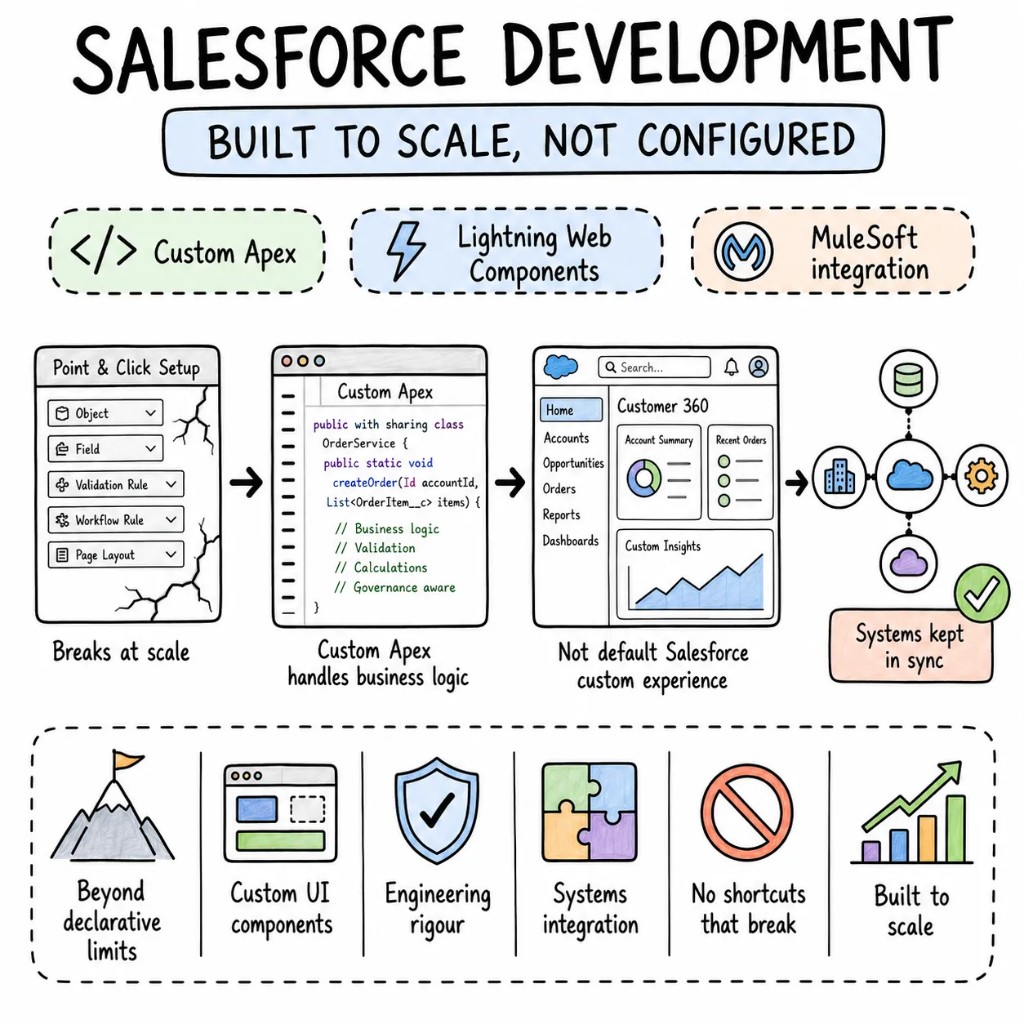
Salesforce development services for teams that have outgrown declarative configuration. Custom Apex for business logic that Flow can't handle. Lightning Web Components for UIs that don't look like default Salesforce. MuleSoft integrations that actually keep your systems in sync. We build on Salesforce with the engineering rigour the platform deserves — not the point-and-click shortcuts that break at scale.
The Salesforce orgs we inherit have the same problems — 200 Flows that nobody can trace, Apex triggers with zero test coverage, Lightning pages still using Aura components from 2018, and integrations held together by middleware nobody maintains. The platform is powerful. Most implementations don't use it properly.
Architecture01
Apex where it earns it. Flows where they belong.
Flow for admin-maintained automation. Apex for complex business logic, bulk processing, and integrations. The two aren't interchangeable — and treating them that way creates maintenance nightmares that neither admins nor developers can fix.
UI02
Lightning Web Components, not Aura in 2026.
LWC is Salesforce's modern UI framework — faster, standards-based, and better supported. We build custom LWC components that look and behave like the UI your users actually want, not the default record pages they work around.
Integration03
MuleSoft or typed APIs. Not point-to-point middleware chaos.
REST callouts with typed Apex classes. MuleSoft for complex multi-system orchestration. Named Credentials for secure authentication. Every integration monitored, logged, and retryable — not a scheduled job that silently fails.
Type safety04
Typed DTOs, typed callouts, 85%+ meaningful test coverage.
No `Map<String, Object>` passed between classes. Typed data transfer objects at every boundary. Test classes that assert behaviour — not just hit coverage numbers. Governor limit-safe by construction.
When Salesforce, when not
Salesforce is a platform. Not a silver bullet.
Salesforce handles CRM, CPQ, service, and marketing better than almost anything. It's also expensive, opinionated, and genuinely complex to extend properly. We'll tell you on the first call if custom Salesforce development is the right path.
BUILD CUSTOM ON SALESFORCE WHEN
Your CRM data is the centre of the business and Salesforce already owns it
Complex business rules need Apex — approval chains, pricing logic, multi-object automation
Your users live in Salesforce all day and need custom LWC interfaces that match their workflows
Enterprise integrations need a governed API layer, not spreadsheet imports
CONSIDER ALTERNATIVES WHEN
You need a custom web application that happens to use CRM data — a headless API + Next.js may be simpler
Licensing costs exceed the value Salesforce adds — for small teams, HubSpot or a custom CRM costs less
Your development team doesn't include Salesforce specialists — the learning curve is real
WE SAY NO WHEN
"Salesforce for a startup with 5 users." You don't need the cost or the complexity yet.
"Just add more Flows until it works." That's how you get 200 Flows nobody can debug.
"Custom Salesforce app in two weeks." That ship has sailed.
What we build on Salesforce
Six product surfaces. One quality bar.
The shapes of Salesforce development work we deliver most. Each built for production orgs — not sandbox demos.
S01
Custom Apex business logic
Custom Apex business logic
Triggers, services, batch jobs, and scheduled classes built with proper separation of concerns. Governor limit-safe. Bulkified. 85%+ test coverage that tests behaviour, not just lines.
APEXTRIGGERSBATCH JOBSTESTNG
S02
Lightning Web Component development
Lightning Web Component development
Custom LWC interfaces — dashboards, data tables, multi-step forms, embedded analytics. Components that look like your product, not like default Salesforce.
LWCAPEX CONTROLLERSLIGHTNING DESIGNJEST
S03
Salesforce integrations
Salesforce integrations
REST/SOAP callouts, MuleSoft orchestration, Platform Events for real-time sync, Named Credentials for auth. Every integration monitored and retryable.
MULESOFTREST APIPLATFORM EVENTSNAMED CREDENTIALS
S04
AppExchange product development
AppExchange product development
ISV apps built for security review. Managed packages, namespaced code, LWC-first interfaces, multi-org compatibility. Passing AppExchange review on the first submission.
MANAGED PACKAGESISVSECURITY REVIEWLWC
S05
Salesforce DevOps & CI/CD
Salesforce DevOps & CI/CD
Source-driven development with SFDX, Git, and DevOps Center. Automated deployments, scratch orgs for testing, and metadata tracked in version control — not deployed manually.
SFDXDEVOPS CENTERGITHUB ACTIONSSCRATCH ORGS
S06
Legacy Salesforce modernisation
Legacy Salesforce modernisation
Aura to LWC, Workflow Rules to Flow, unstructured Apex to service layers. Component by component — the current org keeps running while we modernise.
LWCFLOWAPEX REFACTORSFDX
The playbook
Patterns we ship on repeat.
Salesforce patterns from real production orgs — not Trailhead badges.
P01
Service layer pattern for Apex
Business logic in service classes. Triggers call services, services call selectors. No logic in triggers. No SOQL in controllers. Testable and refactorable.
P02
LWC with wire and imperative Apex
Wire for reactive data. Imperative calls for user actions. Cached results where appropriate. No Aura in new development.
P03
Named Credentials for every callout
No hardcoded endpoints or credentials in Apex. Named Credentials manage auth, endpoints, and certificates. Rotatable without code changes.
P04
Platform Events for real-time sync
Publish/subscribe for cross-system events. Retry logic on subscribers. Event monitoring in production. No polling.
P05
85%+ meaningful test coverage
Test classes assert behaviour and bulk scenarios — not just line coverage. Negative tests included. Governor limit tests on batch jobs.
P06
SFDX source-driven development
All metadata in Git. Scratch orgs for development. CI/CD deploying to sandboxes and production. No manual deployments via change sets.
Signature case
A sales org, rebuilt from Workflow chaos to structured Apex + LWC.
A B2B sales organisation with 340 Workflow Rules, 89 Process Builders, Aura components on every page, and an Apex codebase with 42% test coverage — all running on Classic. Migrated to Lightning with LWC, consolidated automations into structured Flows and Apex services, raised test coverage to 91% in 10 weeks. Without a feature freeze.
Before
Classic · 340 Workflows + 89 Process Builders · Aura components · 42% test coverage
Flows vs Apex, Aura migration, governor limits — the questions we get on every Salesforce discovery call.
Flows for admin-maintainable automation — simple field updates, notifications, approvals. Apex when the logic is complex, needs bulk processing, or involves external callouts. Most orgs need both — the mistake is using one where the other belongs.
Yes for new development — LWC is faster, lighter, and Salesforce's direction going forward. Migrate existing Aura components when they need changes. No flag-day rewrite needed — LWC and Aura coexist cleanly.
Bulkified Apex from day one. SOQL in selectors, not loops. Batch Apex for large datasets. Test classes that assert behaviour at 200-record scale. Governor limits are a design constraint — not a surprise.
Yes. The engineers who write the RFC ship the code. No handoff mid-engagement. Direct access throughout.
Yes. We adapt to your automation framework, package structure, and deployment model. If something needs restructuring, we flag it in the RFC. If it works, we build on top of it.
Founder-direct
Tell us whatyou're building.
Thirty minutes with the founder. We'll bring a senior Salesforce developer, the relevant playbook, and a candid read on whether custom Salesforce development is the right call — or whether a different approach fits your CRM needs better.