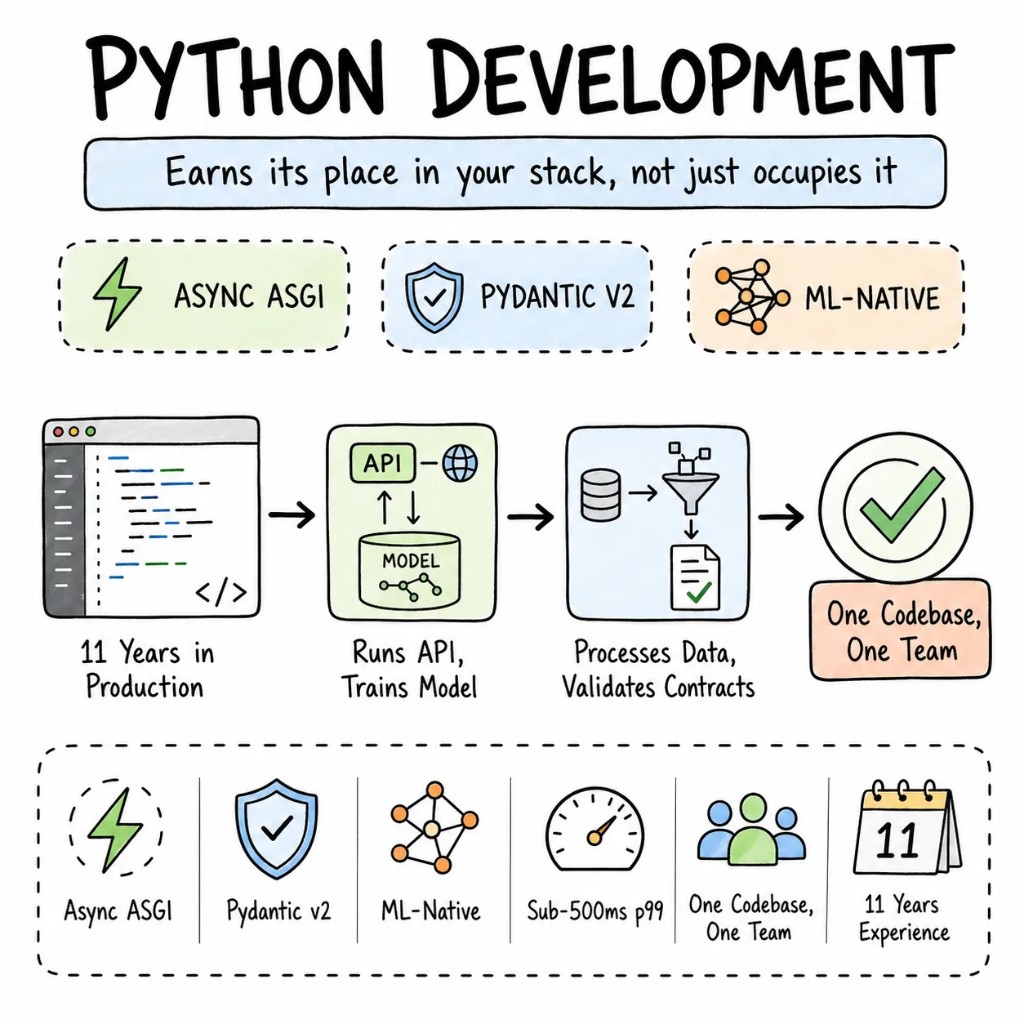
Python that earns its place in your stack - not just occupies it.

Eleven years of Python in production. The language that runs your API, trains your model, processes your data pipeline, and validates your contracts — in one codebase, with one team. No other backend language does that. We know where Python's architecture decisions matter and where they don't, and we don't treat them the same.

  • Async ASGI
  • Pydantic v2
  • ML-native
  • Sub-500ms p99

Why Entalogics for Python

Four things every
Python app
actually needs.

Here's what kills Python in production — one sync ORM call inside an async view, Celery tasks that fail without alerting anyone, N+1 queries nobody noticed until traffic doubled, and a data layer that grew in three different directions. We've inherited all of it. We know exactly where to look.

Performance01

One sync call in an async stack costs you everything.

A synchronous ORM query inside an `async def` view blocks the entire event loop. We audit every layer — database driver, HTTP client, cache — before writing a single new endpoint.

Architecture02

Django and FastAPI aren't competitors. They're complements.

Django's admin and ORM save weeks on workflow-heavy surfaces. FastAPI belongs on high-throughput API and ML inference surfaces. Forcing one to do the other's job is where Python monoliths quietly break down.

State03

Celery is an infrastructure decision, not a default.

Dead-letter queues, beat scheduling, worker concurrency tuning — Celery is powerful and complex to operate. We add it when job complexity justifies a second distributed system. Not before.

Type safety04

Pydantic v2 at every boundary. Not just request bodies.

API responses, environment variables, inter-service payloads. When a schema changes, broken contracts surface at startup — not in a customer's request log on a Sunday night.

When Python, when not

Python is a tool.
Not a religion.

Pick it for what it's genuinely good at. We'll tell you on the first call if the honest answer is something else.

PICK PYTHON WHEN

  • ML, data science, or AI is genuinely first-class — no other language has a decade head start in that ecosystem
  • The product spans API, pipeline, and model inference — one language across all three is a real operational advantage
  • Django's batteries earn their weight — admin, ORM, auth, migrations on a complex content or workflow surface
  • Your team already knows Python well and the domain fits — don't break a stack that ships

CONSIDER OTHERS WHEN

  • Pure high-concurrency I/O with zero data science requirements — Node.js or Go are operationally simpler for that specific shape
  • Microsecond-level latency is a hard requirement — Python's interpreter overhead is real and not solvable with async
  • The team is primarily frontend engineers — Python's tooling assumes backend familiarity and punishes the learning gap

WE SAY NO WHEN

  • "Wrap our Jupyter notebooks in an API." That's not productionisation — that's a Friday afternoon incident waiting to happen.
  • "Python because it's easy." Easy to start is not the same as easy to operate at scale.
  • "We need it live in two weeks and the data model is still changing." That ship has sailed.

What we build with Python

Six product surfaces.
One quality bar.

The shapes of Python work we ship most. Each slots cleanly into your existing infrastructure.

  • S01

    FastAPI microservices & AI backends

    Async ASGI services, Pydantic-validated contracts, streaming inference, OpenAPI docs generated automatically. The Python API your ML team stops routing around.

    FASTAPIPYDANTIC V2UVICORNSQLALCHEMY
  • S02

    Django SaaS platforms

    Multi-tenant architecture, bounded querysets, role-aware admin, Celery for background processing. Django used as the productivity tool it actually is — not fought against.

    DJANGO 5DRFCELERYPOSTGRES
  • S03

    ML inference APIs

    Model serving with async batching to maximise GPU utilisation, streaming token delivery, Pydantic schemas that match model input and output contracts exactly.

    FASTAPIPYTORCHTRANSFORMERSREDIS
  • S04

    Data pipelines & ETL

    Async ingestion, Celery-orchestrated transformation, Pydantic-validated records at every step. Pipelines that fail loudly at the bad record — not silently three hours downstream.

    CELERYPYDANTICSQLALCHEMYKAFKA
  • S05

    Internal tooling

    Replace the spreadsheet. Replace the five spreadsheets. Replace the Jupyter notebook three analysts share over Slack.

    DJANGOHTMXTAILWINDPOSTGRES
  • S06

    Legacy Python migrations

    Flask to FastAPI, Django 3 to Django 5, sync views to async ASGI. One endpoint at a time — the current app keeps serving while we migrate underneath it.

    FASTAPIDJANGOALEMBICPYDANTIC

The playbook

Patterns we
ship on repeat.

Hard-won from production — not conference talks.

  • P01

    ASGI all the way through

    Async views, async ORM via SQLAlchemy 2.0 or Django's async ORM, async Redis and HTTP clients. One synchronous call anywhere in the stack undoes every async gain above it.

  • P02

    Pydantic at every boundary

    Request bodies, response models, settings, Celery task arguments. Pydantic v2 validates at the entry point — silent type coercions don't reach the database or the model inference layer.

  • P03

    Querysets that don't hide N+1s

    `select_related` and `prefetch_related` called explicitly. `django-debug-toolbar` and `nplusone` in the test suite to catch query count regressions before they reach production traffic.

  • P04

    Celery with a dead-letter queue

    Every task has a retry strategy, a failure handler, and a dead-letter queue. Silent background failures are not acceptable. Queue depth monitored with Flower and wired to alerting before it backs up.

  • P05

    Typed tests

    Pytest with Pydantic model fixtures, async test support via `anyio`, integration tests against real Postgres with Testcontainers. The test that actually catches what unit tests miss.

  • P06

    Strangler-fig migrations

    New FastAPI service behind a reverse proxy alongside the legacy Flask or Django app. One endpoint at a time — old app keeps serving until the new one has earned every route.

Signature case

A data platform,
migrated from sync Django to async FastAPI.

A B2B analytics platform — 3.2s p99 on exports, Celery timing out at 12%, N+1 queries on every dashboard load. Migrated to FastAPI with streaming exports and async ORM in 11 weeks. Without a feature freeze.

Before

p99 export 3.2s · Celery timeout 12% · N+1 on every dashboard · full result set in memory

After

p99 export 0.4s · Celery timeout 0.1% · prefetched queries · streaming, flat memory

  • p99 export improvement−88%
  • Celery timeout rate−99%
  • To fully migrated11wk
  • Shipped regressions0

Engagement shape

Eight to ten weeks
to a measurable ship.

One endpoint at a time. The current application never goes dark.

  • W01

    Audit + RFC

    Two senior Python engineers in the codebase. Query profiling, async compatibility audit, Celery failure analysis, memory usage inventory. A ranked, dollarized RFC — not a list of things that feel bad.

  • W02–03

    Foundation + first endpoint

    ASGI baseline, Pydantic v2 at every boundary, one production endpoint migrated end-to-end. Real p99 numbers in your dashboards — not a benchmark on a clean dev machine.

  • W04–08

    Migrate by endpoint, not flag-day

    Old and new behind a reverse proxy, side-by-side. Kill-switch on every cutover. Your roadmap keeps moving throughout.

  • W09+

    Cleanup + handoff

    Decommission the legacy surface. Pytest coverage on critical paths. Runbook handed to your team — or we stay on retainer.

Stack

Tools we
reach for first.

Chosen for production reliability. Already on a stack? We slot in — but greenfield, this is where we start.

  • FrameworkFastAPI · Django 5 · Starlette · Django REST Framework
  • LanguagePython 3.12 · Pydantic v2 · mypy strict · Ruff
  • DataSQLAlchemy 2.0 · Django ORM · Alembic · PostgreSQL · Redis
  • QueueCelery · BullMQ · Kafka · RQ
  • TestingPytest · Testcontainers · Hypothesis · anyio
  • InfraAWS · GCP · Docker · Kubernetes · Datadog · Sentry

Engagement

Three ways
to work with us.

No hourly retainer that bills for "thinking time." Pick a lane that matches your stage; everything is fixed-quote or transparently rated.

FIXED SCOPEone-off build

Ship a Python product, end-to-end.

A defined product, a fixed price, a senior-only team. From RFC to launch in 8–14 weeks.

$15k–$30k

FIXED SCOPE

  • Senior engineers only
  • Fixed quote in week 1
  • Code, infra, runbook — yours
Plan a fixed build
DEDICATED TEAMmonthly

Hire dedicated Python engineers.

Embedded engineers in your Slack, your Linear, your standups. A scaled pod of senior Python engineers, augmenting your team. Pause, resize, end with 30 days' notice.

$5k / eng / mo

PER ENGINEER

  • Same senior bar as fixed-scope
  • Embedded in your team
  • Founder-direct escalation
Hire dedicated Python devs
ENGAGEMENTcustom

Strategic Python partnership.

A long-term partner for product orgs that need both delivery and judgement — ASGI program, migration roadmap, hiring help.

custom

PROCUREMENT-FRIENDLY

  • Multi-quarter roadmap
  • Architecture & hiring partner
  • Procurement-friendly paper
Speak to the founder
FAQ

Sharp questions,
straight answers.

FastAPI vs Django, Flask migrations, the GIL — the questions we get on every Python discovery call.
Django when you need the batteries — admin panel, ORM, migrations, auth — and the surface is content or workflow heavy. FastAPI when the surface is API-first, async I/O matters, or you're serving ML inference. Many production Python platforms run both — Django for the admin and data layer, FastAPI for the high-throughput API surface.
Yes. Flask and FastAPI sit behind the same reverse proxy — one endpoint migrated at a time, Flask keeps serving the rest. No flag-day. No freeze. Your team ships throughout.
Process-level parallelism via Celery workers — not threads. For ML inference specifically: model loading in a separate process pool, async batching to maximise GPU utilisation. The GIL is a real constraint on a single process. Multiple processes is always the answer — not threads.
Yes. The engineers who write the RFC ship the code. No mid-engagement handoff. Direct access throughout.
Yes. We adapt to what's there and flag in the RFC where structural changes would reduce risk. If your data layer works, we build on top of it — we don't rewrite it to match our preferences.

Founder-direct

Tell us whatyou're building.

Thirty minutes with the founder. We'll bring a senior Python engineer, the relevant playbook, and a candid read on whether Python is the right tool — or whether your problem needs a different runtime.