
FIXED SCOPEone-off build
Ship a progressive web app, end to end.
One product, one fixed price, senior-only team. From RFC to a deployed PWA in 8–12 weeks.
FIXED SCOPE
- Zero juniors on client work
- Fixed quote in week 1
- Code, infra, runbook — yours
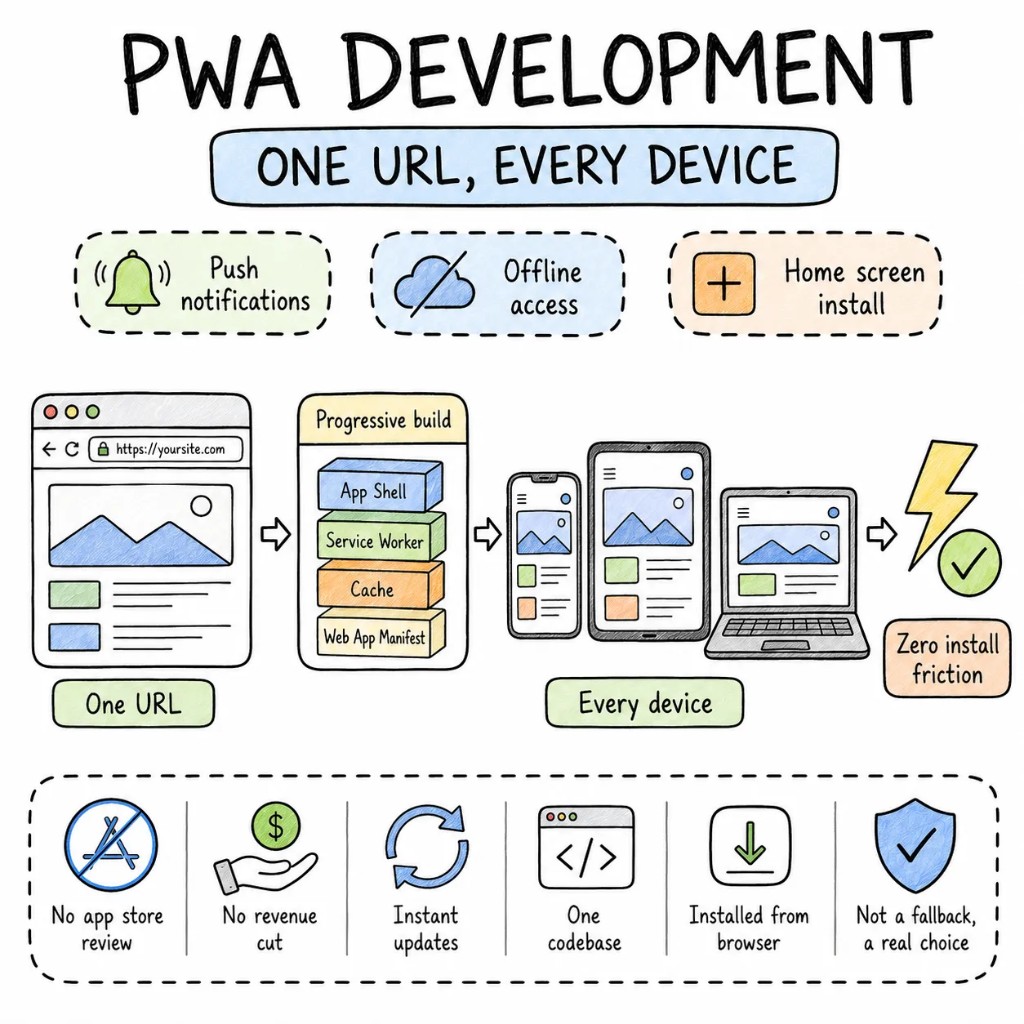
We don't treat progressive web app development as the fallback for teams that can't afford native. Done right, a PWA gives you push notifications, offline access, home screen installs, and instant updates — with no app store review, no 30% revenue cut, and one codebase instead of three.
Why Entalogics for PWAs
Most PWAs we audit fail at the fundamentals — a service worker caching nothing useful, a manifest missing icons, no real offline strategy, push notifications untested on Safari. A progressive web app development company earns that name by getting the basics right first.
App shell cached in the service worker. Critical CSS inlined. Stale-while-revalidate for API data. A PWA that takes three seconds to load has already lost the argument it was built to win.
Workbox configured per route — precache the shell, stale-while-revalidate for images, network-first for API calls. Not one blanket rule that serves stale data and confuses users.
IndexedDB for structured local data, Background Sync for queued actions. The app holds up on a train and in a warehouse — not just on the demo WiFi it was tested on.
Typed cache strategies, typed push payloads, typed manifest config. When the API contract changes, the service worker fails the build instead of quietly serving broken cached data.
When PWA, when not
Progressive web app development is the right call more often than most teams assume — and the wrong one more often than PWA advocates admit. We'll tell you which side your product sits on before you commit budget.
BUILD A PWA WHEN
CONSIDER NATIVE WHEN
WE SAY NO WHEN
What we build as PWAs
Six service types. Each one passes a real Lighthouse audit and behaves like an installed app — not a demo score on localhost.
From concept to deployed app, we design and build progressive web apps on clean, typed architecture — caching strategy, manifest, and offline behaviour planned before the first line of UI code.
Interfaces designed for installability from the first wireframe — icon sizing, splash screens, and layouts that feel native across every screen size, not a responsive website wearing a manifest file.
Product browsing, cart, and checkout cached for instant navigation. Offline product viewing. Push for abandoned carts. SEO-indexed product pages a native app could never rank for.
Replace separate iOS and Android codebases with a single progressive web app — or run both, PWA for reach and native for power users, sharing one backend.
Lighthouse audits, cross-browser testing, and push notification verification on real Safari and Chrome — not just the browser the demo was built in.
Post-launch PWAs degrade the same way native apps do — stale caching rules, outdated dependencies, push delivery drift. We handle ongoing upkeep so your Lighthouse score doesn't slide.
The playbook
Patterns from real production progressive web app deployments — not Lighthouse demo scores that fall apart under real traffic.
P01
Precache for the app shell. Stale-while-revalidate for images and assets. Network-first for API calls. Each route gets the strategy its data volatility actually calls for.
P02
Correct icon sizes for every platform, `display: standalone`, a themed splash screen. The install prompt shows up when it should — not never, not constantly.
P03
Safari push has worked since iOS 16.4. We implement it with the right entitlements and the right timing, with a fallback for browsers that still don't support it.
P04
A form submitted with no connection queues and sends the moment connectivity returns. No lost data, no "please try again" message.
P05
Performance, accessibility, best practices, SEO — all green on the deployed URL under real conditions, not on localhost with an empty cache.
P06
Core functionality works without JavaScript. The service worker adds offline support. The manifest adds installability. Nothing breaks if one layer is missing.
Signature case
A B2C fashion retailer running separate iOS and Android native apps alongside a mobile website — three codebases, three teams, six-week release cycles. Consolidated into a single PWA with offline product browsing, push notifications, and instant checkout. Development cost dropped 68%. Mobile conversion increased 41%.
Before
3 codebases · 3 teams · 6-week release cycle · no SEO from native apps · $18k/mo maintenance
After
1 PWA codebase · 1 team · instant deploys · full SEO · $5.8k/mo maintenance
Industries we serve
We've shipped progressive web app development services for eCommerce, healthcare, fintech, media, logistics, and enterprise teams — anywhere install friction or app store overhead is costing real conversions.
Engagement shape
Feature by feature. The PWA goes live early and keeps improving while your roadmap keeps moving.
Two senior engineers on the project. Lighthouse baseline, offline strategy, push compatibility, caching architecture. A ranked plan with real effort estimates.
App shell cached, manifest configured, service worker wired in, one production route live with offline support. Real Lighthouse scores on the deployed URL.
Push notifications, background sync, offline data, install prompts — each one tested on real devices across browsers, not just the one used to build it.
Lighthouse 100 in production, push fully configured. Runbook handed to your team — or we stay on retainer for PWA maintenance and support.
Stack
Our default PWA development stack — picked for production, not demo scores.
Engagement
No hourly retainer that bills for "thinking time." Every PWA development engagement is fixed-quote or transparently rated.
One product, one fixed price, senior-only team. From RFC to a deployed PWA in 8–12 weeks.
FIXED SCOPE
Senior engineers specialising in progressive web apps, embedded in your Slack, your Linear, your standups. Pause, resize, or end with 30 days' notice.
PER ENGINEER
Long-term partner for organisations replacing native apps with a PWA, or running both in parallel — architecture, migration roadmap, hiring help.
PROCUREMENT-FRIENDLY
Founder-direct
Thirty minutes with the founder — a senior PWA engineer in the room, the relevant playbook on the table, and a straight answer on whether progressive web app development is the right call, or native still serves you better.