Getting off PhoneGap —Getting offPhoneGap —what the move involves.what the move involves.
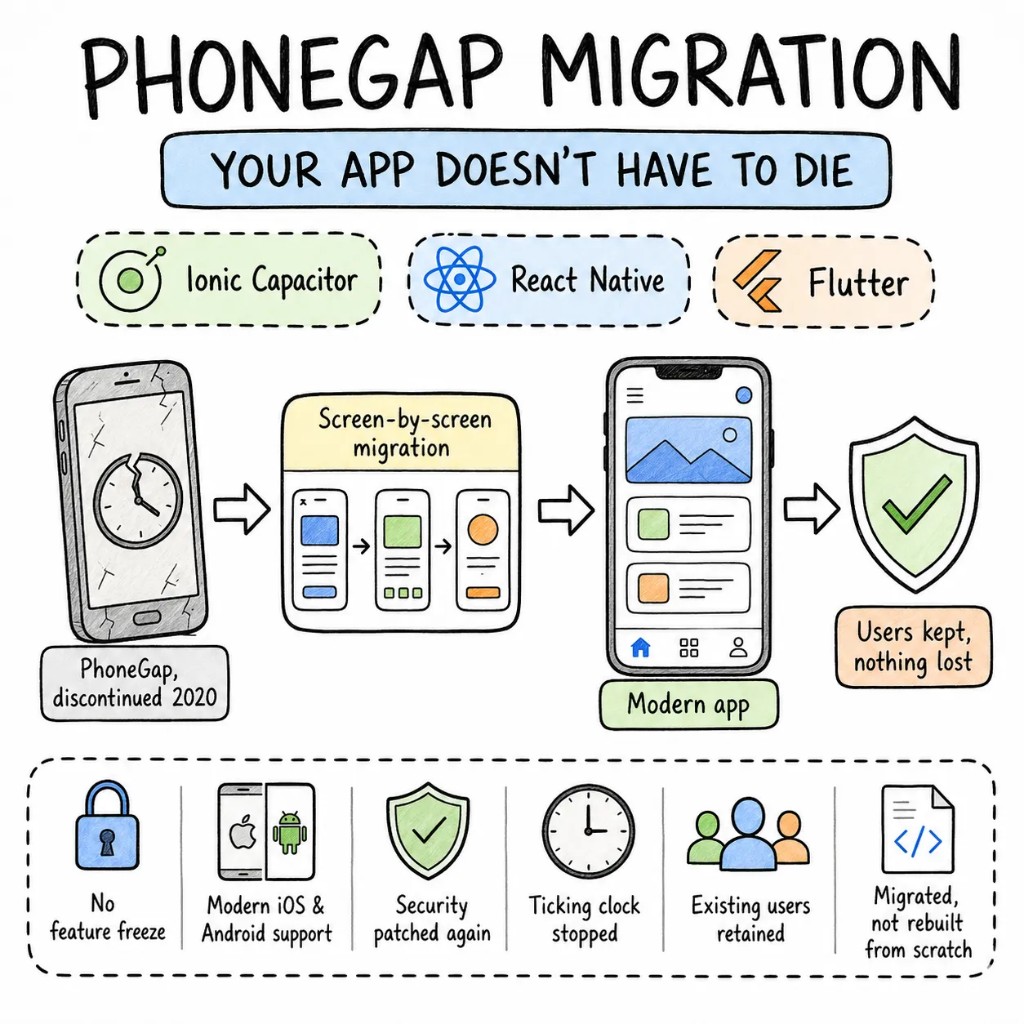
Adobe killed PhoneGap in 2020. No patches, no PhoneGap Build, no compatibility work for the iOS and Android releases that keep shipping every year. This page is about what the migration involves — the plugin inventory, the destination decision, the pipeline PhoneGap Build left behind — so your app lands on a runtime that's still alive without losing the users you already have.
Four things every PhoneGap app development decision needs right now.
PhoneGap stopped being a technology choice in 2020, when Adobe ended it. If your app still runs on it, here is what matters.
Security01
Every unpatched PhoneGap plugin is a live vulnerability.
Nobody has shipped a security patch for a PhoneGap plugin since 2020. Each one sitting in your app is a CVE with no one watching it. We catalogue your full plugin inventory and swap each one for an actively maintained Capacitor or native equivalent.
Compatibility02
The next OS release could be the one that breaks you.
iOS and Android ship major updates every year, and PhoneGap's WebView bridge and build tooling stopped keeping pace in 2020. There's no team fixing compatibility on the other end. Migrating puts your app back on a runtime that is maintained.
Performance03
Capacitor's native bridge beats Cordova's by a wide margin.
PhoneGap runs on Cordova's async JSON bridge between JavaScript and native code. Capacitor's bridge is typed and direct. That difference shows up as native calls users can feel — camera, geolocation, file access — the moment the bridge changes.
Continuity04
Your existing web codebase isn't wasted — it transfers.
A PhoneGap app is still HTML, CSS, and JavaScript underneath. That code carries into Ionic Capacitor with far fewer changes than people assume. Your team's existing skills and business logic move with it.
Migration paths
PhoneGap migration only has one direction. The real question is the destination.
There's no version of "keep PhoneGap running" that holds up past the next OS release. What matters is picking the right target framework for your app, your team, and your timeline. We'll give you a straight answer on the first call.
MOVE TO IONIC CAPACITOR WHEN
Your app is Cordova-based — Capacitor is its official, Ionic-built successor
You want to keep the existing HTML/CSS/JS codebase largely intact
Your team already writes Angular, React, or Vue
Budget favours the shortest path with the fewest code changes
MOVE TO REACT NATIVE WHEN
Native-rendered UI matters more than keeping the WebView approach
The app needs heavier animation or platform integration than WebView supports
Your team is already in React and wants to share code with a web stack
MOVE TO FLUTTER WHEN
Pixel-perfect UI across iOS and Android is the priority
You want one Dart codebase covering mobile, web, and desktop
A full UI rewrite is an acceptable tradeoff for long-term rendering control
WE SAY NO WHEN
"Just patch the plugins and keep it running." Nobody maintains them anymore, so there's nothing to patch against.
"Move it to PhoneGap Build instead." That service has been gone since 2020.
"We need this fully migrated in two weeks." A real migration takes longer than that, and we'll say so.
What we migrate
Six PhoneGap migration services. One quality bar.
The kinds of PhoneGap work we take on most. Every engagement ends with a modern, maintained app live on both stores.
S01
PhoneGap to Ionic Capacitor migration
PhoneGap to Ionic Capacitor migration
The most direct path off PhoneGap. Your web codebase stays largely intact, Cordova plugins get swapped for Capacitor equivalents, and the native bridge is rebuilt on a runtime that is maintained.
IONICCAPACITORTYPESCRIPTCI/CD
S02
PhoneGap to React Native migration
PhoneGap to React Native migration
A full UI rebuild on native-rendered components, with your existing business logic carried over from JavaScript. Expo handles OTA updates and cloud builds going forward.
REACT NATIVEEXPOTYPESCRIPTTANSTACK
S03
PhoneGap to Flutter migration
PhoneGap to Flutter migration
A complete rewrite in Dart for teams that want maximum control over rendering and a fresh architecture rather than a patched-over legacy codebase.
FLUTTERRIVERPODDARTFIREBASE
S04
PhoneGap plugin replacement and security audit
PhoneGap plugin replacement and security audit
Every unmaintained plugin in your PhoneGap app identified, risk-scored against known CVEs, and replaced with a Capacitor or native equivalent that's still receiving updates.
CAPACITORSNYKPLUGIN AUDITCI/CD
S05
App store compliance recovery
App store compliance recovery
PhoneGap apps failing review or flagged for deprecated APIs get fixed at the build-tooling level, then resubmitted against current App Store and Play Store guidelines.
XCODEANDROID STUDIOGRADLEFASTLANE
S06
Hybrid to native conversion
Hybrid to native conversion
For apps that have outgrown the hybrid model. Swift for iOS, Kotlin for Android, built from your existing app's real specification instead of starting from a blank page.
SWIFTKOTLINSWIFTUIJETPACK COMPOSE
The playbook
PhoneGap migration patterns we ship on repeat.
What a PhoneGap rescue needs in practice: plugin inventory first, screen-by-screen cutover, a rebuilt pipeline.
P01
Plugin inventory before anything else.
Every Cordova and PhoneGap plugin catalogued with maintainer status, last update date, known CVEs, and its Capacitor equivalent. This inventory is what the entire migration plan is built on.
P02
Screen by screen, never flag-day.
The old PhoneGap app and the new Capacitor build run side by side for the length of the migration. Each screen ships independently, with a kill-switch on every cutover.
P03
Rebuilding the pipeline PhoneGap Build left behind.
PhoneGap Build shut down years ago. We wire GitHub Actions or Codemagic to build, sign, and submit to both stores from CI, with no manual Xcode steps in the way.
P04
A typed bridge instead of untyped callbacks.
Every native API call moves from Cordova's untyped callback pattern to Capacitor's typed async/await. TypeScript strict from the plugin layer up.
P05
Regression tests before any cutover.
Cypress or Playwright runs against every migrated screen before it goes live. Nothing ships until it matches or beats the old version's behaviour.
P06
Resubmission handled end to end.
Updated build tooling, current SDK targets, privacy manifests, and store metadata. We own the first submission, including compliance with whatever review guidelines are current that quarter.
Engagement shape
Six to twelve weeks to a measurable PhoneGap migration.
Screen by screen, never a flag day. The current app stays live on both stores while we work.
W01
Audit + RFC
Two senior engineers on the project. Full plugin inventory, CVE scan, OS compatibility check, build tooling assessment. The output is a ranked migration plan rather than a list of what's broken.
W02–03
Foundation + first screen
Capacitor baseline established, the first batch of plugins replaced, one production screen migrated end-to-end and measured on a real device.
W04–08
Migrate screen by screen
Old and new versions running side by side. A kill-switch on every cutover. Your team keeps shipping the rest of the roadmap throughout.
W09+
App store resubmission + handoff
Both stores updated, CI/CD wired in. Runbook handed to your team — or we stay on retainer for what comes next.
Stack
Tools we Tools we reach reach for for first.
The default PhoneGap migration stack.
Target
Ionic · Capacitor · React Native · Flutter
Language
TypeScript (strict) · Dart · Zod
Build
GitHub Actions · Codemagic · Fastlane
Testing
Cypress · Playwright · Jest · Detox
Audit
Snyk · npm audit · plugin-inventory scripts
Infra
Firebase · Sentry · Datadog · TestFlight · Play Console
VOICES
What founders say on the record.
Verified feedback from Upwork, Clutch, and reference calls we're happy to set up before you sign anything.
Evan Kanouse
CEO, Modestly
Entalogics has successfully delivered extension prototypes on time, and we are impressed with their project management and the finished product. The client communicates with Entalogics via virtual meetings, email, and messaging apps.
Adam Strock
Founder, Flourish Schools
Collaborating with Entalogics was a great experience. Communication was clear, we aligned quickly, and their team delivered high-quality code on time with thoughtful technical decisions.
Giles Whitman
CTO, SentryBay
Their Chromium expertise helped us ship a hardened browser with live threat controls and enterprise rollout support. Security operations became significantly faster.
George Irvin
Founder, G3 Ventures LLC
Entalogics delivered our custom Electron browser in six months with isolated profile workflows and stable policy sync. Agent onboarding improved by 55% after rollout.
Dani Keo
Project Manager, Sociall
Entalogics built our iOS Chromium-based mobile app with a smooth native feel, stable media rendering, and reliable sync. We shipped faster and improved engagement after launch.
Project Manager
RozmeriGPT
The web dashboard and Chrome extension now share prompts, billing, and analytics in one platform. Our content turnaround improved 4x after launch.
Ilya Khodakovsky
Project Manager, Omni Browser
Entalogics built our Omni Browser on top of Chromium with deep product-level execution. They implemented an integrated VPN and Omni Crypto Wallet directly in the browser, made strong architectural decisions, and delivered quality code on schedule with clear communication.
Sherzod Khabibullayev
Project Manager, Digital Office: Aura
Entalogics built Digital Office: Aura as a custom Chromium-based authentication platform. Their team modified Chromium internals and integrated our manual custom authentication flow with reliable implementation, fast delivery, and consistent communication.
Engagement
Three ways to run your PhoneGap migration with Entalogics.
No hourly billing. Every migration is a fixed quote or a rate you see before you commit.
FIXED SCOPEone-off build
Migrate your PhoneGap app, end to end.
A defined migration scope, a fixed price, a senior-only team. From audit to both app stores live, typically 6–12 weeks.
Different page, different buyer: senior cross-platform engineers who run the migration inside your repo and your standups, priced per engineer per month.
PER ENGINEER
·Capacitor, React Native, or Flutter as the destination
PhoneGap development services — sharp questions, straight answers.
Support status, migration paths, keeping the app live in both stores. The questions that come up on most PhoneGap calls.
No. Adobe discontinued both PhoneGap and PhoneGap Build in 2020, and nothing has changed since. No patches, no compatibility updates, no roadmap. Every new OS release is a risk your app carries with no fix available. Migration is the only real path forward.
Ionic with Capacitor. Capacitor is Cordova's official successor, built by the same team, and your existing HTML, CSS, and JavaScript codebase carries over with far fewer changes than a full rewrite. Equivalent replacements exist for nearly every common PhoneGap plugin.
Not if you migrate to Capacitor. Your web codebase and business logic stay largely intact, and it's the native bridge, plugins, and build tooling that change. A full rewrite only becomes necessary if you choose Flutter or native Swift and Kotlin instead.
They run side by side for the whole migration. Each screen moves to the new Capacitor build behind a kill-switch, with Cypress or Playwright regression tests proving it matches or beats the old behaviour before it goes live. The existing PhoneGap version stays published throughout, so users receive the new build as a normal update — never a second app to find.
Yes. The existing PhoneGap version stays published throughout, and we submit the new build once it's ready. Users experience it as a normal update, not a new app they have to find and reinstall.
Senior engineers
Tell us whatyou're building.
Thirty minutes with a senior engineer and a senior migration engineer, and a straight answer on whether Capacitor, React Native, Flutter, or native is the right destination for your app.