Open source developmentOpen sourcedevelopmentservices, done right.services, done right.
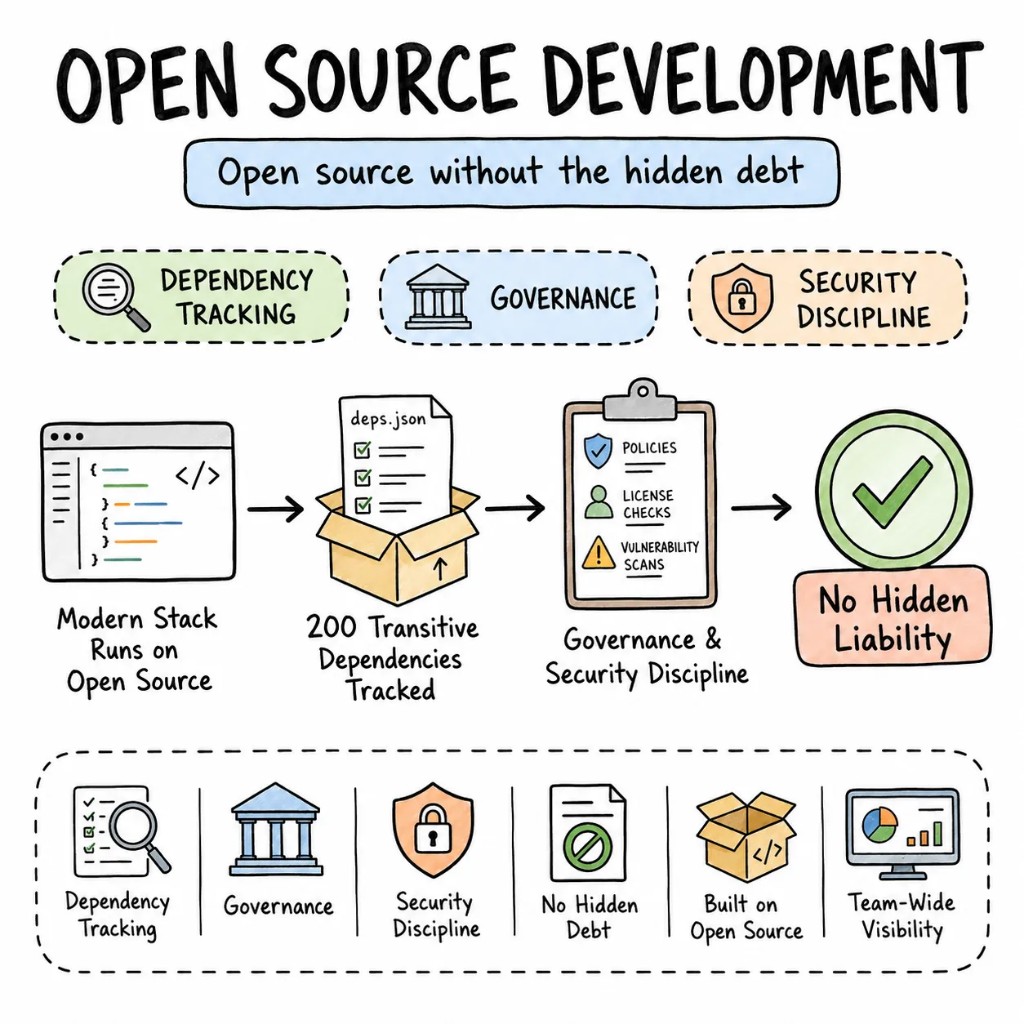
Every modern stack runs on open source. The question is whether anyone on your team is tracking the 200 transitive dependencies that shipped last Tuesday. We provide open source development services with the governance and security discipline that keeps your dependencies from becoming your biggest liability.
Four things every open source project actually needs.
81% of audited codebases have high-risk vulnerabilities. 68% have license conflicts. Those aren't edge cases — that's the open source development default when nobody owns governance. We make sure your project isn't part of that statistic.
Security01
Every dependency is an attack surface you inherited.
SBOM generated from day one, CVE databases monitored continuously, patching enforced before it waits for someone to read a security advisory. Open source development company discipline — not hopeful reviewing.
Licensing02
License compliance — not legal's problem. It's architecture.
GPL in a proprietary binary is a lawsuit waiting for a trigger. License conflicts caught in CI and policies built into the pipeline — not discovered in a quarterly spreadsheet six months after the dependency landed.
Maintenance03
Dead dependencies are ticking clocks.
79% of codebases contain libraries with zero activity in two years. We identify abandoned open source components early and replace them before they become the vulnerability nobody can fix because the maintainer disappeared.
Type safety04
Typed wrappers around untyped community code.
Critical dependencies wrapped in typed interfaces so swapping a library touches one adapter — not fifty files scattered across the codebase. Open source development that survives the next upstream breaking change.
When open source, when not
Open source development is a tool. Not a shortcut.
Using open source well requires more discipline than building from scratch. We'll tell you honestly where it accelerates your product and where it introduces risk you shouldn't carry.
LEAN INTO OPEN SOURCE DEVELOPMENT WHEN
The project is mature with an active security response — PostgreSQL, Linux, Redis, React
The library solves a problem you have no competitive reason to solve yourself
You have the governance in place to track, update, and audit what actually ships
BE CAUTIOUS WHEN
Fewer than two active maintainers and no corporate backing — that's a fork waiting to happen
A copyleft license meets a proprietary product — the boundary has to be airtight
You're pulling an entire framework for one utility function you could write in an afternoon
WE SAY NO WHEN
"Use whatever has the most GitHub stars." Popularity isn't a security audit.
"We'll sort licensing out later." Later is always a legal letter, not a calendar reminder.
"We forked it and we'll maintain it ourselves." You won't. Nobody does.
What we build with open source
Six open source development surfaces. One quality bar.
Where open source engineering shows up most in our work — each with security governance and license compliance built in from the first commit, not the last.
S01
Full-stack open source platforms
Full-stack open source platforms
Next.js, Django, Rails, Spring Boot — production platforms with dependency governance, SBOM generation, and vulnerability scanning wired in before the first deploy.
NEXT.JSDJANGOSPRING BOOTSNYK
S02
Self-hosted open source infrastructure
Self-hosted open source infrastructure
Keycloak, Supabase, Metabase on your own infrastructure — no vendor lock-in, no subscription you can't cancel. Properly configured, hardened, with upgrade paths and an operational runbook your team actually needs.
KEYCLOAKSUPABASEMETABASEDOCKER
S03
Open source contributions & fork maintenance
Open source contributions & fork maintenance
Patches contributed upstream where possible, maintained forks when necessary, rebased against upstream on a schedule so they don't drift into a self-inflicted maintenance nightmare.
GITCI/CDUPSTREAM SYNCCHANGELOG
S04
License-compliant SaaS products
License-compliant SaaS products
SaaS built on open source components with license compliance enforced in CI, SBOM generated per release, and a legal-ready audit trail for due diligence and M&A events.
FOSSALICENSE-CHECKERSBOMCI/CD
S05
Internal tooling on open source
Internal tooling on open source
Replace the SaaS subscription with a self-hosted alternative you actually control — n8n instead of Zapier, NocoDB instead of Airtable. Properly configured, secured, and backed up. Not a Docker Compose file someone found on GitHub.
N8NNOCODBGRAFANATAILWIND
S06
Open source security remediation
Open source security remediation
Inherited 300 unpatched CVEs and license conflicts? We triage by real exploitability, patch what matters, replace what's abandoned, and hand you a clean SBOM at the end.
SNYKTRIVYGRYPEDEPENDABOT
The playbook
Open source development patterns we ship on repeat.
Governance built into every open source development engagement — not compliance checklists copied from a blog post.
P01
SBOM from day one
Every project generates a Software Bill of Materials on every build. You know what shipped, which version, and under which license — before anyone asks during due diligence.
P02
License policy in CI
GPL in a proprietary codebase fails the build, not a quarterly review six months after the dependency was quietly added to the lockfile.
P03
CVE monitoring in real time
Snyk, Trivy, or Grype runs on every pull request and on a scheduled cron. Critical CVEs trigger an alert, not a Jira ticket that sits for three sprints.
P04
Dependency health scoring
Every new open source dependency evaluated on maintainer count, release cadence, and license compatibility before it enters the lockfile at all.
P05
Typed dependency boundaries
Critical libraries wrapped in internal interfaces so swapping one library touches one adapter. The rest of the codebase doesn't know or care what changed underneath.
P06
Fork discipline
When a fork is unavoidable, it stays rebased against upstream with automated conflict detection. Forks that drift become liabilities — we don't let them.
Signature case
A fintech platform, cleaned from 340 CVEs to a green SBOM.
A B2B fintech preparing for acquisition — 340 unpatched CVEs, 12 license conflicts including GPL in proprietary code, 47 abandoned libraries. Triaged by exploitability, patched critical paths, delivered a clean SBOM in 6 weeks. Acquisition closed on schedule.
Before
340 CVEs · 12 license conflicts · 47 abandoned deps · no SBOM · due diligence blocked
After
0 critical CVEs · 0 license conflicts · all deps maintained · full SBOM · due diligence cleared
Critical CVEs resolved−100%
License conflicts−100%
To fully remediated6wk
Acquisition delay0 days
Engagement shape
Six to ten weeks to a clean open source codebase.
Every open source development engagement starts with an audit. What ships at the end is a codebase where every dependency is tracked, licensed, and patched — not just scanned.
W01
Audit + RFC
Two senior open source engineers go through the entire dependency tree — SBOM generation, CVE triage, license conflict mapping, abandoned dep inventory. A ranked remediation plan with real priorities, not a raw scan dump.
W02–03
Critical path first
Highest-risk CVEs patched, license conflicts resolved, SBOM pipeline wired into CI. Real governance in your build before the end of week three, not a report sitting in someone's inbox.
W04–08
Remediate by priority
Dependency by dependency — abandoned libraries replaced, outdated versions upgraded, typed wrappers added around volatile open source APIs. Your team keeps shipping the entire time.
W09+
Cleanup + handoff
Clean SBOM. License policy running in CI. CVE monitoring on autopilot. Runbook handed to your team — or we stay on retainer.
Stack
Tools we Tools we reach reach for for first.
Governance tooling chosen for accuracy and CI integration.
Scanning
Snyk · Trivy · Grype · npm audit · pip-audit
Licensing
FOSSA · license-checker · scancode-toolkit
SBOM
Syft · CycloneDX · SPDX
Monitoring
Dependabot · Renovate · Socket.dev
Testing
Vitest · Pytest · JUnit · Testcontainers
Infra
GitHub Actions · GitLab CI · Docker · Kubernetes
VOICES
What founders say on the record.
Verified feedback from Upwork, Clutch, and reference calls we're happy to set up before you sign anything.
Evan Kanouse
CEO, Modestly
Entalogics has successfully delivered extension prototypes on time, and we are impressed with their project management and the finished product. The client communicates with Entalogics via virtual meetings, email, and messaging apps.
Adam Strock
Founder, Flourish Schools
Collaborating with Entalogics was a great experience. Communication was clear, we aligned quickly, and their team delivered high-quality code on time with thoughtful technical decisions.
Giles Whitman
CTO, SentryBay
Their Chromium expertise helped us ship a hardened browser with live threat controls and enterprise rollout support. Security operations became significantly faster.
George Irvin
Founder, G3 Ventures LLC
Entalogics delivered our custom Electron browser in six months with isolated profile workflows and stable policy sync. Agent onboarding improved by 55% after rollout.
Dani Keo
Project Manager, Sociall
Entalogics built our iOS Chromium-based mobile app with a smooth native feel, stable media rendering, and reliable sync. We shipped faster and improved engagement after launch.
Project Manager
RozmeriGPT
The web dashboard and Chrome extension now share prompts, billing, and analytics in one platform. Our content turnaround improved 4x after launch.
Ilya Khodakovsky
Project Manager, Omni Browser
Entalogics built our Omni Browser on top of Chromium with deep product-level execution. They implemented an integrated VPN and Omni Crypto Wallet directly in the browser, made strong architectural decisions, and delivered quality code on schedule with clear communication.
Sherzod Khabibullayev
Project Manager, Digital Office: Aura
Entalogics built Digital Office: Aura as a custom Chromium-based authentication platform. Their team modified Chromium internals and integrated our manual custom authentication flow with reliable implementation, fast delivery, and consistent communication.
Engagement
Three ways to work with us on open source development.
No hourly retainer billing for "thinking time." Every path is fixed-quote or transparently rated.
FIXED SCOPEone-off build
Ship a clean open source project.
A defined scope, a fixed price, a senior-only team. From audit to clean SBOM in 6–10 weeks.
A pod of senior open source engineers embedded in your Slack, your Linear, your standups — handling dependency governance, security remediation, and upstream contributions. Resize or pause with 30 days' notice.
For product orgs that need more than delivery — a long-term open source consulting partner: SBOM program, license compliance, security monitoring, hiring help.
License conflicts, CVE triage, dependency tooling — the questions we get on every open source development call.
Every dependency's license gets scanned in CI, not after the fact. When we find a conflict, we either replace the dependency, isolate it behind a process boundary, or flag it for legal with a concrete recommendation — not a vague warning. Zero open source license conflicts in the lockfile at all times is the standard we hold.
Exploitability over severity score. A critical CVE in a dev-only dependency ranks lower than a medium CVE in a library handling user input on every request. We triage against your actual runtime and fix in order of real blast radius, not the number on a dashboard.
Renovate for most teams — more configurable, supports monorepos, groups related updates so you're not reviewing fifty PRs. Dependabot if you're GitHub-native and want zero configuration. Either way, automated open source dependency updates are non-negotiable for any production codebase.
Yes. The engineers who triage the dependency tree are the ones remediating it — no handoff mid-engagement, no account manager between you and the people doing the actual work.
Yes. GitHub Actions, GitLab CI, Jenkins, CircleCI, Azure DevOps — we integrate into your pipeline instead of asking you to rebuild it around our preferences.
Senior engineers
Tell us whatyou're building.
Thirty minutes with a senior open source engineer, the relevant playbook, and a candid read on whether your dependency risk is something we should take on.