
FIXED SCOPEone-off build
Ship an Odoo implementation, end to end.
Fixed scope, fixed price, senior-only team. Process audit to live ERP in 10-16 weeks.
FIXED SCOPE
- Zero juniors on client work
- Fixed quote in week 1
- Code, infra, runbook — yours
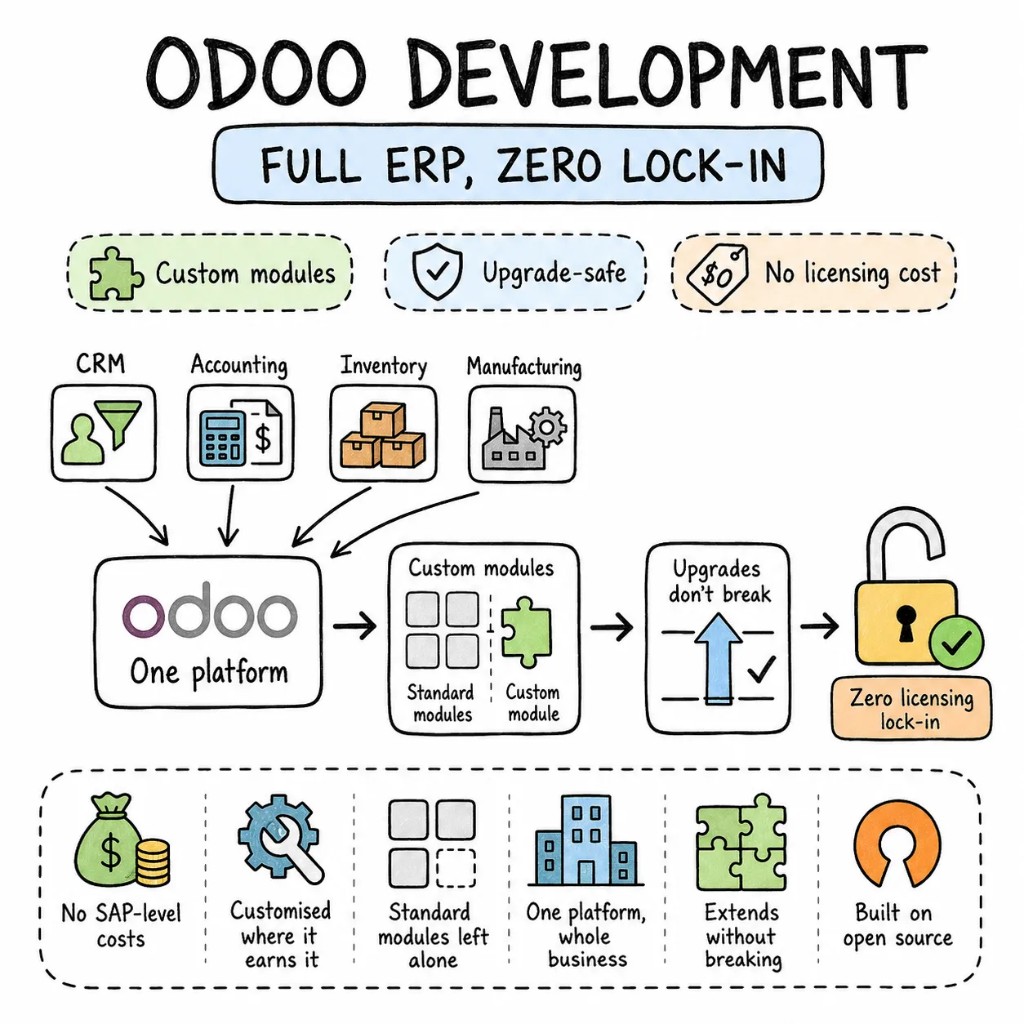
CRM, accounting, inventory, and manufacturing on one platform without SAP's licensing cost — that's what draws businesses to Odoo, and over-customization is what makes most Odoo development companies get it wrong. Our Odoo development services and consulting extend the platform where it genuinely earns its cost and leave standard modules alone everywhere else.
Why Entalogics for Odoo
Over-customization is the number one reason Odoo projects fail. Every Odoo instance we inherit has the same problems — core modules modified directly, custom fields with no naming convention, and Python logic that routes around the ORM entirely.
Custom modules that inherit and extend — never edit base code. When Odoo ships the next version, your customizations survive the upgrade instead of failing it, putting your data at risk, and doubling your timeline.
N+1 queries hidden behind compute fields, search methods loading entire tables, reports running raw SQL with no indexes. We profile with pg_stat_statements and fix the actual bottleneck before scale forces the issue on you.
Odoo connected to Shopify, payment gateways, and accounting systems through typed REST endpoints — webhook-driven where possible, scheduled sync where it's not. A CSV import isn't a data strategy, it's a Monday morning chore waiting to be forgotten.
Every custom module tracked and tested against Odoo's upgrade path. When you move from Odoo 17 to 18, you already know what breaks and how long the fix takes — not after the upgrade already failed in production.
When Odoo, when not
Odoo is the world's largest open-source ERP, and it punishes bad customization harder than any proprietary alternative ever will. We'll tell you honestly on the first call whether Odoo fits your business.
PICK ODOO WHEN
CONSIDER ALTERNATIVES WHEN
WE SAY NO WHEN
What we build on Odoo
Eight ways this work shows up for real clients. Each one built upgrade-safe with proper module architecture — not a customization that turns the next version into a rebuild.
Sales, accounting, inventory, purchasing, manufacturing configured to your actual business workflows. Standard modules first, custom modules only where standard genuinely falls short.
Purpose-built Python modules for business logic Odoo doesn't cover natively — commission engines, approval chains, industry-specific workflows. ORM-native, tested, and documented against the upgrade path from day one.
REST and JSON-RPC connectors for Shopify, payment gateways, shipping providers, and legacy systems. Webhook-driven where possible, every integration monitored and retryable.
Odoo's website and e-commerce module configured for real online stores — product variants, payment integration, shipping rules, and SEO that competes with Shopify on your own infrastructure.
Odoo 14, 15, or 16 to Odoo 18. Module compatibility audit, data migration, custom module rewrite wherever APIs changed. The current instance stays running until the new one is validated.
PostgreSQL query profiling, ORM optimization, indexed fields, materialized views for heavy reports. Odoo that stays fast at 5 million records, not just at 5,000.
Hands-on training for admins and end users on the modules you've implemented — module navigation, report building, and the customization boundaries that keep the instance upgrade-safe after we hand it off.
Ongoing monitoring, version compatibility checks, performance reviews, and custom module upkeep — so the upgrade-safe instance we built doesn't quietly drift back into the direct-core-edit mess we were hired to fix.
The playbook
Patterns from real production Odoo deployments — not tutorial demos.
P01
Every customization in its own module. Inherits and extends via Odoo's `_inherit` mechanism. Core code untouched. Upgrades stay clean.
P02
`search`, `read`, `create`, `write` through the ORM. Raw SQL only when large-dataset performance genuinely demands it — and wrapped in a documented service method, not scattered across business logic.
P03
Every custom module includes real test coverage. CRUD, workflow transitions, and edge cases tested. CI runs the suite before every deployment.
P04
Staging, production, and branch deployments with instant rollbacks. Upgrade testing happens in staging before it ever touches production.
P05
External APIs connected through typed Python classes with error handling, retry logic, and logging. No raw `requests.get()` buried inside a compute method.
P06
Every custom module documented against Odoo's changelog. When the next version ships, we already know which ORM methods changed and which views need updating.
Signature case
A mid-size manufacturer running operations on 14 Excel spreadsheets, a standalone accounting tool, and a paper-based inventory system. Implemented Odoo 18 with manufacturing, inventory, accounting, and sales in 12 weeks. Three custom modules for industry-specific workflows. Inventory accuracy went from "best guess" to 99.2%.
Before
14 spreadsheets · standalone accounting · paper inventory · manual reorder · no traceability
After
Odoo 18 · unified ERP · real-time inventory · automated reorder · full lot traceability
Industries we serve
We've delivered Odoo development services for manufacturing, retail, logistics, healthcare, and construction — anywhere multi-department operations genuinely need one connected system instead of fourteen spreadsheets.
Engagement shape
Module by module. Your team starts using the system incrementally, not all at once.
Two senior Odoo developers. Process audit, gap analysis against standard modules, integration inventory, upgrade path assessment. A ranked, dollarized plan.
Odoo 18 instance configured, first standard modules live, first custom module built and tested. Real users entering real data, not a demo environment.
Each department goes live incrementally. Custom modules deployed. Integrations wired. Training delivered per module, not in a single overwhelming session.
Full ERP operational, data validated. Runbook handed to your team — or we stay on for Odoo maintenance and support.
Stack
Our default Odoo development stack — picked for production ERP.
Engagement
No hourly billing for thinking time. Fixed quote or a transparent monthly rate.
Fixed scope, fixed price, senior-only team. Process audit to live ERP in 10-16 weeks.
FIXED SCOPE
Senior Python developers with Odoo ORM and OWL expertise, embedded in your Slack, your standups. Pause, resize, or exit with 30 days' notice.
PER ENGINEER
A standing partner for Odoo-powered businesses — version upgrades, custom module portfolio, integration architecture, training, hiring help.
PROCUREMENT-FRIENDLY
Founder-direct
Thirty minutes with the founder — a senior Odoo developer, the relevant playbook, and a candid read on whether Odoo is the right ERP, or a different platform fits your operations better.