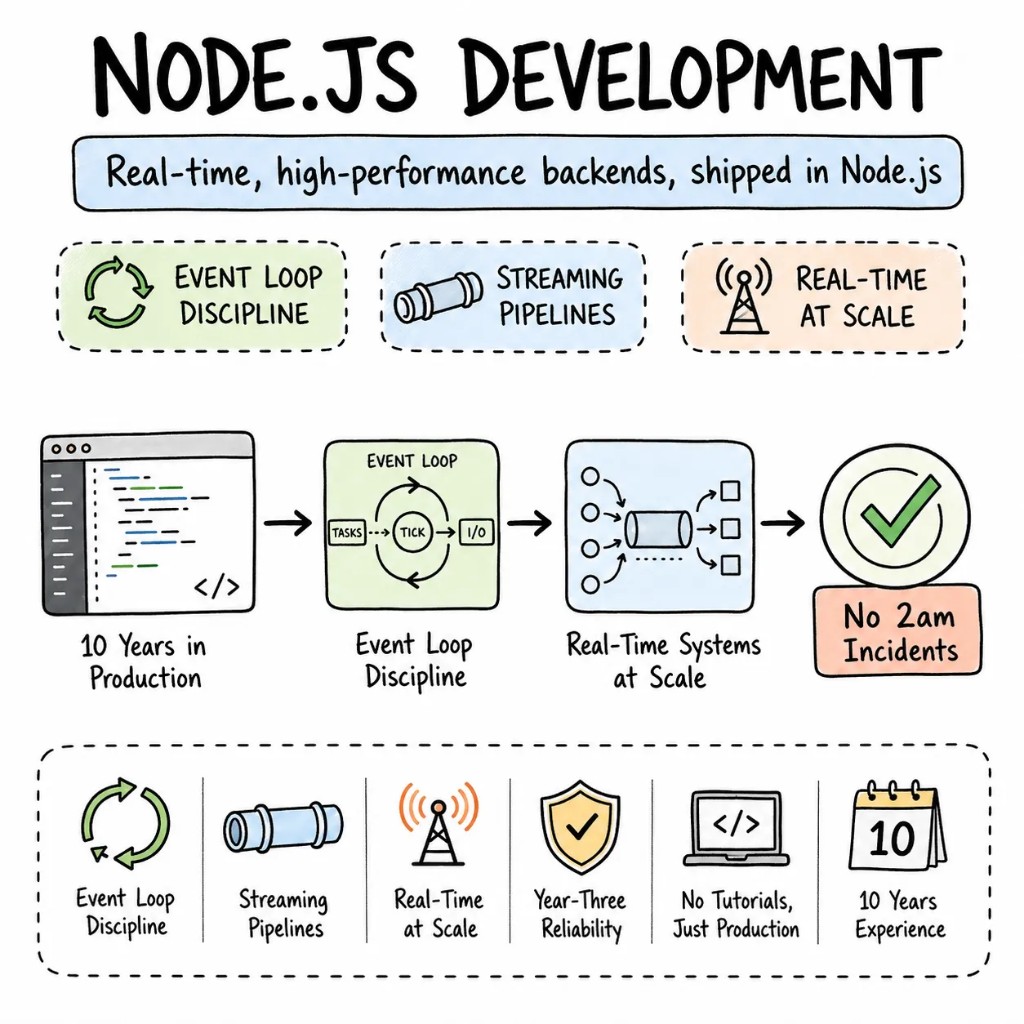
Node.js developmentNode.jsdevelopmentservices. Built for scale.services. Built for scale.
Custom Node.js development — real-time backends, high-throughput APIs, and scalable web applications. Shipped by senior engineers with ten years of Node.js in production.
Most Node.js development companies treat Node like a thread-per-request server. We build around how the runtime actually works.
Performance01
Protect the event loop.
One synchronous CPU-heavy task stalls every pending request. We audit for event loop blockers from day one and offload CPU-bound work to Worker Threads before it becomes a production incident.
Architecture02
Clean module boundaries.
Thin route handlers, domain logic in pure functions, data access behind typed repositories. A new engineer finds the right file in thirty seconds — not thirty minutes of grepping.
Async03
Async patterns that don't lie.
An omitted `await` passes a Promise instead of a value. Sequential awaits that could run in parallel double your latency for free. We catch this before the integration test does — with TypeScript and ESLint rules on every codebase.
Type safety04
TypeScript strict, end to end.
Zod at every external boundary. tRPC or typed OpenAPI at the API layer. A schema change surfaces every broken call site in seconds — not after a production deploy.
When Node.js, when not
Node.js is a tool. Not a religion.
An honest decision matrix. If your problem needs a different runtime, we say so — before you've committed budget.
PICK NODE.JS WHEN
High-concurrency I/O — thousands of simultaneous connections, WebSockets, real-time streaming
Real-time is first-class — live collaboration, AI token streaming, event feeds
Edge or serverless deployment where cold start time matters
JavaScript across the full stack — shared types and validation, front to back
CONSIDER OTHERS WHEN
CPU-intensive workloads with minimal I/O — Go or Rust will outperform Node regardless
Large enterprise with existing Java or .NET infrastructure already in production
Data-science-adjacent product where Python has a decade head start on libraries
WE SAY NO WHEN
"We want Node.js because JavaScript is everywhere." That's convenience, not architecture.
"Rewrite our Python ML pipeline in Node.js." The inference libraries don't exist.
"We need this in two weeks and the API contract is still being negotiated." That ship has sailed.
What we build with Node.js
Node.js development services we deliver.
The shapes of Node.js work we ship most often — each slots cleanly into your existing infrastructure, or we build greenfield from scratch.
S01
Real-time application development
Real-time application development
Live collaboration tools, event feeds, and AI token streaming. Node's event loop handles ten thousand concurrent WebSocket connections where a thread-per-request server needs ten machines. We use Socket.io, WebSockets, and Redis pub/sub to keep latency flat under load.
SOCKET.IOWEBSOCKETSREDISNODE.JS
S02
Node.js API development
Node.js API development
Custom RESTful APIs and GraphQL services built for scale. Fastify for Node-native performance, Hono for edge-deployed APIs. Built-in schema validation, typed contracts from route definition to client — no drift between what the API sends and what the client expects.
FASTIFYHONOGRAPHQLTRPC
S03
Custom Node.js web application development
Custom Node.js web application development
Full-stack JavaScript development from MVP to enterprise platform. Scalable web applications with clean backend architecture, optimized for high traffic without the 2am incident. Built in TypeScript with testable, maintainable code from day one.
TYPESCRIPTNODE.JSFASTIFYZOD
S04
Node.js microservices development
Node.js microservices development
Decouple your monolith into independently deployable services. Each microservice handles its own data, scales on its own, and fails without taking down the rest. Docker, Kubernetes, and API gateways wired in from the start.
DOCKERKUBERNETESNODE.JSAPI GATEWAY
S05
Node.js migration services
Node.js migration services
Stuck on a legacy Express codebase, PHP backend, or Python server? We migrate route by route behind a reverse proxy — never a flag-day cutover. Your app keeps shipping throughout. Express, PHP, .NET, Python — we've migrated all of them to Node.js.
FASTIFYEXPRESSPROXYNODE.JS
S06
Node.js support and maintenance
Node.js support and maintenance
Post-launch is where most Node.js projects start to degrade — memory creep, event loop slowdowns, outdated packages. We offer ongoing support, performance audits, security patches, and dependency updates to keep your application running at peak.
AUDITSSECURITYDEPENDENCIESNODE.JS
The playbook
How we build Node.js applications.
Not invention — convention, applied carefully. The patterns that show up on almost every Node.js engagement we take.
P01
Event loop first
Every handler stays async. CPU-bound work goes to a Worker Thread pool. Clinic.js runs in CI to catch event loop regressions before production does.
P02
Typed contracts end to end
tRPC for full-stack TypeScript. Zod schemas that become the types — one definition, no drift between API output and client expectations.
P03
Stream-first data
Large payloads streamed, never buffered into memory first. `pipeline()` over manual `pipe()` for proper error propagation. Memory that stays flat under load.
P04
Structured error handling
Typed error classes, not string messages. Global error handler that logs, traces, and returns consistent shapes. Unhandled rejections wired to alerting — not swallowed by a catch block.
P05
Graceful shutdown
SIGTERM handler that drains in-flight requests, closes database pools, and flushes logs before exit. Zero dropped requests during rolling deploys.
P06
Strangler-fig migrations
New Fastify or Hono routes behind a reverse proxy alongside the old Express app. One route at a time until the new code has earned every path.
Signature case
A B2B real-time platform — rebuilt around the event loop.
A B2B collaboration platform on Express.js: 450ms p99 on the WebSocket broadcast path, synchronous JSON processing blocking the event loop, memory climbing 40MB per hour until the daily restart. Rebuilt on Fastify with Worker Threads and Redis pub/sub in 9 weeks. Without a downtime window.
A typical Node.js engagement, end to end. We migrate route by route — never flag-day. The current app keeps shipping while we work.
W01
Audit + RFC
Two senior Node.js engineers in your codebase. Event loop profiling with Clinic.js, async anti-pattern inventory, memory leak audit. You leave week one with a ranked, costed RFC.
W02–03
Foundation + first route
TypeScript strict, Fastify or Hono wired in, Zod at every boundary, one production route migrated end-to-end. Real p99 numbers in your dashboards — not a local benchmark.
W04–08
Migrate by route, not flag-day
Route by route behind a reverse proxy. Old and new run side by side. Kill-switch on every cutover. Your roadmap keeps moving throughout.
W09+
Cleanup + handoff
Decommission the old. Integration tests with Testcontainers. Runbook handed to your team — or we stay on retainer for ongoing Node.js support and maintenance.
Stack
Our Node.js Our Node.js tech tech stack.
Picked by problem, not by resume. Happy to slot into your existing stack — but greenfield, this is what we default to.
Embedded engineers in your Slack, your Linear, your standups. Senior Node.js engineers augmenting your team. Pause, resize, or end with 30 days' notice.
Node.js development services — questions we get every discovery call.
Express vs Fastify vs Hono, migrations, pricing — the questions we get on every Node.js discovery call.
Express for existing codebases where migration cost isn't justified. Fastify for new Node-native APIs — 2x faster than Express with built-in schema validation. Hono for anything edge-deployed or multi-runtime. Don't start a greenfield project on Express in 2025 — you're paying a performance tax with no return.
Worker Threads. The main thread handles I/O and coordination. CPU-bound tasks — document processing, image resizing, large JSON transformations — run in a typed Worker Thread pool without touching the event loop.
For I/O-bound APIs, the gap is small enough that language choice won't be your bottleneck. For CPU-bound workloads Go wins measurably. Most SaaS APIs are I/O-bound. We'll tell you which side your workload sits on before you commit to either runtime.
Yes — and we do it without a flag-day cutover. New routes go live behind a reverse proxy alongside the old app. One route at a time, until the new code has earned every path. We've migrated from Express, PHP, .NET, and Python.
Fixed-scope Node.js projects start at $15k. Dedicated Node.js engineers are $5k/engineer/month. The price driver is scope and team size — we give you a fixed quote after the week-one audit, not a range that grows with every sprint.
Yes. The engineers who write the RFC ship the code. No mid-engagement bait-and-switch. Direct access to the people doing the work throughout.
Founder-direct
Tell us whatyou're building.
Thirty minutes with the founder. We bring a senior Node.js engineer, the relevant playbook, and a candid read on whether Node.js is the right runtime — or whether your workload needs something else.