
FIXED SCOPEone-off build
Tune or migrate a MySQL database, end to end.
Fixed scope, fixed price, senior-only team. Audit to tuned production in 6-10 weeks.
FIXED SCOPE
- Zero juniors on client work
- Fixed quote in week 1
- Code, infra, runbook — yours
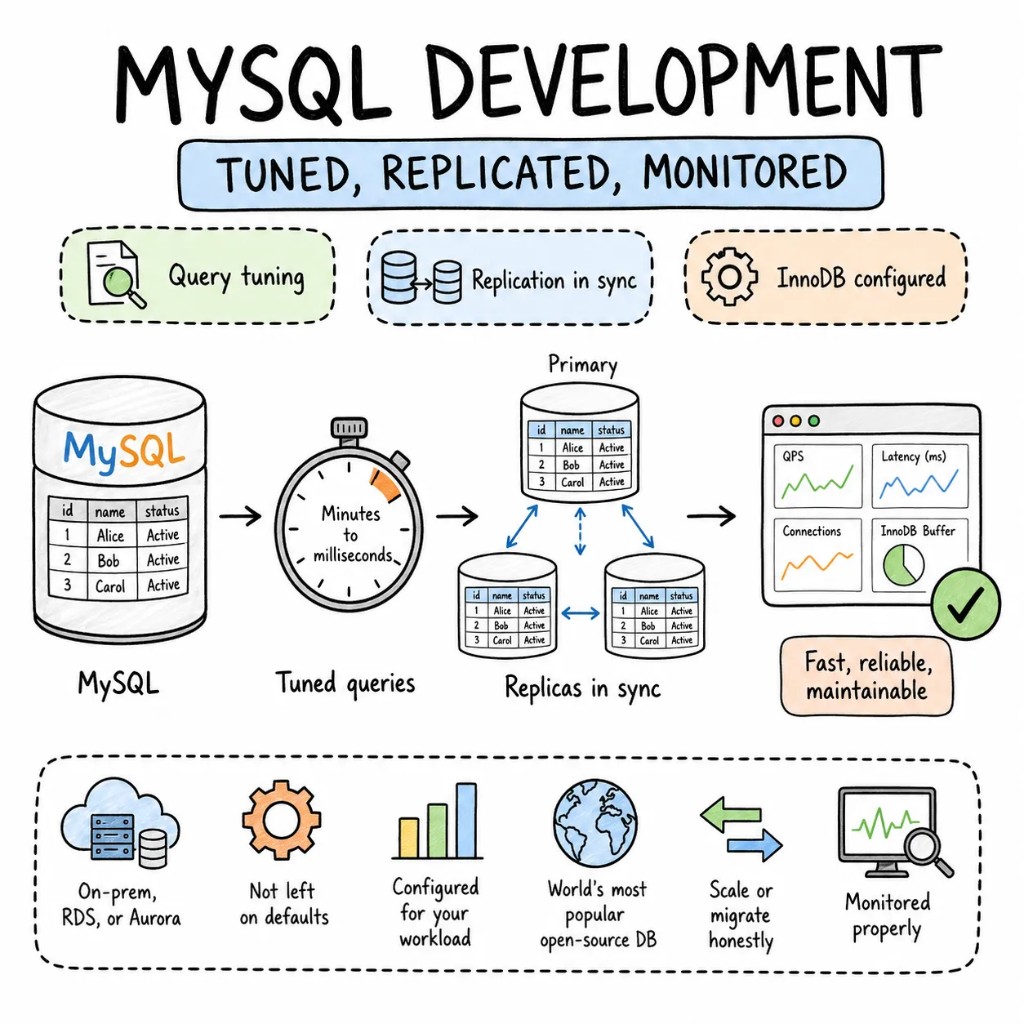
Our MySQL development services and consulting cover teams running the world's most popular open-source relational database — on-prem, on RDS, or on Aurora, powering everything from a PHP application to a full enterprise platform. Queries that take minutes tuned to milliseconds. Replication that actually keeps replicas in sync. InnoDB configured for your workload, not left on defaults. We make MySQL fast, reliable, and maintainable — whether you're scaling what you have or migrating to something better.
Why Entalogics for MySQL
Every MySQL database we audit has the same problems — `SELECT *` everywhere, no covering indexes, InnoDB buffer pool sized at defaults, replication lag nobody monitors, and the slow query log turned off because "it fills up the disk." MySQL powers 70% of web applications. Most of them run it badly.
Every query that hits production should have gone through EXPLAIN first. Slow query log enabled with a sane threshold. The difference between a fast MySQL database and a slow one is almost never the server — it's the queries running against it.
Buffer pool sized to 70-80% of available RAM. Log file size matched to write volume. Thread pool enabled for high concurrency. Defaults are fine for development. Production needs real tuning.
GTID-based replication for clean failover. Multi-threaded applier for replica throughput. Replica lag monitored and alerted, with read routing that never sends a query to a replica running 30 seconds behind.
Aurora for high-availability, storage autoscaling, and read replicas without managing replication yourself. RDS for simpler workloads where Aurora's premium isn't justified. Self-managed only when cloud genuinely isn't an option.
When MySQL, when not
MySQL powers more web applications than any other database. It's also owned by Oracle, and PostgreSQL has caught up on most features that used to be a real differentiator. We'll tell you honestly on the first call if MySQL is the right fit, or if migrating makes more sense.
STAY ON MYSQL WHEN
CONSIDER POSTGRESQL WHEN
WE SAY NO WHEN
What we build on MySQL
Eight ways this work shows up for real clients. Each one tuned and production-ready.
EXPLAIN analysis, covering indexes, slow query log review, query rewriting. Queries that took minutes reduced to milliseconds, with a measured before and after on every change.
GTID replication, semi-synchronous for data safety, multi-threaded applier for throughput, ProxySQL for read/write routing. Replicas that actually stay in sync.
Self-managed or RDS MySQL to Aurora. Performance baselined, compatibility tested, read replicas configured. Zero-downtime cutover via DMS or binlog replication.
Server configuration, user privileges, access controls, resource limits, patching, and routine health checks — the ongoing DBA work most teams don't have in-house.
Proper normalization, correctly sized data types, enforced foreign keys, partitioning for large tables. Schemas that perform at 100 million rows, not just 100 thousand.
MySQL 5.7 to 8.4, RDS upgrades, Aurora major version upgrades. Compatibility tested, deprecated features remediated, performance validated. The current database stays running.
Privilege audits, encryption at rest and in transit, SQL injection surface review, and access control tightened to least-privilege — the security work most performance-focused engagements skip entirely.
Ongoing monitoring, backup verification, replication health checks, and slow query reviews — so the tuned database we handed over doesn't quietly drift back into the mess we were hired to fix.
The playbook
Patterns from real production databases, not Stack Overflow answers.
P01
No query reaches production without EXPLAIN analysis. Full table scans caught in code review. Index recommendations based on actual execution plans, not guesses.
P02
The top 20 queries by execution time get covering indexes. Reads that used to hit disk now served entirely from the index, with measured improvement on each one.
P03
Buffer pool sized to the working set. Hit ratio monitored. Pages flushed at a rate matched to write volume — not defaults, not maximum, matched to your actual workload.
P04
GTID for clean failover. Replica lag monitored with alerts at 5 seconds and 30 seconds. Multi-threaded applier configured for write-heavy primaries.
P05
Slow query log enabled at a 100ms threshold. Reviewed weekly. Top offenders addressed as a practice, not a one-time setup.
P06
`gh-ost` or `pt-online-schema-change` for ALTER TABLE on large tables. No table locks in production. Schemas evolve without downtime or degraded performance.
Signature case
A B2B SaaS platform on MySQL 5.7 — 8-second page loads on the dashboard, `SELECT *` on every query, zero covering indexes, InnoDB buffer pool at default 128MB on a 32GB server, and replication lag averaging 45 seconds. Tuned queries, added covering indexes, sized the buffer pool, upgraded to MySQL 8.4, and configured multi-threaded replication in 6 weeks. Dashboard loads in 180ms. Replica lag under 1 second.
Before
MySQL 5.7 · 8s dashboard load · 0 covering indexes · 128MB buffer pool · 45s replica lag
After
MySQL 8.4 · 180ms dashboard load · 14 covering indexes · 24GB buffer pool · <1s replica lag
Industries we serve
We've delivered MySQL development services for SaaS platforms, eCommerce, content publishing, and enterprise applications — anywhere query performance and replication reliability directly affect the user experience.
Engagement shape
Database by database. The current environment stays live the entire time we work.
Two senior MySQL DBAs. Slow query analysis, index audit, InnoDB configuration review, replication health check. A ranked, dollarized plan.
Top 10 slow queries tuned, covering indexes created, buffer pool sized, slow query log configured. Measurable improvement visible in week two.
Database by database. Queries rewritten, replication stabilized, Aurora migrated with a real baseline comparison. Your applications keep running.
Slow query monitoring configured, replication stable. Runbook handed to your team — or we stay on for MySQL support and maintenance.
Stack
Our default MySQL development stack — picked for production databases.
Engagement
No hourly billing for thinking time. Fixed quote or a transparent monthly rate.
Fixed scope, fixed price, senior-only team. Audit to tuned production in 6-10 weeks.
FIXED SCOPE
Senior DBAs handling tuning, replication, upgrades, and migrations, embedded in your team. Pause, resize, or exit with 30 days' notice.
PER ENGINEER
A standing partner for database operations — performance tuning, Aurora migration, replication architecture, security review, hiring help.
PROCUREMENT-FRIENDLY
Founder-direct
Thirty minutes with the founder — a senior MySQL DBA, the relevant playbook, and a candid read on whether your database needs tuning, migration, or a different engine entirely.