
FIXED SCOPEone-off build
Ship a MongoDB deployment, end to end.
Fixed scope, fixed price, senior-only team. Schema design to production in 6-10 weeks.
FIXED SCOPE
- Zero juniors on client work
- Fixed quote in week 1
- Code, infra, runbook — yours
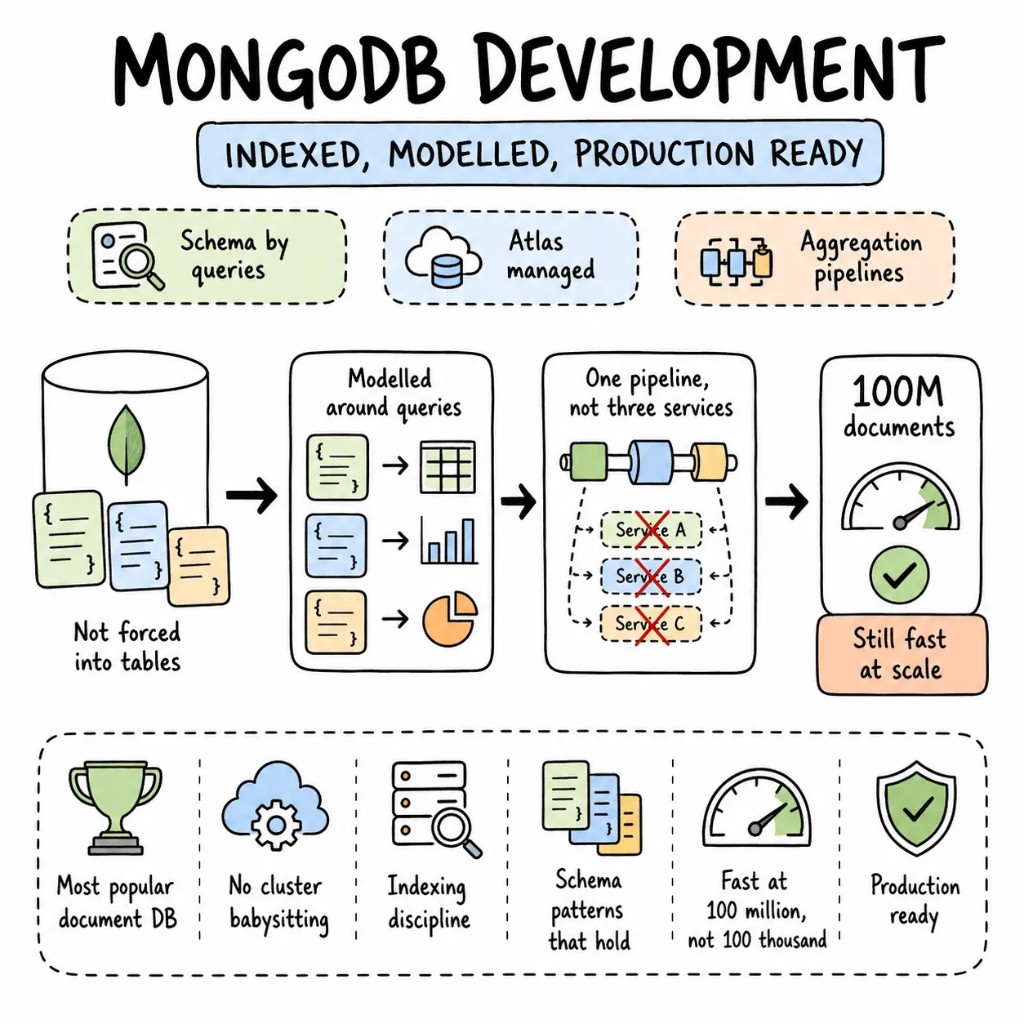
Our MongoDB development services and consulting cover teams building on the most popular document database, whether it's the data layer behind a MERN or MEAN stack app or a standalone service. Schema design modeled around your queries, not forced into tables. Atlas for managed infrastructure without cluster babysitting. Aggregation pipelines that replace what used to take three microservices. We build on MongoDB with the indexing discipline and schema patterns that keep it fast at 100 million documents, not just at 100 thousand.
Why Entalogics for MongoDB
Every MongoDB deployment we audit has the same problems — no indexes on fields used in every query, schemas that embed everything until documents hit the 16MB limit, replica sets nobody monitors for lag, and Atlas clusters sized at M30 when M10 handles the load. MongoDB is flexible. Most teams mistake that flexibility for "no rules."
Embed data that's read together. Reference data that's updated independently. Don't embed unbounded arrays that grow forever. The schema decided in month one determines query performance in month twelve, whether anyone planned for that or not.
Compound indexes matching your most common query patterns. Covered queries that return results from the index alone. Unused indexes dropped, since they slow writes without helping reads. `explain()` before production, always.
`$match` into `$lookup` into `$group` into `$project`, run in the database instead of stitched together across five queries in a Node.js service. Pipeline stages ordered so `$match` narrows the dataset before the expensive operations run.
Atlas handles replication, backups, scaling, and patching. Self-managed MongoDB requires dedicated ops expertise most teams don't have and don't budget for. We default to Atlas and only recommend self-managed when compliance or cost genuinely demands it.
When MongoDB, when not
MongoDB excels at flexible document storage, rapid iteration, and horizontal scaling. It also makes relational queries harder, lacks cross-shard transactions by default, and punishes bad schema design silently. We'll tell you honestly on the first call if MongoDB fits.
PICK MONGODB WHEN
CONSIDER POSTGRESQL WHEN
WE SAY NO WHEN
What we build on MongoDB
Eight ways this work shows up for real clients. Each one schema-designed and index-optimized.
Schema patterns, index strategy, aggregation pipelines. The document data layer your application needs — fast, flexible, and maintainable at scale.
Cluster sizing, auto-scaling configuration, backup policies, network peering. Atlas configured for your actual workload, not left on defaults.
Shard key selection, chunk distribution, and cluster sizing for write-heavy workloads that outgrow a single replica set. Architecture that scales horizontally without becoming unmanageable.
Atlas Search for full-text queries. Atlas Vector Search for AI embeddings. Combined search and filter queries without standing up a separate search engine.
Complex data transformations, reporting queries, and analytics built as pipelines, not application code. Stages ordered for performance from the first version.
`explain()` analysis, index review, slow query profiling, schema refactoring. Queries taking seconds reduced to milliseconds, measured every time.
SQL to MongoDB schema modeling. Mongoose to native driver. Self-managed to Atlas. Version upgrades. Data migrated with validation, not hope.
Ongoing index reviews, Atlas monitoring, and schema health checks — so the database we optimized doesn't quietly drift back into the collection-scan chaos we were hired to fix.
The playbook
Patterns from real production deployments, not tutorial examples.
P01
Access patterns documented. Embed-versus-reference decisions justified per relationship. Unbounded arrays avoided. Schema that performs at scale, not just at demo.
P02
Index fields in the order queries filter and sort. Covered queries where possible. `explain()` confirming index usage on every hot-path query. No COLLSCAN in production.
P03
Data transformation in the database, not in the service layer. Pipeline stages ordered to narrow data early. `$match` before `$lookup`, `$project` before `$group`. One round trip instead of five.
P04
Cluster tier auto-scales with traffic. Scale-down configured to avoid paying peak pricing 24/7. Alerts wired on IOPS, connections, and oplog lag.
P05
Change Streams replacing polling for real-time features. Resume tokens persisted for recovery. Event-driven architecture without a separate message broker.
P06
JSON Schema validation on every collection. Required fields, type enforcement, enum constraints. The flexibility of a document database with the safety of schema enforcement.
Signature case
A B2B SaaS platform on MongoDB — every listing page running full collection scans, no compound indexes, embedded arrays growing unbounded, and Atlas cluster at M40 because nobody profiled the actual workload. Remodelled schema, added compound indexes, capped embedded arrays, configured aggregation pipelines, and downsized to M20 in 7 weeks. Average query time dropped from 1.2s to 18ms. Atlas bill dropped 48%.
Before
COLLSCAN on listing pages · 0 compound indexes · unbounded arrays · M40 cluster · 1.2s avg query
After
Index-covered queries · 8 compound indexes · capped arrays · M20 cluster · 18ms avg query
Industries we serve
We've delivered MongoDB development services for SaaS platforms, eCommerce, content and media, and IoT products — anywhere document-shaped data and horizontal scale genuinely matter.
Engagement shape
Collection by collection. The current database stays live the entire time we work.
Two senior MongoDB engineers. `explain()` analysis, index audit, schema review, Atlas cluster assessment. A ranked, dollarized plan.
Top slow queries indexed, unbounded arrays capped, schema validation added. Measurable improvement visible in week two.
Aggregation pipelines built, schema remodeled where needed, Atlas right-sized. Your application keeps running throughout.
Profiler monitoring configured, Atlas alerts live. Runbook handed to your team — or we stay on for MongoDB support and maintenance.
Stack
Our default MongoDB development stack — picked for production.
Engagement
No hourly billing for thinking time. Fixed quote or a transparent monthly rate.
Fixed scope, fixed price, senior-only team. Schema design to production in 6-10 weeks.
FIXED SCOPE
Senior database engineers specializing in MongoDB, embedded in your team. Pause, resize, or exit with 30 days' notice.
PER ENGINEER
A standing partner for MongoDB-powered products — schema evolution, Atlas optimization, sharding strategy, search integration, hiring help.
PROCUREMENT-FRIENDLY
Founder-direct
Thirty minutes with the founder — a senior MongoDB engineer, the relevant playbook, and a candid read on whether MongoDB is the right database, or PostgreSQL or a different document store fits your data better.