Jenkins Development Services.Jenkins DevelopmentServices. PipelinesThat Ship, Not Break.Pipelines That Ship, Not Break.
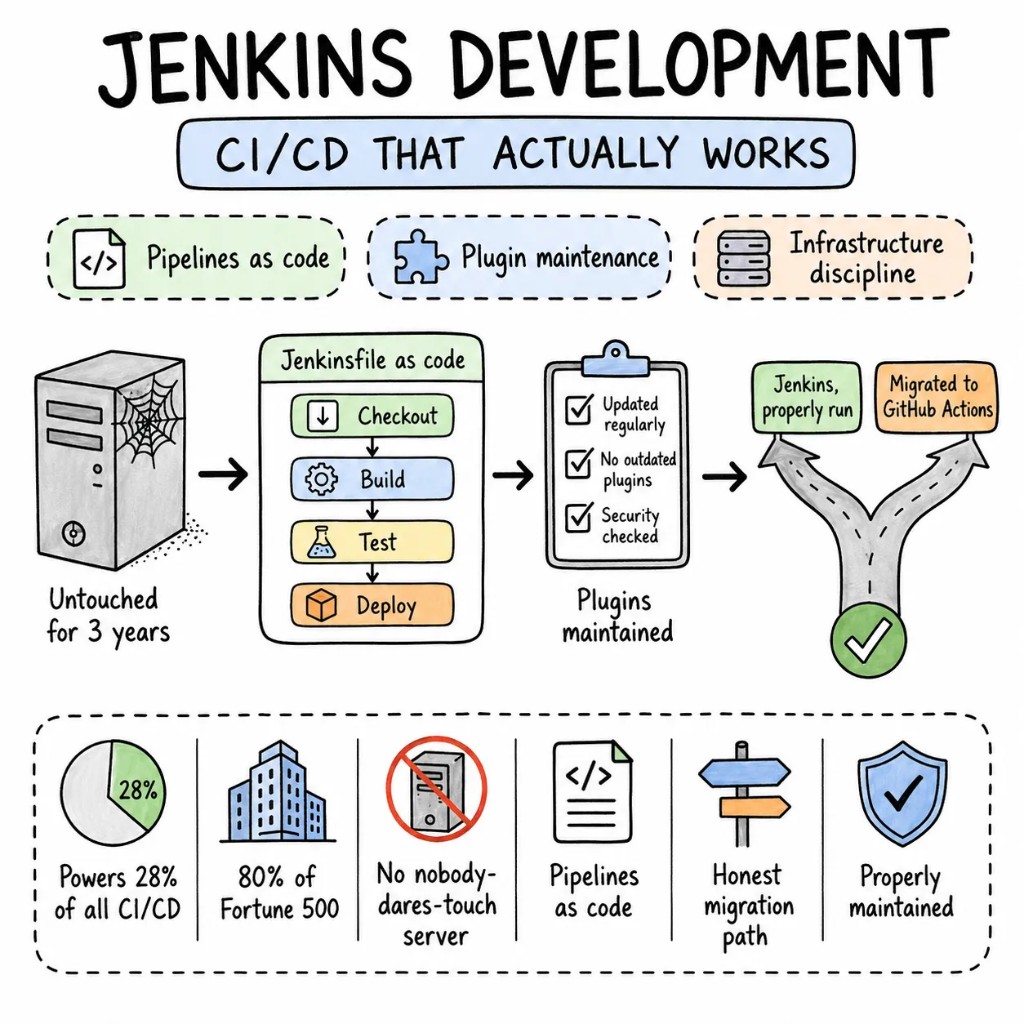
28% of all CI/CD still runs on Jenkins. 80% of the Fortune 500 still depends on it. The framework was never the problem — the click-configured server that one engineer built three years ago and nobody's touched since is. Our Jenkins development services turn that liability back into infrastructure your team can trust, reproduce, and hand off without fear.
Every Jenkins instance we inherit tells the same story — freestyle jobs configured through the UI, 60 plugins with a third of them outdated, build agents accumulating state nobody can explain, and no way to reproduce the server if it dies tomorrow. Jenkins is powerful. Most Jenkins development companies leave that power on the table.
Performance01
The build agents were snowflakes nobody dared reboot.
Kubernetes pod agents spin up clean per build and disappear when it's done. No leaked state between runs, no "works on the build server" mystery, no permanent VMs someone has to nurse. Builds parallelise on their own because the cluster handles capacity.
Architecture02
Fifty pipelines were configured by clicking, and none of them lived in git.
Declarative Jenkinsfiles in version control, reviewed like application code, reproducible on any Jenkins instance. Freestyle jobs don't survive an audit — and they shouldn't survive ours.
State03
Twenty plugins were installed to solve problems a shell script handles.
Every plugin is an attack surface and a maintenance burden. We audit the full list, remove what isn't earning its place, pin what stays to a tested version, and run upgrades through staging before they ever reach production.
Type safety04
The same deployment logic was copy-pasted into 200 Jenkinsfiles.
Groovy shared libraries with unit tests, versioned with semver, consumed by every pipeline at a pinned version. Common steps live in one place, tested in one place, and updated in one place.
When Jenkins, when not
Jenkins is a tool. Not always the right one in 2026.
Jenkins is the most flexible CI/CD server that exists. That flexibility costs operational overhead that not every team should pay. We'll say so on the first call if a managed alternative gets you there with less maintenance.
STAY ON JENKINS WHEN
Self-hosted CI/CD is a hard requirement — air-gapped networks, compliance mandates, data sovereignty rules
Your pipelines span multiple version control systems — GitHub, GitLab, Bitbucket, and SVN running simultaneously
The plugin ecosystem solves a problem no managed CI/CD tool covers
200 existing pipelines are cheaper to fix than to migrate somewhere else
CONSIDER ALTERNATIVES WHEN
You're on GitHub and want simpler CI — GitHub Actions is natively integrated with zero separate infrastructure
GitLab is your platform — GitLab CI is built in and needs no external server
Nobody on the team wants to own a Jenkins server, and there's no compliance reason forcing it
WE SAY NO WHEN
"Jenkins because we've always used it" — that's habit, not an architecture decision
"Set up Jenkins for our three-person startup" — GitHub Actions is free and you don't need the overhead
"Fix our Jenkins in a day" — if it took years to break, it takes weeks to fix properly
What we build with Jenkins
Jenkins development services and consulting we deliver.
Seven ways this work shows up for real clients. Each one leaves you with CI/CD that's reproducible, version-controlled, and maintained — not a fragile server held together by one engineer's memory.
S01
Jenkins pipeline-as-code migration
Jenkins pipeline-as-code migration
Freestyle jobs converted to declarative Jenkinsfiles, stored in git, reviewable like application code. Shared libraries for common steps. Every pipeline reproducible on any Jenkins instance.
JENKINSFILESHARED LIBRARIESGROOVYGIT
S02
Kubernetes-native Jenkins automation
Kubernetes-native Jenkins automation
Jenkins on Kubernetes with ephemeral pod agents that spin up per build and die after. No permanent build servers leaking state. Builds parallelise automatically because the cluster handles capacity.
JENKINS OPERATORKUBERNETESHELMPOD AGENTS
S03
Jenkins hardening and plugin audit
Jenkins hardening and plugin audit
Full plugin inventory, CVE scan, version pinning, removal of everything unused. RBAC configured properly. Credentials moved to a vault. The plugin list treated as a security surface, not a convenience store.
RBACHASHICORP VAULTPLUGIN AUDITCREDENTIALS
S04
Jenkins shared library development
Jenkins shared library development
Groovy libraries with unit tests, documentation, and semver releases. Deployment, notification, and approval steps centralised in one tested place — not copy-pasted across hundreds of Jenkinsfiles.
GROOVYPIPELINE UNITSHARED LIBSSEMVER
S05
Jenkins to GitHub Actions migration
Jenkins to GitHub Actions migration
When the honest answer is to leave Jenkins entirely. Pipeline by pipeline, with Jenkins running until every workflow has earned its migration. No flag-day, no broken builds.
GITHUB ACTIONSJENKINSMIGRATIONCI/CD
S06
Jenkins server setup and infrastructure as code
Jenkins server setup and infrastructure as code
JCasC for every server setting, Helm for Kubernetes deployment, Docker for controller and agent images. The entire Jenkins instance reproducible from git in minutes, not rebuilt from memory over days.
JCASCHELMDOCKERTERRAFORM
S07
Jenkins maintenance and support
Jenkins maintenance and support
Ongoing plugin patching, security advisories monitored, upgrade testing, and performance tuning — so the CI/CD system that launched clean doesn't quietly rot six months later.
PROMETHEUSGRAFANADATADOGJENKINS METRICS
The playbook
Jenkins CI/CD patterns we ship on repeat.
Patterns from real enterprise Jenkins deployments — not a "Hello World" pipeline tutorial.
P01
Declarative over scripted
Declarative pipelines by default. Scripted blocks only when declarative genuinely can't express the logic. Readability matters more than cleverness when someone else has to maintain it.
P02
Ephemeral Kubernetes agents
Pod templates defined per pipeline stage. Build, test, and deploy containers specified in the Jenkinsfile itself. No persistent agents accumulating state between builds.
P03
JCasC for server configuration
Every setting — security realm, credentials, tool locations, node configuration — defined in YAML and deployed from git. The server is reproducible from a file, not from someone's memory.
P04
Plugin version pinning
Every plugin pinned in a plugins.txt. Upgrades tested on a staging Jenkins before production. No automatic plugin update breaking builds on a Monday morning.
P05
Shared libraries with real tests
Jenkins Pipeline Unit testing every shared step. Library versioned with semver. Consumers pin to a version, not `@main`.
P06
Credentials in a vault, not in Jenkins
HashiCorp Vault or AWS Secrets Manager for all secrets. The Jenkins credentials plugin as a thin accessor. Nothing sensitive stored in Jenkins' own credential store.
Signature case
An enterprise CI/CD system, rebuilt from freestyle chaos to pipeline-as-code.
A financial services company with 180 Jenkins freestyle jobs — click-configured, no version control, 63 plugins (22 outdated, 4 with known CVEs), builds running on two snowflake VMs nobody dared reboot. Migrated to declarative pipelines, Kubernetes agents, JCasC, and a hardened plugin list in 8 weeks. Build times dropped 60%. Zero builds broken by plugin updates since.
Before
180 freestyle jobs · 63 plugins, 4 CVEs · snowflake VMs · no pipeline-as-code · builds break monthly
We've delivered Jenkins development services for finance, healthcare, SaaS, and enterprise IT — anywhere self-hosted CI/CD, compliance-grade audit trails, or air-gapped pipelines are real requirements.
Pipeline by pipeline. The current CI/CD keeps running the entire time we work.
W01
Audit + RFC
Plugin inventory, CVE scan, pipeline complexity audit, agent infrastructure review. A ranked, dollarized plan, not a list of vague concerns.
W02–03
Foundation + first pipelines
JCasC configured, Kubernetes agents wired, shared library scaffolded, first batch of freestyle jobs converted to declarative. Builds running on new infrastructure.
W04–08
Pipeline by pipeline
Each freestyle job converted to a Jenkinsfile. Shared steps extracted into the library. Old agents decommissioned as pipelines move to Kubernetes.
W09+
Handoff
All pipelines in version control, JCasC reproducible, plugin list hardened. Runbook handed over, or we stay on for Jenkins maintenance and support.
Stack
Tools we Tools we reach reach for for first.
Our default Jenkins development stack — picked for enterprise CI/CD.
Verified feedback from Upwork, Clutch, and reference calls we're happy to set up before you sign anything.
Evan Kanouse
CEO, Modestly
Entalogics has successfully delivered extension prototypes on time, and we are impressed with their project management and the finished product. The client communicates with Entalogics via virtual meetings, email, and messaging apps.
Adam Strock
Founder, Flourish Schools
Collaborating with Entalogics was a great experience. Communication was clear, we aligned quickly, and their team delivered high-quality code on time with thoughtful technical decisions.
Giles Whitman
CTO, SentryBay
Their Chromium expertise helped us ship a hardened browser with live threat controls and enterprise rollout support. Security operations became significantly faster.
George Irvin
Founder, G3 Ventures LLC
Entalogics delivered our custom Electron browser in six months with isolated profile workflows and stable policy sync. Agent onboarding improved by 55% after rollout.
Dani Keo
Project Manager, Sociall
Entalogics built our iOS Chromium-based mobile app with a smooth native feel, stable media rendering, and reliable sync. We shipped faster and improved engagement after launch.
Project Manager
RozmeriGPT
The web dashboard and Chrome extension now share prompts, billing, and analytics in one platform. Our content turnaround improved 4x after launch.
Ilya Khodakovsky
Project Manager, Omni Browser
Entalogics built our Omni Browser on top of Chromium with deep product-level execution. They implemented an integrated VPN and Omni Crypto Wallet directly in the browser, made strong architectural decisions, and delivered quality code on schedule with clear communication.
Sherzod Khabibullayev
Project Manager, Digital Office: Aura
Entalogics built Digital Office: Aura as a custom Chromium-based authentication platform. Their team modified Chromium internals and integrated our manual custom authentication flow with reliable implementation, fast delivery, and consistent communication.
Engagement
Three ways to hire Jenkins developers at Entalogics.
No hourly billing for thinking time. Fixed quote or a transparent monthly rate.
FIXED SCOPEone-off build
Fix your Jenkins, end to end.
Fixed scope, fixed price, senior-only team. From audit to production-ready CI/CD in 6-10 weeks.
Jenkins development — questions we get on every call.
Jenkins vs GitHub Actions, plugin security, freestyle migrations, cost — in roughly the order people ask.
Stay if self-hosted is mandatory, your pipelines span multiple VCS systems, or the plugin ecosystem solves a problem GitHub Actions genuinely can't. Migrate if you're GitHub-native, your workflows are straightforward, and nobody wants to own a server. We'll tell you which applies on the first call.
Audit every installed plugin against the Jenkins security advisory list. Remove anything unused. Pin every remaining version. Test upgrades on a staging instance before they ever reach production. No automatic updates — ever.
Yes. Job by job. The freestyle job keeps running until the declarative Jenkinsfile replacement is tested and live. No flag-day, no builds interrupted, no downtime.
Depends on the number of pipelines, the plugin situation, and whether it's a fix or a migration. The week-one audit gives real numbers — the quote is fixed from there, not a range that grows. Most engagements run 6-10 weeks.
Yes — and it should. Docker for consistent build environments, Kubernetes for ephemeral agents that scale automatically. We wire both through JCasC so the integration is reproducible, not manually configured.
Yes. The engineers who write the RFC ship the pipelines. No handoff mid-engagement, no account manager in between.
Senior engineers
Tell us whatyou're building.
Thirty minutes with a senior DevOps engineer, the relevant playbook, and a candid read on whether Jenkins is the right CI/CD tool, or GitHub Actions and GitLab CI serve your team better.