Ship an iOS app, end-to-end.
A defined product, a fixed price, a senior-only team. From RFC to App Store submission in 8–14 weeks.
$15k–$30k
FIXED SCOPE
- Senior engineers only
- Fixed quote in week 1
- Code, infra, runbook — yours
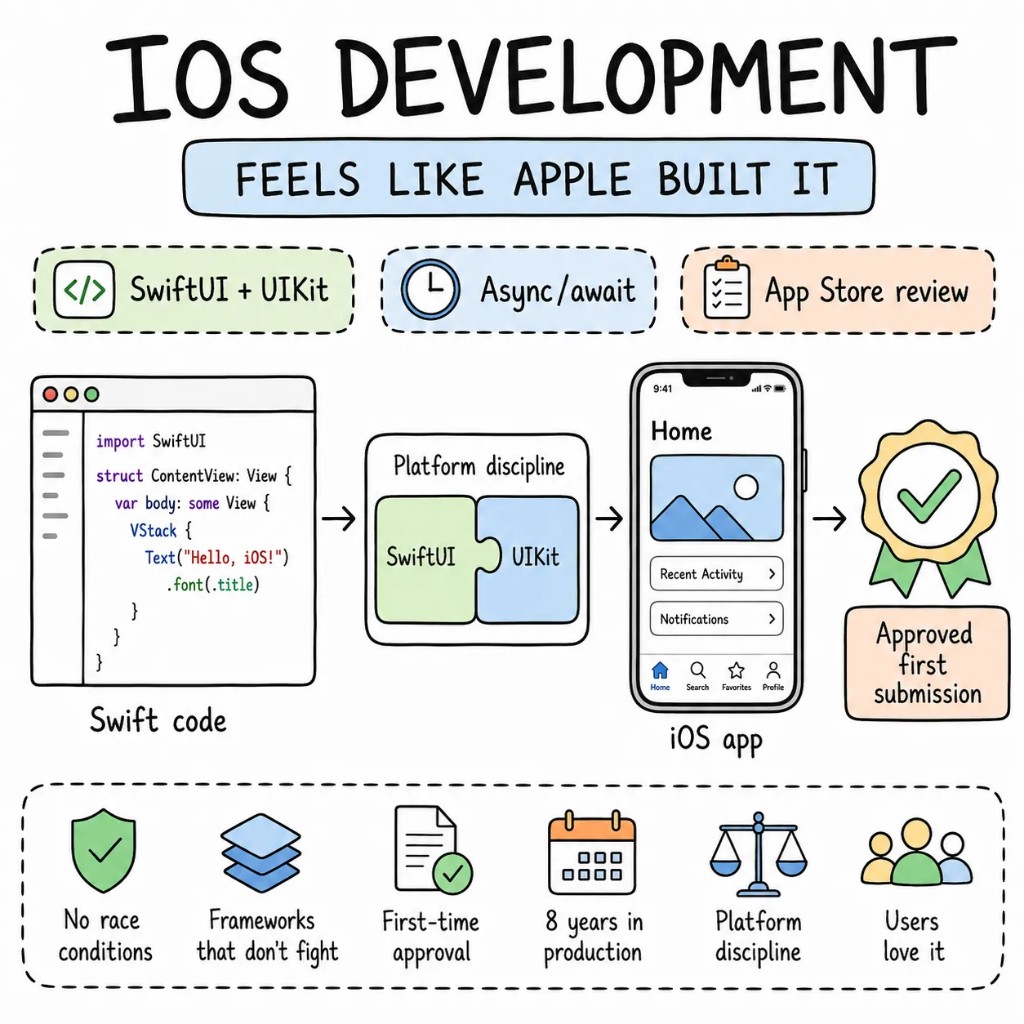
Eight years of iOS in production. SwiftUI that doesn't fight UIKit when it shouldn't, async/await concurrency that doesn't race, and architecture that passes App Store review on the first submission. The difference between an app that works and one users love is the platform discipline most teams skip.
Why Entalogics for iOS
Most iOS codebases we inherit have massive ViewControllers nobody will touch, a networking layer with six different patterns, Core Data migrations that crash on update, and zero UI tests. We bring the architecture that keeps an iOS app shippable past version 3.0.
We profile with Instruments from day one — Time Profiler, Allocations, Core Animation. Image decoding off the main thread. Heavy computation on background actors. A janky scroll isn't a bug — it's a one-star review.
ViewModels own the logic. Views own the layout. Navigation is coordinator-driven and testable. Each feature is a Swift Package with explicit dependencies — not an Xcode project where everything imports everything.
SwiftData for structured persistence that needs migration support. Keychain for credentials. UserDefaults for simple preferences. Core Data only when the existing codebase already depends on it. Each tool chosen for the job — not carried over from the last project.
Enums with associated values for state machines. Result types for expected failures. Codable with custom keys at every API boundary. When the backend changes a field, the compiler catches it — not the QA team three days later.
When native, when not
Native Swift gives you the deepest access to Apple's platform. It also costs the most. We'll tell you on the first call if native is genuinely justified — or if cross-platform gets you there at half the cost.
GO NATIVE WHEN
CONSIDER CROSS-PLATFORM WHEN
WE SAY NO WHEN
What we build for iOS
The shapes of native iOS work we ship most. Each built to Apple's standards — not just functional, but reviewable.
Onboarding, subscriptions via StoreKit 2, push notifications, App Clips, Widgets. The full consumer stack — polished for App Store featuring.
HealthKit integration, workout tracking, background delivery, Apple Watch companion. Data handling that respects Apple's privacy requirements from day one.
ARKit experiences, RealityKit rendering, and visionOS-ready spatial UI. SwiftUI skills that transfer directly to Vision Pro development.
MDM compatibility, SSO via ASWebAuthenticationSession, certificate pinning, offline-first sync. Enterprise distribution without App Store dependency.
Replace the spreadsheet your field team emails around. Barcode scanning, offline data capture, GPS logging — built for iPad and iPhone.
UIHostingController for incremental adoption. Screen by screen, no flag-day. The current app stays on the App Store while we modernise underneath.
The playbook
iOS patterns proven in production apps with real App Store reviews — not WWDC sample code.
P01
New screens in SwiftUI by default. UIKit only for components SwiftUI doesn't handle well yet — complex text editing, custom collection view layouts. No mixed-for-no-reason codebases.
P02
async/await for networking. Actors for shared mutable state. Task groups for parallel work. No more completion handler pyramids or GCD queue juggling.
P03
Each feature is a Swift Package with explicit imports. Build times drop. Test targets isolate. Two engineers build two features without touching the same Xcode project file.
P04
Colour, spacing, typography as typed extensions on SwiftUI primitives. Light/dark, Dynamic Type, and accessibility contrast from a single token source.
P05
Snapshot tests for visual regression. XCUITest for critical user flows. CI runs on every PR against real simulators. Catches the regression a unit test can't see.
P06
UIHostingController wraps new SwiftUI views inside existing UIKit navigation. One screen at a time. The app ships continuously — no rewrite required.
Signature case
A B2C health tracking app on UIKit — 6,000-line ViewControllers, no test coverage, a networking layer with three different patterns, and a Watch app that hadn't compiled in four months. Migrated to SwiftUI with MVVM, async/await networking, and a working watchOS companion in 12 weeks. App Store rating went from 3.4 to 4.8.
Before
UIKit · avg ViewController 6,000 lines · 0% test coverage · Watch app broken · rating 3.4★
After
SwiftUI · avg View + ViewModel 280 lines · 82% coverage · Watch companion live · rating 4.8★
Engagement shape
A typical iOS engagement, end-to-end. We build or migrate screen by screen — never a six-month rewrite. The current app stays on the App Store while we work.
Two senior iOS engineers on the project. Instruments profiling, architecture review, test coverage audit. A ranked, dollarized RFC.
SwiftUI baseline, Swift Package modularisation, MVVM established, one production screen built end-to-end. Real performance numbers on a physical device.
Feature by feature under feature flags. TestFlight releases weekly. Your roadmap keeps moving.
Store assets, review guidelines compliance, first submission. Runbook handed to your team — or we stay on retainer.
Stack
Picked for production iOS — not tutorial starters.
Engagement
No hourly retainer that bills for "thinking time." Pick a lane that matches your stage; everything is fixed-quote or transparently rated.
A defined product, a fixed price, a senior-only team. From RFC to App Store submission in 8–14 weeks.
$15k–$30k
FIXED SCOPE
Embedded engineers in your Slack, your Linear, your standups. A scaled pod of senior Swift engineers. Pause, resize, end with 30 days' notice.
$5k / eng / mo
PER ENGINEER
A long-term partner for product orgs shipping across Apple's ecosystem — iPhone, iPad, Watch, Vision Pro. Architecture, performance, hiring help.
custom
PROCUREMENT-FRIENDLY
Founder-direct
Thirty minutes with the founder. We'll bring a senior iOS engineer, the relevant playbook, and a candid read on whether native Swift is the right call — or whether cross-platform gets you there faster.