Your web skills,shipped to the app store.Powered by Ionic.

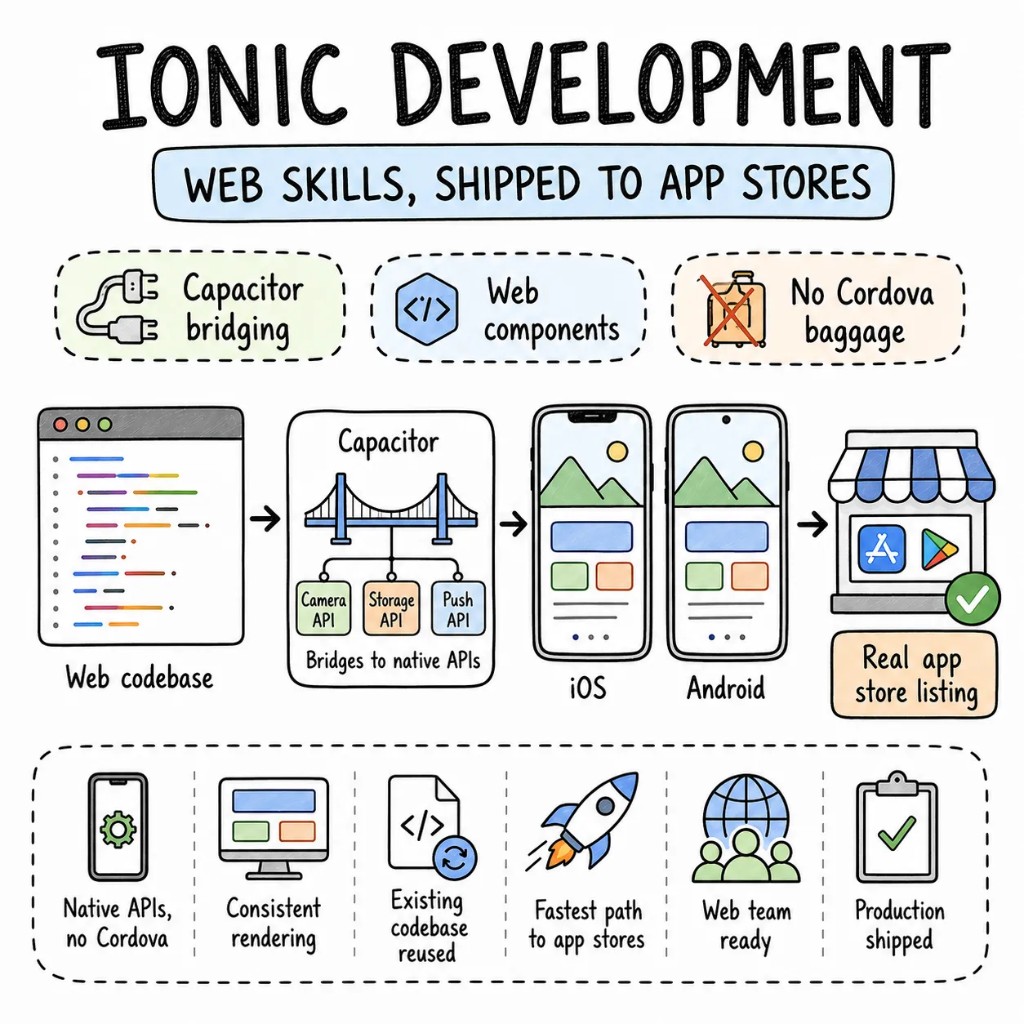
We don't follow tutorials — we ship Ionic in production. Capacitor bridging native APIs without Cordova's baggage, web components that render consistently across both platforms. Your web team's fastest path from existing codebase to a real app store listing.

  • Capacitor 6
  • Ionic 8
  • Web-to-native
  • PWA-ready

Why Entalogics for Ionic

Four things every
Ionic app
actually needs.

The hybrid apps we inherit usually have the same story — Cordova plugins that break on every OS update, WebView performance nobody profiled, a UI that looks like a website pretending to be an app, and no native-feel navigation. We fix the foundation before it costs you app store ratings.

Performance01

WebView performance is real — when you optimise for it.

Lazy-loaded routes, virtual scrolling, hardware-accelerated transitions, and Capacitor's native bridge instead of Cordova's legacy one. The 47% latency reduction is measured, not theoretical.

Architecture02

Capacitor-first. Cordova only for legacy plugins.

Capacitor exposes real native projects — Xcode, Android Studio, full SDK access. Custom native code when needed, web code for everything else.

State03

Your web framework's state layer. Not a mobile-specific one.

Angular signals, React hooks, Vue composables — your existing patterns work inside Ionic. No mobile-specific state library unless the problem demands one.

Type safety04

TypeScript strict, from API to Ionic component.

Typed Capacitor plugin calls. Typed route params. Typed API contracts. Backend changes fail the build — not the WebView at runtime.

When Ionic, when not

Ionic is a tool.
Not a compromise.

Ionic is the fastest path from web team to app store. It's also WebView-based — and pretending otherwise causes the problems. We'll tell you on the first call if hybrid is the right call.

PICK IONIC WHEN

  • Your team writes Angular, React, or Vue and wants both app stores without learning Swift or Kotlin
  • The app is data-driven — forms, lists, dashboards — where WebView performance matches native
  • You want one codebase that also ships as a Progressive Web App
  • Budget doesn't justify two native teams and the product doesn't need deep hardware access

CONSIDER NATIVE WHEN

  • Animation-heavy, gesture-heavy UI where WebView frame drops are noticeable
  • Deep hardware access — Bluetooth LE, ARKit, real-time camera processing
  • Every millisecond of startup matters and the app store bar is extremely high

WE SAY NO WHEN

  • "Wrap our responsive website in Capacitor and submit it." That's not an app.
  • "Ionic for a real-time multiplayer game." Wrong tool entirely.
  • "Both stores in two weeks." That ship has sailed.

What we build with Ionic

Six product surfaces.
One quality bar.

The shapes of Ionic app development we deliver most. Each built for real app store submission.

  • S01

    Enterprise internal apps

    Multi-role dashboards, form-heavy workflows, document capture, offline sync. Ionic's component library handles complex enterprise UI faster than native.

    IONIC 8CAPACITORANGULARSQLITE
  • S02

    SaaS companion apps

    Your web dashboard, installable on your user's phone. Push, biometrics, offline — same code your web team already writes.

    IONICCAPACITORREACTONESIGNAL
  • S03

    Customer-facing utility apps

    Appointment booking, account management, service requests, loyalty programs. Simple interaction, business logic on the server.

    IONICCAPACITORVUESTRIPE
  • S04

    Progressive Web Apps

    Same Ionic codebase deployed as a PWA — installable, offline-capable, push-enabled. One build, three surfaces.

    IONICPWASERVICE WORKERCAPACITOR
  • S05

    Field data collection apps

    Camera capture, GPS tagging, barcode scanning, offline submission with background sync.

    IONICCAPACITORSQLITEBACKGROUND SYNC
  • S06

    Cordova to Capacitor migrations

    Plugin-by-plugin migration. Legacy adapters for unmigrated plugins. Zero user-facing downtime.

    CAPACITOR 6CORDOVA ADAPTERIONIC 8CI/CD

The playbook

Patterns we
ship on repeat.

Ionic patterns from production hybrid apps — not Stackblitz demos.

  • P01

    Capacitor-first native access

    Every native API call through Capacitor. Cordova adapters only for unmigrated plugins. Bridge maintenance drops to zero.

  • P02

    Lazy-loaded feature modules

    Each route lazy-loaded. Initial bundle stays lean. Fast startup on mid-range devices where WebView time matters most.

  • P03

    Platform-adaptive UI

    Ionic's `mode` prop plus platform CSS. iOS users get iOS patterns, Android gets Material. One codebase, two native-feeling experiences.

  • P04

    Offline-first with SQLite

    Capacitor SQLite for structured local data. Background sync when connectivity returns. Works in the warehouse and the subway.

  • P05

    Web + mobile from one build

    Same codebase to app stores via Capacitor and to web as PWA. Feature flags for platform-specific behaviour. One CI pipeline, three channels.

  • P06

    Automated app store builds

    Appflow or GitHub Actions with Capacitor CLI. Build, sign, submit from CI. No manual Xcode steps.

Signature case

An enterprise field app,
migrated from Cordova to Capacitor.

An inspection app on Ionic 5 Cordova — 14hrs/sprint maintaining plugins, three outages in one quarter, 420ms p99 on native calls. Migrated to Ionic 8 Capacitor 6 in 8 weeks. Latency dropped 47%. Bridge maintenance dropped to zero.

Before

Ionic 5 Cordova · p99 420ms · 14hrs/sprint maintenance · 3 outages in Q1

After

Ionic 8 Capacitor 6 · p99 220ms · 0hrs maintenance · 0 outages in Q2

  • Plugin latency−47%
  • Bridge maintenance−100%
  • To fully migrated8wk
  • Plugin outages0

Engagement shape

Eight to ten weeks
to a measurable ship.

A typical Ionic development engagement. We build or migrate screen by screen — never flag-day. The current app stays live while we work.

  • W01

    Audit + RFC

    Two senior Ionic developers on the project. Cordova plugin inventory, WebView profiling, Capacitor compatibility check. A ranked, dollarized RFC.

  • W02–03

    Foundation + first screen

    Ionic 8 + Capacitor 6 baseline, lazy-loaded routing, one production screen end-to-end. Real numbers on a mid-range device.

  • W04–08

    Build screen by screen

    Feature by feature under feature flags. TestFlight and internal track weekly. Your roadmap keeps moving.

  • W09+

    App store submission + handoff

    Store assets, compliance, first submission. Runbook handed to your team — or we stay on retainer.

Stack

Tools we
reach for first.

Our default Ionic development stack — picked for production hybrid apps.

  • FrameworkIonic 8 · Capacitor 6 · Angular · React · Vue
  • LanguageTypeScript (strict) · Zod · ESLint
  • DataCapacitor SQLite · TanStack Query · Ionic Storage
  • NativeCapacitor Camera · Geolocation · Push Notifications
  • TestingCypress · Playwright · Jest · Capacitor Test Utils
  • InfraAppflow · GitHub Actions · Firebase · Sentry · Datadog

Engagement

Three ways
to work with us.

No hourly retainer that bills for "thinking time." Pick a lane that matches your stage; everything is fixed-quote or transparently rated.

FIXED SCOPEone-off build

Ship an Ionic app, end-to-end.

A defined product, a fixed price, a senior-only team. From RFC to app store submission in 8–14 weeks.

$15k–$30k

FIXED SCOPE

  • Senior engineers only
  • Fixed quote in week 1
  • Code, infra, runbook — yours
Plan a fixed build
DEDICATED TEAMmonthly

Hire dedicated Ionic developers.

Embedded engineers in your Slack, your Linear, your standups. Senior hybrid app engineers on Capacitor. Pause, resize, end with 30 days' notice.

$5k / eng / mo

PER ENGINEER

  • Same senior bar as fixed-scope
  • Embedded in your team
  • Founder-direct escalation
Hire dedicated Ionic devs
ENGAGEMENTcustom

Strategic Ionic partnership.

A long-term partner for teams shipping hybrid apps across web and mobile — Capacitor migration, PWA strategy, hiring help.

custom

PROCUREMENT-FRIENDLY

  • Multi-quarter roadmap
  • Architecture & hiring partner
  • Procurement-friendly paper
Speak to the founder
FAQ

Sharp questions,
straight answers.

Ionic vs React Native, Cordova migration, app store quality — the questions we get on every Ionic discovery call.
Ionic if your team writes Angular, React, or Vue and the app is data-driven. React Native if you need native-rendered components or heavier animations. For most enterprise and utility apps, Ionic with Capacitor delivers the same result at lower cost.
Yes. Cordova adds measurable latency and costs real engineering hours every sprint. Capacitor is its official successor. We migrate plugin by plugin with adapters for anything not yet ported.
Yes — when built properly. Platform-adaptive styling, native navigation patterns, Capacitor for native APIs, and profiling on real devices. Apps that feel like "a website in a wrapper" were built without these.
Yes. The engineers who write the RFC ship the code. No handoff mid-engagement. Direct access throughout.
Yes. We adapt to your framework, plugin stack, and CI pipeline. If Cordova needs migrating, we flag it in the RFC. If it's stable, we build on top of it.

Founder-direct

Tell us whatyou're building.

Thirty minutes with the founder. We'll bring a senior Ionic developer, the relevant playbook, and a candid read on whether hybrid app development is the right call — or whether native serves your product better.