
Ship an HTML5 product, end-to-end.
A defined product, a fixed price, a senior-only team. From RFC to launch in 8–14 weeks.
$15k–$30k
FIXED SCOPE
- Senior engineers only
- Fixed quote in week 1
- Code, infra, runbook — yours
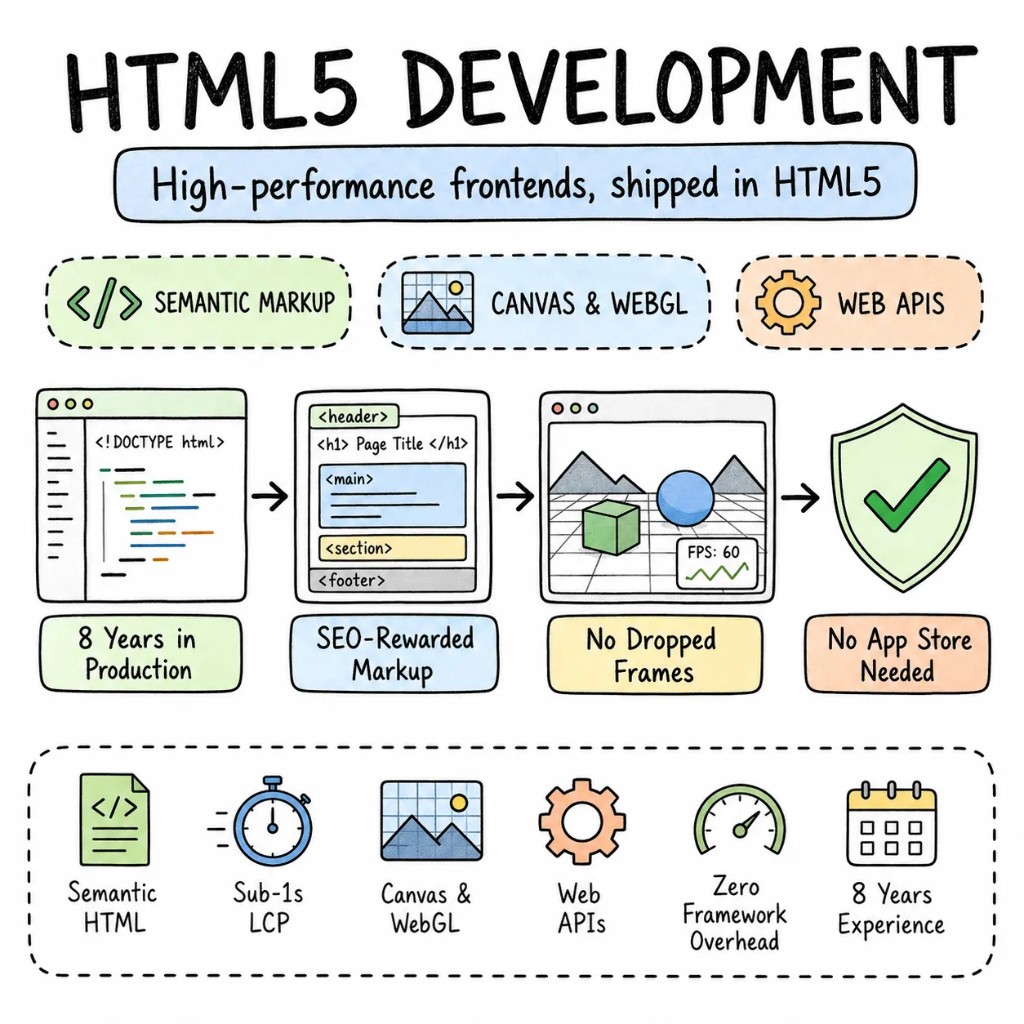
We don't treat HTML5 as a fallback. Eight years of it in production — semantic markup that search engines actually reward, Canvas and WebGL that don't drop frames, Web APIs that replace native app features without the app store. The platform is more powerful than most teams use it. We use all of it.
Why Entalogics for HTML5
Most teams treat HTML5 as the layer underneath their framework — something the bundler outputs and nobody reads. That's where performance, accessibility, and SEO get quietly destroyed. We treat the platform as the product.
Preloaded fonts, inlined critical CSS, deferred non-essential scripts, properly sized images with native lazy loading. No framework runtime between the browser and your content. HTML5 delivered correctly is the fastest frontend stack available — most teams just never deliver it correctly.
Custom Elements, Shadow DOM, and the HTML Template element give you encapsulated, reusable components with zero runtime dependency. We build component systems that work in any framework, survive any future migration, and add exactly zero kilobytes of third-party JavaScript to your bundle.
History API for routing. Local Storage and IndexedDB for persistence. BroadcastChannel for cross-tab coordination. The browser ships a capable state layer that most teams replace with a 40kB library because they never learned what the platform provides. We know what the platform provides.
TypeScript's DOM typings are thorough — when you use them. Typed Custom Events, typed Web Component props, typed fetch responses validated at the boundary with Zod. Refactors that touch the DOM layer land cleanly because the compiler does the boring half of the review.
When HTML5, when not
An honest decision matrix. We'll tell you on the first call whether vanilla HTML5 is the right call for your problem — or whether a framework buys you something worth the cost.
PICK HTML5 WHEN
CONSIDER OTHERS WHEN
WE SAY NO WHEN
What we build with HTML5
The shapes of HTML5 work we ship most often. Each slots cleanly into your existing stack if you already have one.
High-traffic landing pages, content sites, documentation. Semantic HTML5, structured data, edge-delivered, Lighthouse 100 by construction. The fastest path from content to indexed, ranking page.
Custom Elements built to the platform standard — framework-agnostic, Shadow DOM encapsulated, ARIA-compliant. Components that work in React today and in whatever comes next.
Data visualisations, interactive graphics, game-adjacent UIs. Native Canvas 2D for charts and editors, WebGL for 3D and GPU-accelerated rendering. No wrapper library between your logic and the GPU.
Service Workers, Web App Manifest, Background Sync, Push Notifications. A PWA that passes the installability criteria, works offline on the critical path, and loads in under two seconds on a 3G connection.
Replace the spreadsheet. Replace the five spreadsheets. Lightweight, zero-dependency internal tools that don't need a framework and don't accumulate one over time.
Third-party embeds, checkout widgets, comment systems, live chat. Shadow DOM isolation means your widget doesn't leak styles into the host page — and the host page doesn't break your widget.
The playbook
The HTML5 patterns that show up on almost every engagement. Not invention — convention, applied carefully.
P01
The right element for the right job. article, nav, main, dialog — not div all the way down. Semantic HTML is free SEO, free accessibility, and free document structure. Most teams throw it away without noticing.
P02
Zod at every data boundary — API responses, form inputs, URL parameters, postMessage payloads. TypeScript's DOM typings used in strict mode. No any near the DOM.
P03
Service Worker caching strategy matched to data volatility. Static assets at the edge. API responses stale-while-revalidate where staleness is acceptable. The network is optional on the critical path.
P04
CSS custom properties as the token layer — not screenshots, not hardcoded hex values. Light/dark, density, and brand variants fall out of a single token file. The design system and the running application share the same source of truth.
P05
Playwright against real browser APIs — not a simulated DOM. Web Component interaction tests. Accessibility assertions in CI. Catches the regressions humans miss; runs in under five minutes.
P06
Core functionality works without JavaScript. Interactivity layered on top. Users on slow connections, screen readers, and corporate proxy environments get a working product — not a blank screen.
Signature case
A high-traffic B2C marketing platform on a legacy SPA — 5.8s LCP, a 1.6 MB JavaScript bundle for a site that was primarily content, and an SEO profile that hadn't recovered from a framework migration three years earlier. We rebuilt on semantic HTML5 with Vite, progressive enhancement, and edge delivery in 9 weeks. Without a content freeze.
Before
p75 LCP 5.8s · bundle 1.6 MB · Lighthouse SEO 61 · Core Web Vitals failing · 0 structured data
After
p75 LCP 0.78s · bundle 48 kB · Lighthouse SEO 100 · Core Web Vitals passing · full Schema.org coverage
Engagement shape
A typical HTML5 engagement, end-to-end. We migrate route by route — never flag-day. The current product keeps shipping while we work.
Two senior engineers across the codebase. Bundle analysis, render-blocking inventory, semantic markup audit, Core Web Vitals baseline, structured data gaps. You leave week one with a ranked, dollarized RFC — not a list of Lighthouse complaints.
Semantic HTML baseline, critical CSS inlined, font loading strategy, one production route migrated end-to-end. Real Core Web Vitals in your Search Console — not a local Lighthouse run on a fast machine.
Route by route. Old and new coexist behind a reverse proxy. Your content team keeps publishing — we don't ask for a freeze to rebuild your frontend.
Delete the old. Component library documented. Storybook for Web Components. Playwright integration tests. Runbook handed to your team — or we stay on retainer.
Stack
Picked by problem, not by resume. Happy to slot into your stack — but greenfield, this is the default.
Engagement
No hourly retainer that bills for "thinking time." Pick a lane that matches your stage; everything is fixed-quote or transparently rated.
A defined product, a fixed price, a senior-only team. From RFC to launch in 8–14 weeks.
$15k–$30k
FIXED SCOPE
Embedded engineers in your Slack, your Linear, your standups. A scaled pod of senior HTML5 engineers, augmenting your team. Pause, resize, end with 30 days' notice.
$5k / eng / mo
PER ENGINEER
A long-term partner for product orgs that need both delivery and judgement — design system, performance program, hiring help.
custom
PROCUREMENT-FRIENDLY
Founder-direct
Thirty minutes with the founder. We'll bring a senior HTML5 engineer, the relevant playbook, and a candid read on whether the platform is the right tool — or whether a framework earns its keep for your specific problem.