
FIXED SCOPEone-off build
Ship a DynamoDB deployment, end to end.
Fixed scope, fixed price, senior-only team. Data modeling to production in 6-10 weeks.
FIXED SCOPE
- Zero juniors on client work
- Fixed quote in week 1
- Code, infra, runbook — yours
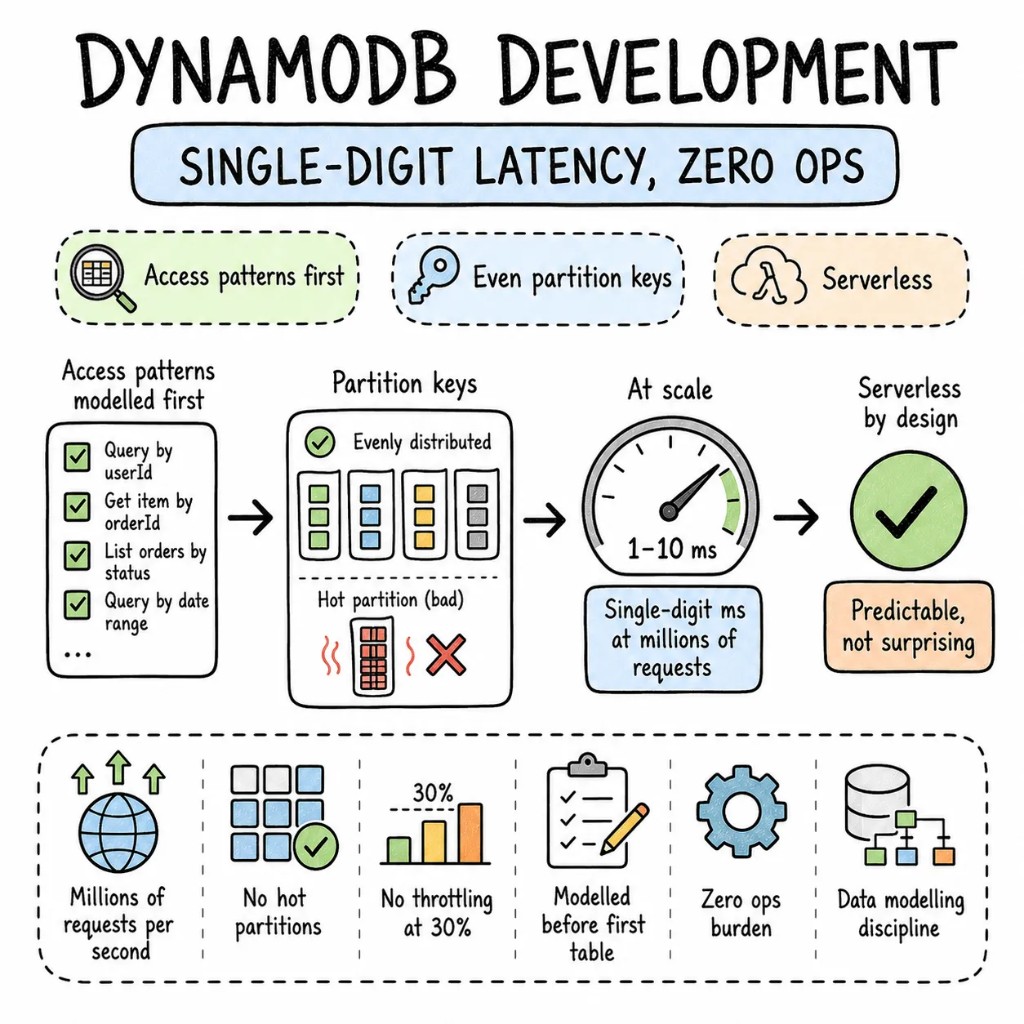
Our Amazon DynamoDB development services and consulting exist for applications where single-digit latency at millions of requests per second isn't optional. Access patterns modeled before the first table gets created. Partition keys that distribute evenly, not ones that create hot partitions and throttle at 30% of provisioned capacity. We build on DynamoDB with the data modeling discipline that turns a serverless database into a predictable one.
Why Entalogics for DynamoDB
Every DynamoDB table we audit has the same problems — a partition key chosen by field name instead of access pattern, five GSIs where two would do, scan operations sitting on hot paths because nobody modeled the query first. DynamoDB is simple to start. It's not simple to get right.
DynamoDB inverts the usual order — you design for your queries first, entities second. We document every access pattern before a table exists. Every key, every GSI, every sort key has to be justified by a real query the application actually makes.
A bad partition key creates hot partitions that throttle long before the table's real capacity is reached. We model for high cardinality and even distribution — composite keys, write sharding, hierarchical keys wherever a single attribute won't spread the load evenly enough.
On-demand for genuinely unpredictable traffic. Provisioned with reserved capacity for stable baselines, at a fraction of the per-request cost. We measure the actual traffic pattern and pick the mode that matches it, with GSIs sized using sparse projections instead of ALL.
Single-table design co-locates related data for fewer round trips — and it also raises complexity and can bloat GSIs when applied indiscriminately. We use it where entities are genuinely related and reach for separate tables where independent scaling actually matters more.
When DynamoDB, when not
DynamoDB delivers predictable millisecond latency at any scale with zero operational overhead — and it punishes a bad data model harder than any relational database ever will. We'll tell you honestly on the first call if DynamoDB fits.
PICK DYNAMODB WHEN
CONSIDER ALTERNATIVES WHEN
WE SAY NO WHEN
What we build on DynamoDB
Eight ways this work shows up for real clients. Each one modeled for access patterns from day one.
Lambda plus DynamoDB for event-driven APIs. Single-table design co-locating related entities. Sub-5ms reads on every hot path.
Millions of events per second with composite partition keys distributing writes evenly. TTL for automatic expiration, DynamoDB Streams for real-time processing.
Tenant-isolated data with tenant ID as the partition key prefix. Per-tenant query scoping without cross-partition reads. GSIs for admin-level views.
DynamoDB as a managed session store or cache layer. TTL for auto-expiry, DAX for microsecond read caching on the hottest items.
SQL data remodeled for DynamoDB access patterns. Entities denormalized, relationships handled through composite keys and GSIs. Migration validated against real performance numbers.
Existing tables with throttling or runaway costs. Partition key analysis, GSI consolidation, capacity mode right-sizing, reserved capacity applied wherever the workload is stable.
Hands-on training for engineering teams on access pattern modeling, single-table design, and the partition key discipline that keeps a table predictable long after we hand it off.
Ongoing capacity monitoring, GSI reviews, and cost audits — so the table we optimized doesn't quietly drift back into the throttling and runaway cost we were hired to fix.
The playbook
Patterns from real production tables, not workshop exercises.
P01
Every query listed. Every key justified. Every GSI mapped to a real access pattern. No table gets created on an assumption.
P02
Related entities share a partition key. Sort key distinguishes type and enables range queries. One Query call returns everything a screen needs.
P03
GSIs project only the attributes a query actually needs. Items missing those attributes don't appear in the index. Less storage, less write amplification, lower cost.
P04
Write to one table, stream changes to Lambda, write denormalized views to another table or GSI. Every hot-path query reads from a pre-computed structure.
P05
Enabled on every production table. Most-accessed partition keys visible in real time. Hot partitions caught before they throttle, not after.
P06
Provisioned mode with reserved capacity for predictable baselines. On-demand for spiky traffic. Mixed across tables based on actual usage, not a blanket policy.
Signature case
A B2C e-commerce platform on DynamoDB — scan operations on the product listing page, five GSIs with ALL projections, on-demand pricing at $4,800/mo, and throttling on the order table during flash sales. Remodelled to single-table design with sparse GSIs, switched hot tables to provisioned with reserved capacity, eliminated all scan operations in 7 weeks. Monthly cost dropped to $1,900. Zero throttling during the next flash sale.
Before
Scan on product listing · 5 GSIs with ALL projection · on-demand $4,800/mo · throttling during sales
After
Query-only, partition-aligned · 2 sparse GSIs · provisioned + reserved $1,900/mo · zero throttling
Industries we serve
We've delivered DynamoDB development services for eCommerce, gaming, IoT, and multi-tenant SaaS platforms — anywhere millisecond latency at unpredictable scale genuinely matters more than complex querying.
Engagement shape
Table by table. The current data stays live the entire time we work.
Two senior DynamoDB engineers. Access pattern analysis, partition key audit, GSI review, capacity mode assessment. A ranked, dollarized plan.
Access patterns modeled, keys designed, GSIs defined, first table deployed with SDK integration. Real throughput measured.
Each table modeled, migrated, and validated. Streams wired. Capacity mode optimized. Your application keeps running throughout.
Contributor Insights enabled, cost dashboard live. Runbook handed to your team — or we stay on for DynamoDB support and maintenance.
Stack
Our default DynamoDB development stack — picked for production.
Engagement
No hourly billing for thinking time. Fixed quote or a transparent monthly rate.
Fixed scope, fixed price, senior-only team. Data modeling to production in 6-10 weeks.
FIXED SCOPE
Senior data architects specializing in DynamoDB modeling, embedded in your team. Pause, resize, or exit with 30 days' notice.
PER ENGINEER
A standing partner for serverless data — cost optimization, single-table architecture, migration strategy, team training, hiring help.
PROCUREMENT-FRIENDLY
Founder-direct
Thirty minutes with the founder — a senior DynamoDB engineer, the relevant playbook, and a candid read on whether DynamoDB is the right database, or PostgreSQL, Aurora, or Cosmos DB fits your workload better.