Ship a DevOps pipeline, end-to-end.
A defined scope, a fixed price, a senior-only team. From audit to production delivery system in 8–12 weeks.
$15k–$30k
FIXED SCOPE
- Senior engineers only
- Fixed quote in week 1
- Code, infra, runbook — yours
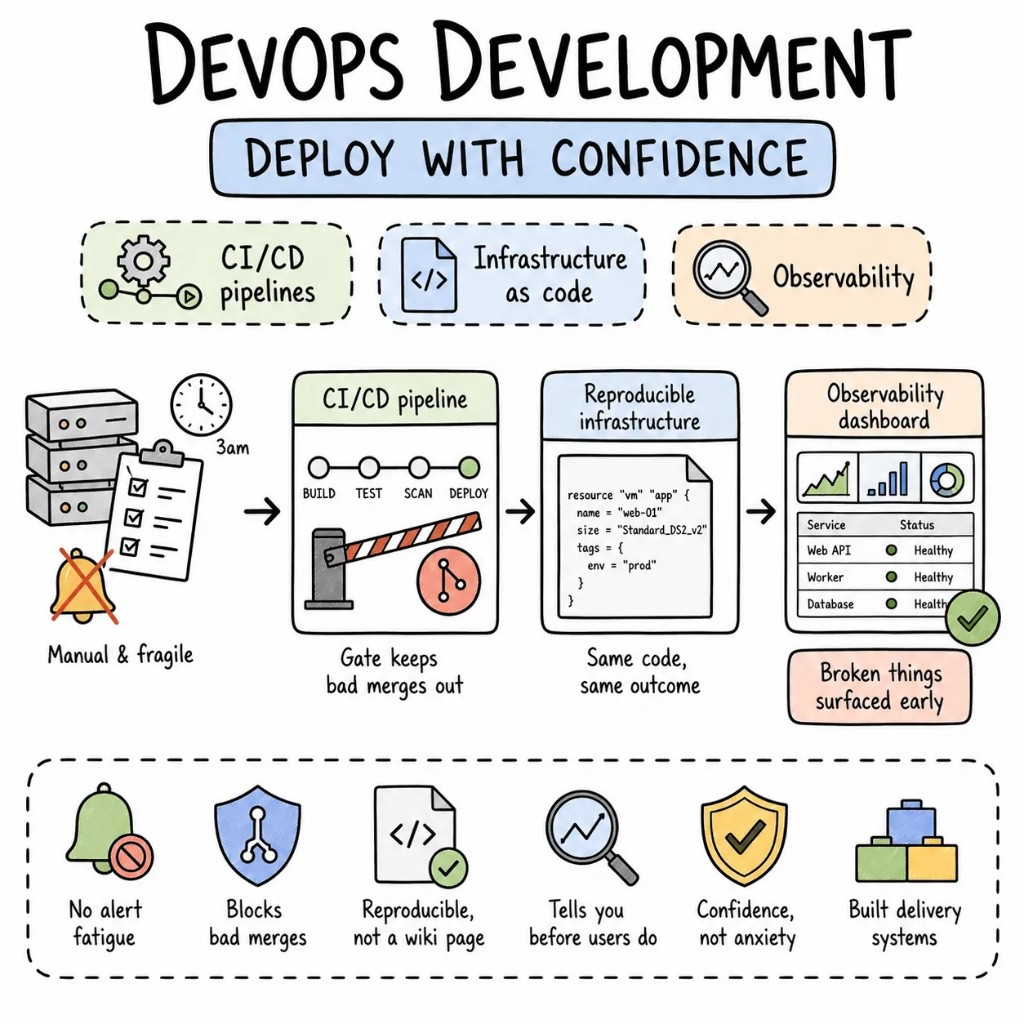
DevOps services for teams tired of manual deployments, fragile infrastructure, and alert fatigue at 3am. CI/CD pipelines that actually block bad merges. Infrastructure as code that's reproducible, not a wiki page nobody updates. Observability that tells you what's broken before your users do. We build the delivery systems that let your engineering team ship with confidence — not anxiety.
Why Entalogics for DevOps
The DevOps setups we inherit always have the same gaps — a CI pipeline nobody trusts, infrastructure configured by clicking in a console, monitoring that alerts on everything so the team ignores it all, and deployments that require a senior engineer and a prayer. DevOps isn't a title — it's a delivery system. Most teams don't have one.
Build, test, scan, deploy — triggered on every merge. Stage-gated with approval gates on production. Rollback automated. No manual deploy scripts. No "it worked on my machine."
Terraform or Pulumi for every resource. State locked and versioned. Drift detection enabled. The infrastructure is reproducible from git — not from one engineer's memory.
Metrics, logs, and traces connected. SLOs defined for critical paths. Alerts fire on symptoms — not on every CPU spike. The on-call engineer knows what's broken and where, not just that something is red.
Dependency scanning in CI. Container image scanning. Secrets in a vault, not in environment variables. Policy-as-code enforcing guardrails automatically. Security baked into the pipeline — not a quarterly review.
When DevOps, when not
Hiring a "DevOps engineer" doesn't give you DevOps. Buying a CI/CD tool doesn't give you DevOps. We'll tell you on the first call what your delivery system actually needs — and what it doesn't.
INVEST IN DEVOPS WHEN
START WITH PLATFORM ENGINEERING WHEN
WE SAY NO WHEN
What we build with DevOps
The shapes of DevOps development services we deliver most. Each leaves you with a delivery system your team actually uses — not a tool nobody maintains.
GitHub Actions, GitLab CI, or Jenkins — designed for your stack. Build, test, scan, deploy, verify. Stage-gated with approval gates and automated rollback.
Terraform or Pulumi for every cloud resource. Modules, state management, drift detection, PR-based review. The infrastructure is code — reviewable, versioned, reproducible.
EKS, AKS, or GKE configured for your workload. Helm charts, ArgoCD for GitOps, Karpenter or cluster autoscaler for cost-efficient scaling.
Prometheus, Grafana, Datadog, or CloudWatch — connected metrics, logs, and traces. SLOs defined. Alerts that mean something. Dashboards someone reads.
Dependency scanning, container scanning, SBOM generation, secrets management, policy-as-code. Security in the pipeline — not after the audit.
Internal developer platforms with self-service provisioning, golden paths for deployment, and standardised observability. DevOps at scale for multi-team organisations.
The playbook
DevOps patterns from real production delivery systems — not conference talks.
P01
Git as the single source of truth for infrastructure and application state. ArgoCD syncs the cluster to the repo. No kubectl apply from a laptop.
P02
Reusable modules for common infrastructure. Every change goes through a PR. Plan output reviewed before apply. No console clicking.
P03
Dev → staging → production with approval gates. Canary or blue-green where the workload justifies it. Automated rollback on health check failure.
P04
Alerts based on error budgets and SLO burn rates — not raw metric thresholds. The on-call engineer gets alerted when users are impacted, not when a CPU spikes for 10 seconds.
P05
HashiCorp Vault or cloud-native secrets manager for every credential. No secrets in environment variables, no secrets in git history, no secrets in CI job logs.
P06
Trivy or Snyk scanning every container image on every PR. Critical vulnerabilities block the merge. No unscanned images reaching production.
Signature case
A B2B SaaS platform with manual deployments — SSH into production, run a script, hope it works. Deploys took 45 minutes and happened weekly because they were scary. No IaC, no monitoring beyond ping checks, and two incidents per month from configuration drift. Rebuilt with Terraform, GitHub Actions, ArgoCD, and Prometheus/Grafana in 9 weeks. Deploys now take 4 minutes and happen 12 times per day.
Before
Manual SSH deploys · 45min per deploy · weekly frequency · no IaC · 2 incidents/mo
After
GitOps via ArgoCD · 4min per deploy · 12x daily · full Terraform · 0 drift incidents
Engagement shape
A typical DevOps engagement. We build the delivery system piece by piece — your team keeps shipping throughout.
Two senior DevOps engineers. Pipeline review, IaC audit, monitoring gap analysis, security posture check. A ranked, dollarized RFC.
IaC baseline, CI/CD wired for one service, monitoring and alerting configured. Real deploy metrics in your dashboard.
Each service gets CI/CD, IaC, monitoring, and security scanning. ArgoCD or GitOps configured. Your team keeps shipping.
Full delivery system operational. SLOs defined. Runbook handed to your team — or we stay on retainer.
Stack
Our default DevOps stack — picked for production delivery, not resume padding.
Engagement
No hourly retainer that bills for "thinking time." Pick a lane that matches your stage; everything is fixed-quote or transparently rated.
A defined scope, a fixed price, a senior-only team. From audit to production delivery system in 8–12 weeks.
$15k–$30k
FIXED SCOPE
Embedded engineers in your Slack, your standups. Senior infrastructure and delivery engineers. Pause, resize, end with 30 days' notice.
$5k / eng / mo
PER ENGINEER
A long-term partner for delivery excellence — platform engineering, observability, security posture, FinOps, hiring help.
custom
PROCUREMENT-FRIENDLY
Founder-direct
Thirty minutes with the founder. We'll bring a senior DevOps engineer, the relevant playbook, and a candid read on whether your delivery system needs a rebuild, a tune-up, or a platform engineering layer on top.