
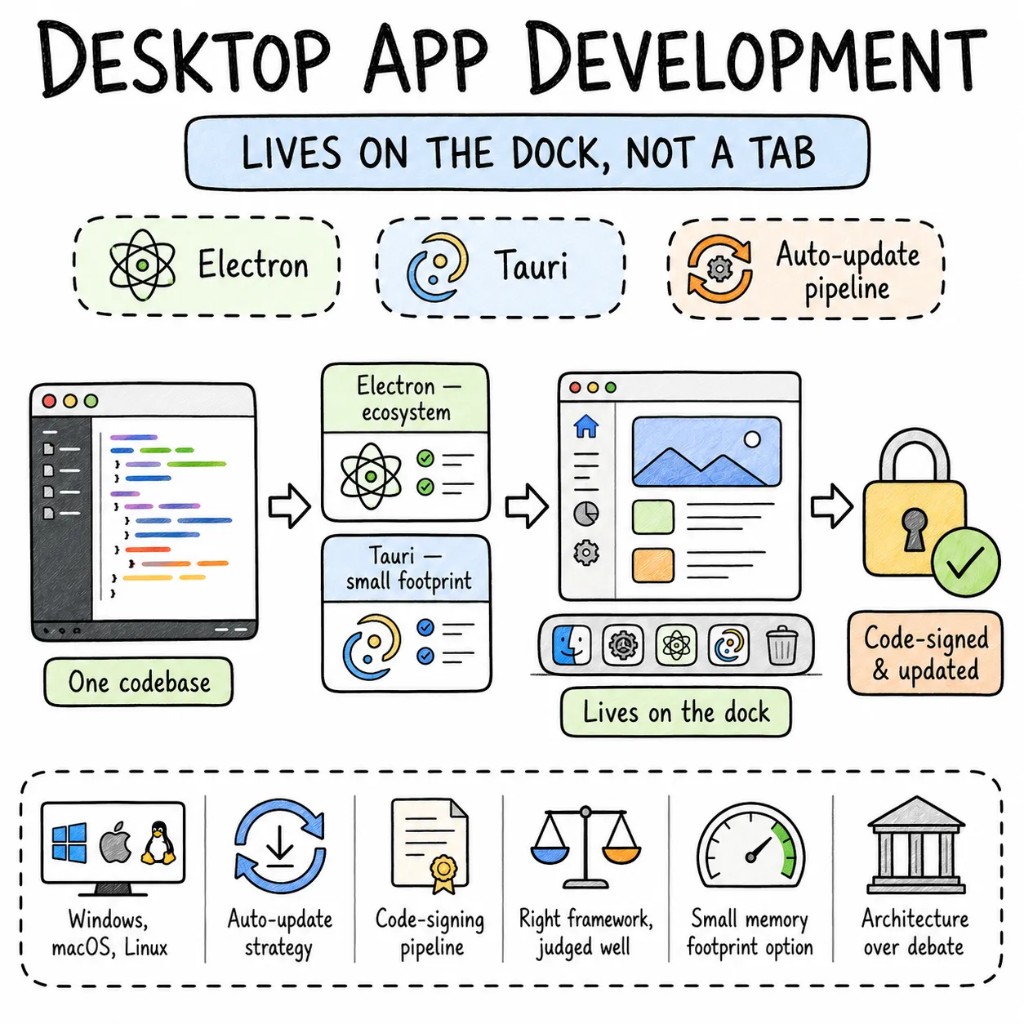
Desktop appsthat live onthe dock – notin the browser tab.

We ship cross-platform desktop applications that run on Windows, macOS, and Linux from a single codebase. Electron when ecosystem maturity and web team velocity matter. Tauri when bundle size and memory footprint are non-negotiable. The framework debate matters less than the architecture, auto-update strategy, and code-signing pipeline most teams skip.

  • Electron + Tauri
  • Cross-platform
  • Auto-update
  • Code-signed

Why Entalogics for desktop

Four things every
desktop app
actually needs.

The desktop apps we inherit usually share the same problems — 300MB Electron bundles nobody optimised, auto-update that silently breaks, no code-signing pipeline, and a main process that blocks the UI thread. Desktop development has real operational complexity that web teams don't expect.

Performance01

Memory matters when your app shares the dock with everything else.

An idle Electron app uses 150–300MB. Tauri uses 30–50MB. We pick the framework based on your user's machine constraints — and then optimise within it. Lazy window loading, IPC batching, off-main-thread processing.

Architecture02

Main process and renderer process are separate apps. Treat them that way.

Business logic in the main/backend process. UI in the renderer. IPC typed end-to-end. No database calls from the renderer. No UI work in the main process. The boundary is strict or it becomes a debugging nightmare.

State03

Local-first data that syncs when it can.

SQLite via better-sqlite3 or Tauri's SQL plugin for structured local data. Conflict-free sync when the server is reachable. Desktop users expect their app to work offline by default — not as a progressive enhancement.

Type safety04

TypeScript strict in the renderer. Typed IPC between processes.

Every IPC message typed. Every file system call typed. Every auto-update payload validated. When the backend changes a command signature, the frontend fails to compile — not at runtime when a user triggers it.

When desktop, when not

Desktop is a tool decision.
Not a default one.

Not every product needs a desktop app. We'll tell you on the first call if a desktop application genuinely solves your problem — or if a PWA or web app gets you there at a fraction of the cost.

BUILD A DESKTOP APP WHEN

  • Offline-first is non-negotiable — the app must work without internet, fully, not partially
  • File system access, local database, or hardware integration are core to the product
  • Your users live in the app all day — dock presence, system tray, keyboard shortcuts matter
  • Data sensitivity requires local processing — nothing leaves the device

PICK ELECTRON WHEN

  • Your team writes TypeScript and React — Electron is the fastest path to production
  • You need deep native API access — Electron's ecosystem has thousands of battle-tested packages
  • Consistency across platforms matters more than bundle size

PICK TAURI WHEN

  • Bundle size under 10MB and memory under 50MB are hard requirements
  • Security posture demands a smaller attack surface than bundled Chromium
  • Your team can work with Rust for the backend layer — or you're willing to invest in it

WE SAY NO WHEN

  • "Desktop app because it feels more serious." That's not a product requirement.
  • "Electron for a calculator." You don't need us — or Electron.
  • "Ship to three platforms in three weeks." That ship has sailed.

What we build on desktop

Six product surfaces.
One quality bar.

The shapes of desktop app development services we deliver most. Each ships signed, auto-updating, and production-ready on all three platforms.

  • S01

    SaaS desktop companions

    Your web dashboard as a native desktop app. System tray presence, native notifications, offline access, keyboard shortcuts. Dock-worthy, not tab-worthy.

    ELECTRONREACTSQLITEAUTO-UPDATE
  • S02

    Developer tools & IDEs

    Code editors, database GUIs, API clients, CLI wrappers. Desktop apps that developers install once and use daily — where memory footprint and startup time matter.

    TAURIREACTRUSTMONACO
  • S03

    AI-native desktop apps

    Local model inference, on-device processing, privacy-first AI tools. Tauri + Rust for ONNX Runtime inference or Electron + Ollama sidecar for LLM integration. Data never leaves the machine.

    TAURIONNXRUSTOLLAMA
  • S04

    Enterprise internal tools

    Replace the VPN-accessed internal web portal with a signed, auto-updating desktop app. SSO, certificate pinning, local data cache, MDM-compatible.

    ELECTRONREACTSQLITESSO
  • S05

    Media & creative tools

    Image editors, audio tools, video processors. Desktop-native file handling, GPU acceleration, drag-and-drop that feels native because it is.

    TAURIWEBGPURUSTFFMPEG
  • S06

    Electron to Tauri migrations

    Shrink your bundle from 150MB to 10MB. Replace Node.js backend with Rust. Migrate IPC layer and native modules. The app keeps shipping during migration.

    TAURI 2RUSTREACTAUTO-UPDATE

The playbook

Patterns we
ship on repeat.

Desktop patterns from production apps — not Electron quick-start demos.

  • P01

    Typed IPC between processes

    Every message between main/backend and renderer is typed. Zod validation on both sides. No untyped `ipcRenderer.send` calls surviving past code review.

  • P02

    Auto-update that actually works

    electron-updater or Tauri's built-in updater. Signed releases, delta updates where possible, rollback on failure. The update pipeline is tested in CI — not discovered broken in production.

  • P03

    Code-signing for all three platforms

    macOS notarization, Windows Authenticode, Linux AppImage signing. CI handles it end-to-end. No manual signing steps in the release process.

  • P04

    Local-first SQLite

    better-sqlite3 for Electron, Tauri SQL plugin for Tauri. The app works fully offline. Sync when available. Conflict resolution strategy defined before the first sync — not after the first data loss.

  • P05

    Secure context isolation

    Context Bridge in Electron. Tauri's command allowlist. No Node.js access from the renderer. No arbitrary shell execution from the frontend. The attack surface stays small.

  • P06

    Multi-window architecture

    Main window, settings, detachable panels — each window lifecycle managed properly. Memory released on close. State synced via IPC, not global variables.

Signature case

A developer tool,
migrated from Electron to Tauri.

A B2B database GUI on Electron — 180MB bundle, 340MB memory at idle, 6-second cold start on Windows, and auto-update that failed silently for 20% of users. Migrated to Tauri 2 with Rust backend in 9 weeks. Bundle dropped to 12MB. Memory to 45MB. Auto-update now works for everyone.

Before

Electron · 180MB bundle · 340MB idle memory · 6s cold start · auto-update 80% success

After

Tauri 2 · 12MB bundle · 45MB idle memory · 1.2s cold start · auto-update 100% success

  • Bundle size−93%
  • Idle memory−87%
  • To fully migrated9wk
  • Shipped regressions0

Engagement shape

Eight to ten weeks
to a measurable ship.

A typical desktop app development engagement. We build feature by feature — signed releases shipping to testers from week two.

  • W01

    Audit + RFC

    Two senior desktop engineers. Bundle analysis, memory profiling, IPC architecture review, auto-update audit. A ranked, dollarized RFC.

  • W02–03

    Foundation + first window

    Electron or Tauri baseline, typed IPC, auto-update wired, code-signing configured, one production window end-to-end. Signed test build on all three platforms.

  • W04–08

    Feature by feature

    Window by window under feature flags. Signed beta releases weekly. Your roadmap keeps moving.

  • W09+

    Release + handoff

    Signed production release on Windows, macOS, Linux. Auto-update verified. Runbook handed to your team — or we stay on retainer.

Stack

Tools we
reach for first.

Our default desktop development stack — picked for production, not quick-start templates.

  • FrameworkElectron · Tauri 2 · Neutralinojs
  • LanguageTypeScript (strict) · Rust · Zod
  • Databetter-sqlite3 · Tauri SQL · Keytar · electron-store
  • UIReact · Vue · Tailwind · shadcn/ui
  • TestingPlaywright · Spectron · Vitest · Tauri test utils
  • Infraelectron-builder · Tauri CLI · GitHub Actions · Sentry

Engagement

Three ways
to work with us.

No hourly retainer that bills for "thinking time." Pick a lane that matches your stage; everything is fixed-quote or transparently rated.

FIXED SCOPEone-off build

Ship a desktop app, end-to-end.

A defined product, a fixed price, a senior-only team. From RFC to signed release on all three platforms in 8–14 weeks.

$15k–$30k

FIXED SCOPE

  • Senior engineers only
  • Fixed quote in week 1
  • Code, infra, runbook — yours
Plan a fixed build
DEDICATED TEAMmonthly

Hire dedicated desktop developers.

Embedded engineers in your Slack, your Linear, your standups. Senior Electron or Tauri engineers. Pause, resize, end with 30 days' notice.

$5k / eng / mo

PER ENGINEER

  • Same senior bar as fixed-scope
  • Embedded in your team
  • Founder-direct escalation
Hire dedicated desktop devs
ENGAGEMENTcustom

Strategic desktop partnership.

A long-term partner for product orgs shipping desktop software — architecture, auto-update infrastructure, Electron-to-Tauri migration, hiring help.

custom

PROCUREMENT-FRIENDLY

  • Multi-quarter roadmap
  • Architecture & hiring partner
  • Procurement-friendly paper
Speak to the founder
FAQ

Sharp questions,
straight answers.

Electron vs Tauri, web companions, migrations, existing codebases — the questions we get on every desktop discovery call.
Electron if your team writes TypeScript and you need the deepest native API ecosystem — it's battle-tested behind VS Code, Slack, and Figma. Tauri if bundle size, memory, and security posture are hard requirements — 10MB bundles vs 150MB, 45MB memory vs 300MB. For most new projects in 2026, Tauri is the stronger default.
Only if desktop-specific capabilities matter — offline-first, file system access, system tray, local AI processing, or "lives on the dock all day" UX. If users just need a tab, a PWA is cheaper and ships faster.
Yes. We migrate the IPC layer, replace Node.js backend code with Rust commands, and update native modules to Tauri plugins. The app keeps shipping during migration. Most migrations take 8–12 weeks.
Yes. The engineers who write the RFC ship the code. No handoff mid-engagement. Direct access throughout.
Yes. We adapt to your IPC patterns, build pipeline, and auto-update setup. If something needs changing, we flag it in the RFC. If it works, we build on top of it.

Founder-direct

Tell us whatyou're building.

Thirty minutes with the founder. We'll bring a senior desktop engineer, the relevant playbook, and a candid read on whether a desktop app is the right call — or whether a PWA or web app solves your problem at lower cost.