
Ship a C++ system, end-to-end.
A defined product, a fixed price, a senior-only team. From RFC to production in 8–14 weeks.
$15k–$30k
FIXED SCOPE
- Senior engineers only
- Fixed quote in week 1
- Code, infra, runbook — yours
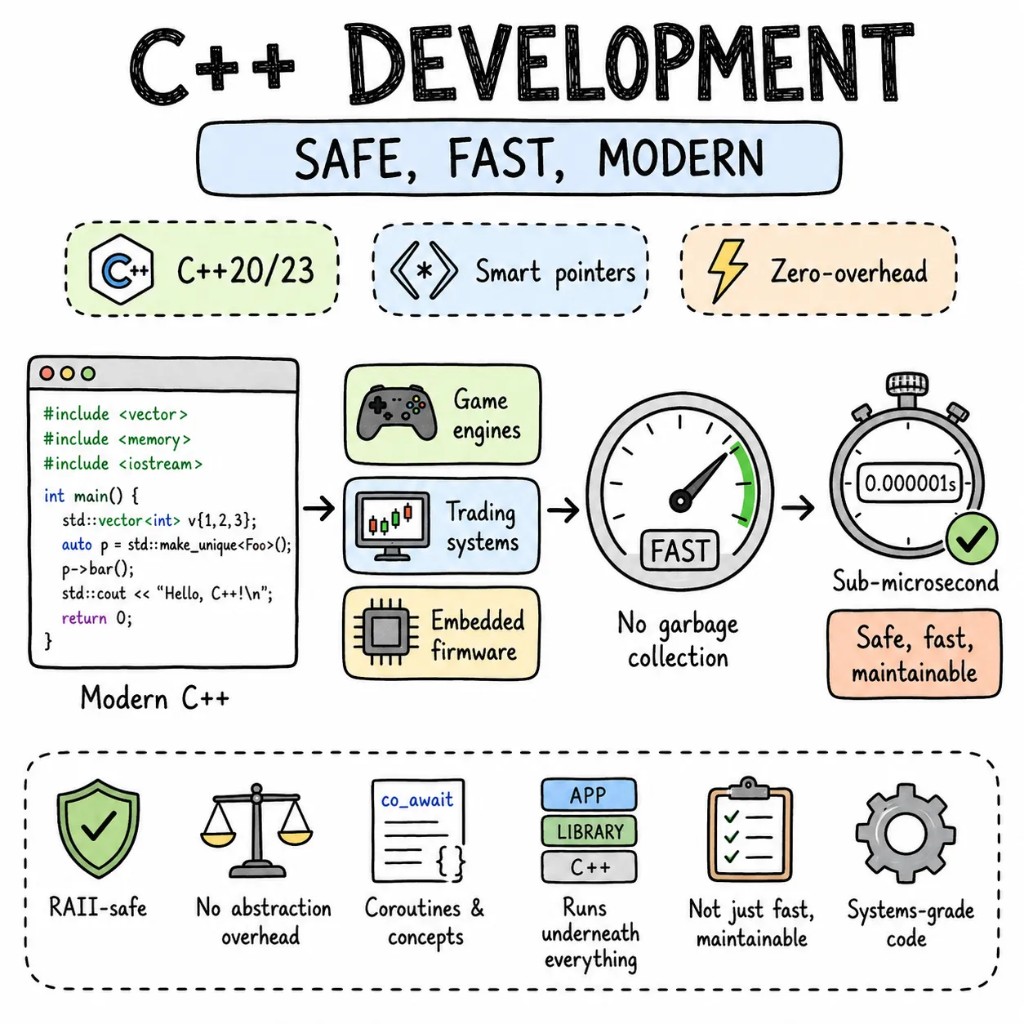
C++ development services for systems where garbage collection isn't an option and abstraction overhead isn't acceptable. Game engines, trading systems, embedded firmware, AI inference runtimes — the software that runs underneath everything else. Modern C++20/23 with smart pointers, concepts, and coroutines. We write C++ that's safe, fast, and maintainable — not just fast.
Why Entalogics for C++
The C++ codebases we inherit usually have raw `new`/`delete` scattered across 200 files, no static analysis in CI, `undefined behaviour` that "works in production until it doesn't", and build systems that take 45 minutes because nobody set up precompiled headers. C++ gives you the power. Most teams don't add the guardrails.
Premature optimisation in C++ creates unreadable code for a 2% improvement nobody measured. We profile with Perf, VTune, or Tracy, identify the actual hot path, and optimise that — with benchmarks that prove the improvement before and after.
RAII for resource management. Smart pointers for ownership. `std::span` and `std::string_view` instead of raw pointer + length pairs. The codebase reads like modern C++, not 1998 C++ with a class keyword.
`unique_ptr` for single ownership. `shared_ptr` only when shared ownership is genuinely required. Value semantics by default. Move semantics where copies are expensive. Ownership is explicit — not a comment that says "// caller owns this."
C++23's `std::expected` for recoverable errors. Strong typedefs to prevent unit confusion — a `Distance` is not a `Duration` even though both are `double`. The compiler catches the misuse. A code review shouldn't have to.
When C++, when not
C++ gives you control no other mainstream language offers. That control has a cost — complexity, compilation time, and a hiring pool that shrinks every year. We'll tell you on the first call if C++ is genuinely justified for your problem.
PICK C++ WHEN
CONSIDER RUST WHEN
WE SAY NO WHEN
What we build in C++
The shapes of C++ development work we deliver most. Each built for production — not a university project.
Custom engines, Unreal Engine integration, rendering pipelines, physics systems. C++ at 60fps or higher where every frame budget is 16ms.
Order matching, market data processing, FIX protocol, kernel bypass networking. Microsecond-level latency where garbage collection is a dealbreaker.
ARM Cortex targets, RTOS integration, sensor drivers, bare-metal applications. C++ on constrained hardware where every byte counts.
ONNX Runtime, TensorRT, custom inference pipelines. C++ wrapping GPU kernels for production model serving where Python is too slow.
Native modules for Electron/Tauri apps, codec libraries, file processing engines. The C++ layer that does the heavy lifting behind a modern UI.
C++11 to C++23, raw pointers to smart pointers, Makefiles to CMake, no tests to sanitizer-clean CI. The existing code keeps shipping while we modernise underneath.
The playbook
C++ patterns from production systems — not textbook examples.
P01
`unique_ptr` for ownership. `shared_ptr` only when genuinely shared. No raw `new`/`delete` in application code. Ownership expressed in the type system, not in comments.
P02
Clang-Tidy, cppcheck, and AddressSanitizer on every PR. Undefined behaviour caught before merge — not after a crash in production at 3am.
P03
Modern CMake with targets, not variables. Precompiled headers configured. Build times measured and budgeted. CI builds in under 10 minutes.
P04
C++20 concepts instead of SFINAE. Template errors that read like English, not like compiler core dumps. Generic code that documents its own requirements.
P05
Google Benchmark on critical paths. No optimisation without a measured before and after. CI alerts on performance regressions across releases.
P06
One file at a time. Replace `new`/`delete` with smart pointers. Replace macros with `constexpr`. Replace C-style casts. The codebase improves continuously — no flag-day rewrite.
Signature case
A high-frequency trading system on C++11 — raw pointer ownership nobody could trace, a Makefile build taking 40 minutes, zero static analysis, and three production crashes in one quarter from undefined behaviour that "worked in testing." Modernised to C++23 with smart pointers, CMake, sanitizers in CI, and `std::expected` error handling in 10 weeks. Under live market load the entire time.
Before
C++11 · raw pointers · 40-min build · 0 static analysis · 3 UB crashes in Q1
After
C++23 · smart pointers · 8-min build · Clang-Tidy + ASan in CI · 0 crashes in Q2+Q3
Engagement shape
A typical C++ development engagement. We modernise or build module by module — the system keeps running while we work.
Two senior C++ engineers. Profiling, sanitiser analysis, build system review, ownership audit. A ranked, dollarized RFC.
CMake baseline, sanitisers in CI, smart pointer conventions established, one production module modernised end-to-end. Real benchmarks on target hardware.
File by file under feature flags where applicable. Sanitisers and benchmarks on every PR. Your system keeps running.
CI clean. Benchmarks documented. Runbook handed to your team — or we stay on retainer.
Stack
Our default C++ development stack — picked for production, not homework.
Engagement
No hourly retainer that bills for "thinking time." Pick a lane that matches your stage; everything is fixed-quote or transparently rated.
A defined product, a fixed price, a senior-only team. From RFC to production in 8–14 weeks.
$15k–$30k
FIXED SCOPE
Embedded engineers in your Slack, your Jira, your standups. Senior C++ engineers shipping modern C++20/23. Pause, resize, end with 30 days' notice.
$5k / eng / mo
PER ENGINEER
A long-term partner for product orgs maintaining or modernising C++ systems — codebase modernisation, performance tuning, Rust interop, hiring help.
custom
PROCUREMENT-FRIENDLY
Founder-direct
Thirty minutes with the founder. We'll bring a senior C++ engineer, the relevant playbook, and a candid read on whether C++ is the right tool — or whether Rust, Go, or a higher-level language solves your problem at lower cost.