
FIXED SCOPEone-off build
Ship an Azure deployment, end to end.
Fixed scope, fixed price, senior-only team. Landing zone to production workloads in 8-14 weeks.
FIXED SCOPE
- Zero juniors on client work
- Fixed quote in week 1
- Code, infra, runbook — yours
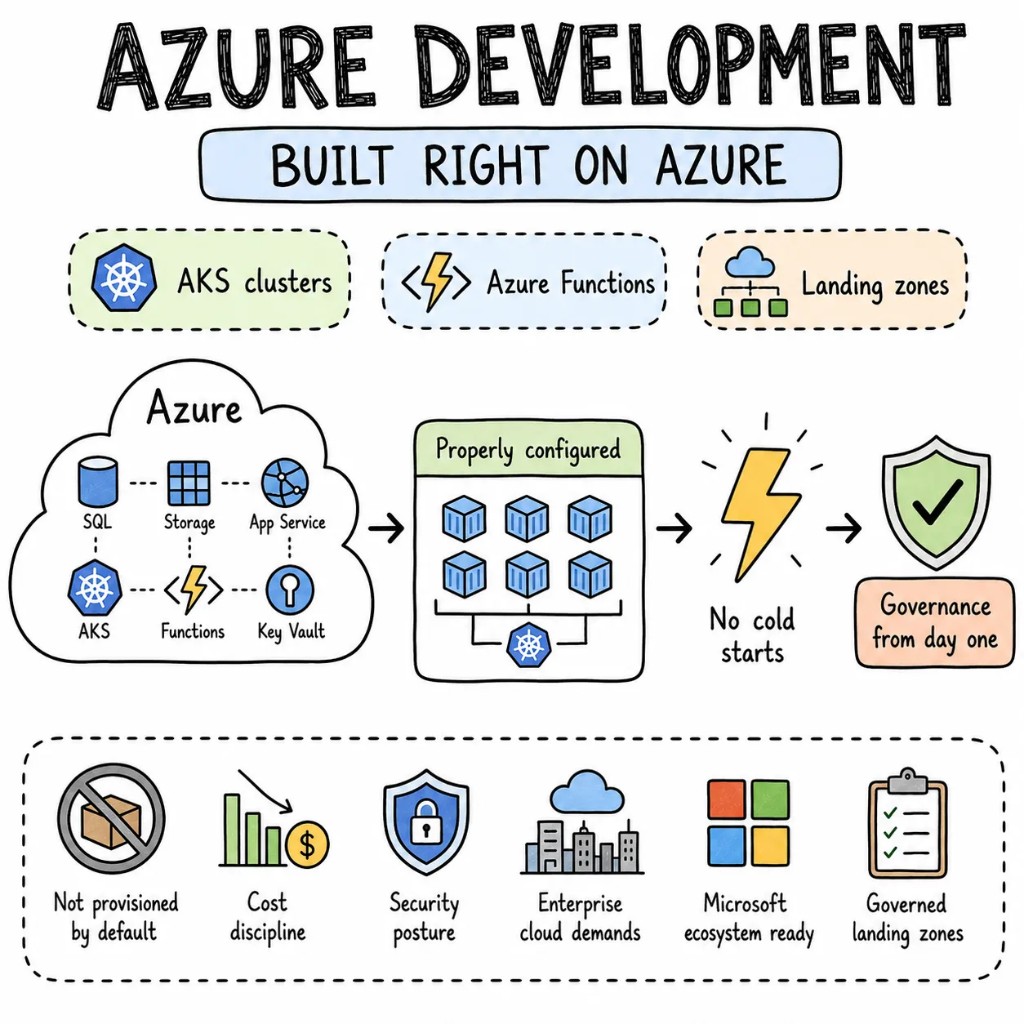
Our Azure development services exist for teams already living in the Microsoft ecosystem, or moving there on purpose. AKS clusters sized for what you actually run, not what a tutorial suggested. Azure Functions that don't cold-start when a customer's watching. Landing zones with governance built in from day one, not bolted on after the first audit finding.
Why Entalogics for Azure
Resource groups nobody owns. AKS sized for a peak that happens twice a year, billed for 24/7 anyway. No tagging strategy, so finance asks where the money went and nobody has an answer. We fix this before the next invoice becomes a fire drill.
Reserved instances, Hybrid Benefit, Spot VMs, storage tiering — each one saves real money, but only applied to the workload it actually fits. We tag everything, set budget alerts per subscription, and turn a confusing invoice into a dashboard someone can act on.
Subscriptions, management groups, Azure Policy, RBAC — skip this and you're retrofitting governance onto production later, which is always harder and always more expensive. We deploy the landing zone first.
Azure SQL instead of self-managed SQL Server on a VM. App Service instead of IIS on a box someone has to patch. AKS only when container orchestration is a real requirement, not a resume line. Every service choice has to justify its own operational cost.
Bicep or Terraform, every resource, stored in git, deployed through Azure DevOps or GitHub Actions. Drift detection catches the manual portal click before it becomes an untraceable production incident.
When Azure, when not
Azure earns its place when your organization already runs on Microsoft. It's not automatically the right cloud for everyone, and treating it as a default choice is how teams end up overpaying for the wrong architecture. We'll say so on the first call.
PICK AZURE WHEN
CONSIDER AWS WHEN
WE SAY NO WHEN
What we build on Azure
Eight ways this work shows up for real clients. Each one built with governance and cost controls from day one, not added after a compliance finding.
Kubernetes clusters with autoscaling node pools, network policies, Azure AD integration, Helm-based deployment. AKS treated as a platform decision, not the default hosting choice.
Event-driven compute for API endpoints, queue processors, and scheduled jobs. Consumption plan for variable load, Premium plan wherever a cold start would actually cost you a customer.
Enterprise-scale landing zones with management groups, subscription vending, Azure Policy, Defender for Cloud, and cost guardrails — the foundation before the first workload lands.
Service-to-service architecture on AKS or Container Apps, API Management fronting it all, with typed contracts between services that don't drift silently over time.
Azure SQL, Cosmos DB, Azure Data Factory, Synapse Analytics — operational and analytical workloads separated deliberately, with storage tiering that matches how the data actually gets accessed.
On-prem to Azure, AWS to Azure, or an old Azure estate modernized properly. Workload by workload, using Azure Migrate, with compliance and cost analysis built into the plan, not bolted on after.
Pipelines, repos, boards, and artifacts — or GitHub Actions targeting Azure. One pipeline building, testing, and deploying both infrastructure and application code.
Ongoing monitoring, cost reviews, patching, and incident response after go-live — so the environment that launched clean doesn't quietly drift back into the mess we were hired to fix in the first place.
The playbook
Patterns from real enterprise Azure deployments — not a Microsoft Learn tutorial dressed up as a case study.
P01
Every resource defined in Bicep modules, deployed through CI/CD, no portal changes surviving past a PR. Drift detection makes the infrastructure as reviewable as the application code sitting next to it.
P02
Cost center, environment, owner, and workload on every resource. Budget alerts per subscription. Right-sizing reviewed monthly, not discovered during a year-end audit.
P03
Azure SQL over SQL Server on a VM. App Service over a managed VM someone has to patch. Every IaaS choice has to justify itself in writing.
P04
System pool on reserved instances for stability. User pools on cluster autoscaler and Spot VMs for anything that can tolerate interruption. Node pools sized from measurement, not from a guess.
P05
Security posture management and SIEM in place before the first compliance audit forces the question, not after.
P06
Stage-gated deployments, approval gates, environment locks, rollback automation. No production deploy that depends on someone being paying attention at the right moment.
Signature case
A B2B SaaS platform on AWS — $42k/mo infrastructure cost, no reserved instances, EKS control plane charges on 8 clusters, and a SQL Server workload paying full license cost without Hybrid Benefit. Migrated to Azure with AKS (free control plane), Azure SQL with Hybrid Benefit, Spot VMs for dev/staging, and FinOps tagging across all subscriptions in 12 weeks. Monthly spend dropped to $27.7k.
Before
AWS · $42k/mo · EKS control plane charges · full SQL Server licensing · no cost tagging
After
Azure · $27.7k/mo · free AKS control plane · Hybrid Benefit · FinOps dashboard live
Industries we serve
We've delivered Azure development services for SaaS, finance, healthcare, retail, and enterprise IT — anywhere Microsoft's ecosystem, compliance coverage, or hybrid cloud model is already part of the decision.
Engagement shape
Workload by workload. The current infrastructure stays live the entire time we work.
Cost analysis, security posture review, resource organization audit, tagging gap assessment. A ranked, dollarized plan, not a list of vague concerns.
Bicep landing zone deployed, Azure Policy enforced, first production workload live with monitoring and cost tagging. Real cost data in your dashboard by week three.
Each workload migrated or deployed with right-sized compute, proper storage tiering, and Defender enabled. Your product keeps running throughout.
FinOps dashboard live, security posture green. Runbook handed over, or we stay on for Azure managed services.
Stack
Our default Azure cloud development stack — picked for enterprise production.
Engagement
No hourly billing for thinking time. Fixed quote or a transparent monthly rate.
Fixed scope, fixed price, senior-only team. Landing zone to production workloads in 8-14 weeks.
FIXED SCOPE
Senior cloud architects and DevOps engineers embedded in your Slack, your Azure DevOps, your standups. Pause, resize, or exit with 30 days' notice.
PER ENGINEER
A standing partner for enterprise cloud — landing zone governance, cost optimization, security posture, migration roadmap, hiring help.
PROCUREMENT-FRIENDLY
Founder-direct
Thirty minutes with the founder — a senior Azure architect, the relevant playbook, and a candid read on whether Azure is the right cloud, or AWS and a multi-cloud approach actually fits your workload better.