FIXED SCOPEone-off build
Ship an AWS deployment, end to end.
Fixed scope, fixed price, senior-only team. Landing zone to production workloads in 8-14 weeks.
FIXED SCOPE
- Zero juniors on client work
- Fixed quote in week 1
- Code, infra, runbook — yours
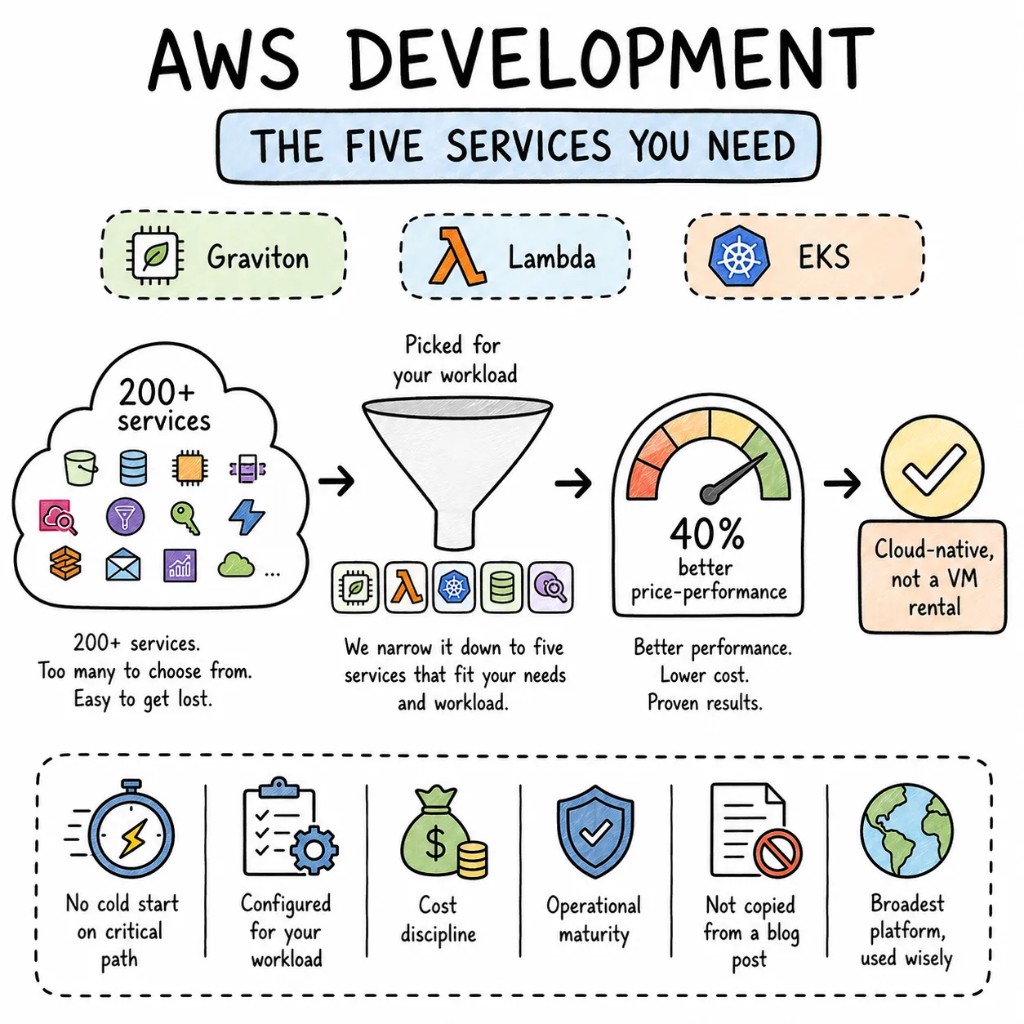
AWS ships 200+ services. Our AWS development services exist to filter that down to the handful your workload genuinely needs — Graviton for 40% better price-performance, Lambda that doesn't cold-start on the critical path, EKS configured for your actual traffic pattern, not copied from a blog post. We build on AWS with the cost discipline that separates a cloud-native product from an expensive VM rental.
Why Entalogics for AWS
30-40% of cloud spend gets wasted on idle resources, over-provisioned instances, and zombie assets nobody remembers creating. Every AWS estate we audit has the same story — on-demand instances running 24/7 with no Savings Plan, S3 buckets in the wrong tier, and EKS node pools sized for a peak that happens twice a year.
Graviton4 for 40% better price-performance on sustained compute. Spot for anything stateless. Savings Plans covering 60-70% of baseline. We wire in FinOps tagging, budget alerts, and Compute Optimizer recommendations before the first bill becomes a surprise.
Lambda for event-driven spikes. Fargate for containers without node management. EKS only when orchestration complexity is genuinely justified. Every service choice has to be defended by the actual workload pattern, not by what someone deployed on the last project.
Standard for hot data, Intelligent-Tiering for anything unpredictable, Glacier for archives. Lifecycle rules move data automatically once we set them — not manually, six months after someone notices the bill.
Every resource lives in Terraform or CDK, stored in git, deployed through GitHub Actions or CodePipeline. Drift detection catches the manual console click before it becomes an untraceable production incident.
When AWS, when not
AWS has the deepest service catalogue of any cloud provider — and the steepest learning curve, with the most ways to spend money without meaning to. We'll say so on the first call if AWS development isn't actually the right fit for your workload.
PICK AWS WHEN
CONSIDER AZURE WHEN
WE SAY NO WHEN
What we build on AWS
Eight ways this work shows up for real clients. Each one deployed with cost controls and observability from day one, not bolted on after the first surprise invoice.
Kubernetes with Graviton node groups, Karpenter autoscaling, Spot for non-critical workloads, ArgoCD for GitOps. EKS used deliberately, never as a default.
Event-driven compute on Lambda with Graviton2, API Gateway, SQS, EventBridge. Consumption pricing for variable workloads, with cold starts managed instead of ignored.
Control Tower, Organizations, SCPs, GuardDuty, SecurityHub — the governance foundation deployed before the first workload lands, not retrofitted at audit time.
Aurora, DynamoDB, S3, Redshift, Glue. Transactional and analytical workloads separated deliberately, with cost tiering that actually matches access patterns.
On-prem to AWS, Azure to AWS, or a legacy AWS estate modernized properly. Workload by workload using AWS Migration Hub, with real cost modeling built into the plan.
GitHub Actions targeting AWS, CodePipeline, or ArgoCD on EKS. One pipeline building, testing, and deploying both infrastructure and application code.
A structured audit against AWS's own six pillars — cost, security, reliability, performance, operational excellence, sustainability — with a ranked, actionable remediation plan, not a generic scorecard.
Ongoing monitoring, cost reviews, patching, and incident response after go-live — so the environment that launched clean doesn't quietly drift back into the mess we were hired to fix in the first place.
The playbook
Patterns from real production deployments — not a re:Invent slide deck dressed up as a case study.
P01
Every resource in Terraform modules, state in S3 with DynamoDB locking, no console changes surviving past a PR. Drift detection through Terraform Cloud or Spacelift.
P02
Graviton4 for EC2, EKS node groups, RDS, ElastiCache. ARM container images built in CI. x86 only when a dependency genuinely requires it — 20-40% savings from a configuration change alone.
P03
Cost center, environment, and owner on every resource. Budget alerts per account. Compute Optimizer and Trusted Advisor reviewed monthly, not once a year.
P04
Karpenter provisions the right instance for the actual workload, not the one preconfigured in a node group months ago. Spot and on-demand mixed automatically, bin-packed to save real money.
P05
Threat detection and security posture live before the first incident forces the question. Findings aggregated, prioritized, and actionable — not a dashboard nobody checks.
P06
Dev to staging to production with approval gates, canary analysis, and automated rollback. No YOLO deploys, no "it worked in dev" as a deployment strategy.
Signature case
A B2B SaaS platform on AWS — $67k/mo, all on-demand x86 instances, EKS node groups sized for peak load 24/7, S3 Standard for everything including three-year-old logs, and no Savings Plans. Migrated to Graviton4, implemented Karpenter with Spot, applied Savings Plans to baseline, and configured S3 lifecycle policies in 8 weeks. Monthly spend dropped 43%.
Before
$67k/mo · all on-demand x86 · static EKS node groups · S3 Standard for everything · no tagging
After
$38k/mo · Graviton4 + Spot · Karpenter autoscaling · S3 lifecycle policies · full FinOps dashboard
Industries we serve
We've delivered AWS development services for SaaS, fintech, healthcare, retail, and enterprise IT — anywhere the breadth of AWS's service catalogue and Graviton's price-performance are already part of the decision.
Engagement shape
Workload by workload. The current infrastructure stays live the entire time we work.
Cost analysis, security posture review, resource tagging audit, Compute Optimizer review. A ranked, dollarized plan, not a list of vague concerns.
Terraform landing zone deployed, SCPs enforced, first production workload live with monitoring and cost tagging. Real cost data in your dashboard by week three.
Each workload deployed or migrated with Graviton, right-sized compute, proper storage tiering, and GuardDuty enabled. Your product keeps running throughout.
FinOps dashboard live, security posture green. Runbook handed over, or we stay on for AWS managed services.
Stack
Our default AWS cloud development stack — picked for production, not certification exams.
Engagement
No hourly billing for thinking time. Fixed quote or a transparent monthly rate.
Fixed scope, fixed price, senior-only team. Landing zone to production workloads in 8-14 weeks.
FIXED SCOPE
Senior cloud architects and DevOps engineers embedded in your Slack, your standups. Pause, resize, or exit with 30 days' notice.
PER ENGINEER
A standing partner for enterprise cloud — landing zone governance, cost optimization, security posture, migration roadmap, hiring help.
PROCUREMENT-FRIENDLY
Founder-direct
Thirty minutes with the founder — a senior AWS architect, the relevant playbook, and a candid read on whether AWS is the right cloud, or Azure and a multi-cloud approach actually fits your workload better.