Enterprise Angular developmentEnterprise Angulardevelopmentbuilt to survive scale.Enterprise Angulardevelopmentbuilt to survive scale.built to survive scale.
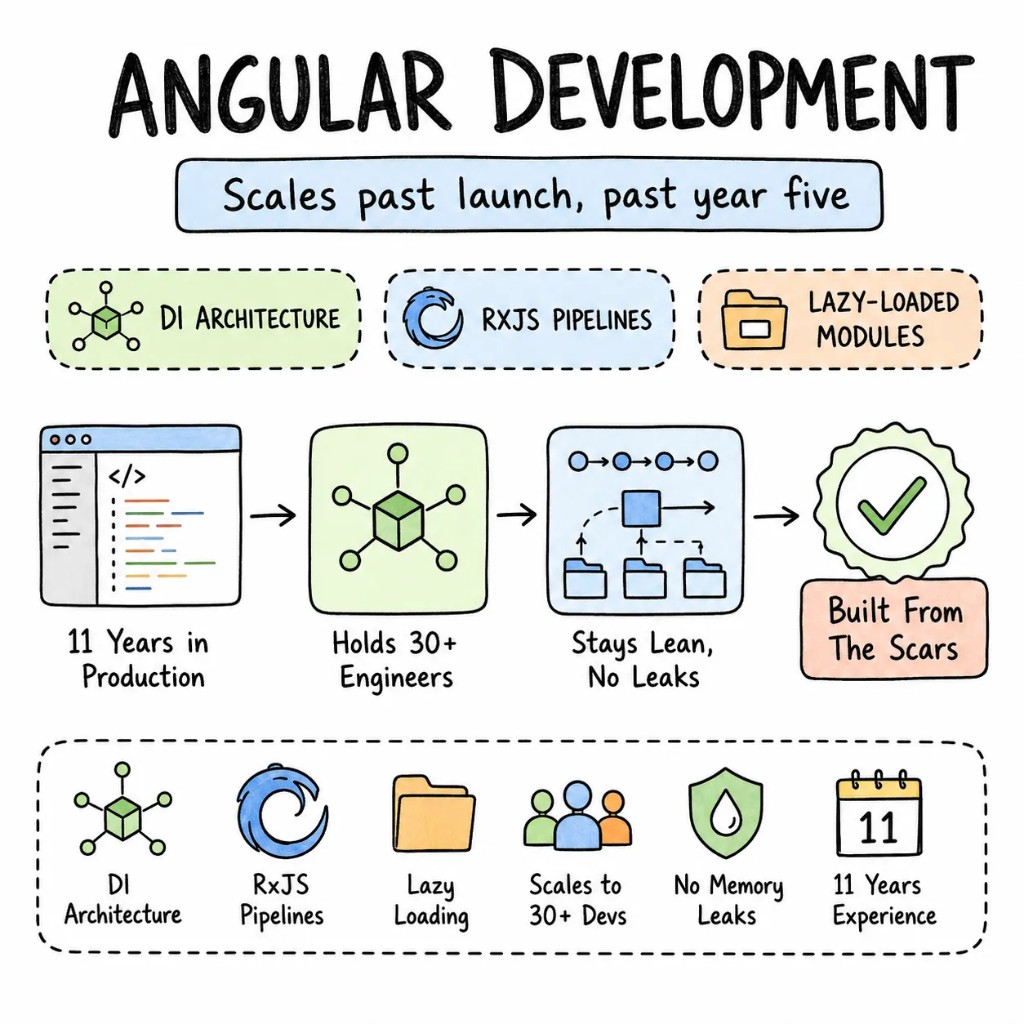
Scaffolding a component and walking away isn't Angular development services — it's a demo. Eleven years running Angular in production: DI architectures that hold under 30 engineers, RxJS pipelines that don't leak, lazy-loaded modules that stay lean. The decisions that make or break Angular at scale aren't in the docs. They're in the scars.
Most teams hire an Angular development company expecting expertise and end up with service spaghetti, a god-module, and change detection bugs nobody can explain.
Performance01
OnPush everywhere. Signals where they earn it.
Change detection is Angular's sharpest tool and easiest way to shoot yourself in the foot. OnPush by default, Signals on hot paths, zone discipline enforced from day one — not discovered during the first performance incident.
Architecture02
Module boundaries, not a mono-folder feature dump.
Angular gives you a real DI system, and most teams ignore it — services injected everywhere, nobody willing to delete them. We enforce standalone component boundaries, skip barrel imports, and use injection tokens deliberately. The dependency graph reads clearly on paper.
State03
NgRx when complexity earns it, Signals when it doesn't.
Not every app needs a store. URL state, local signals, and the service layer cover 80% of real products. NgRx earns its place when cross-feature coordination, audit trails, or time-travel debugging justify the overhead — not because a blog post said so.
Type safety04
Strict templates. Typed reactive forms. End to end.
Angular is TypeScript-native, and most teams still ship it loose. Strict templates, fully typed reactive forms, Zod-validated contracts — a two-sprint refactor becomes two hours because the compiler catches what code review misses.
When Angular, when not
Angular is a tool. Not a religion.
An honest decision matrix. We'll tell you on the first call whether Angular is right for your problem, or whether your budget is better spent elsewhere.
PICK ANGULAR WHEN
A large team (5–50 engineers) needs guardrails the framework enforces, not ones negotiated in every PR
The app will live three-plus years, not run as a six-month pilot
Enterprise auth, role-based access, and audit-grade logging are first-class from day one
You want the framework's opinions to hold, not get re-litigated every PR
CONSIDER OTHERS WHEN
Content-first marketing or docs at scale — Astro or Next.js are lighter
Your team already ships React or Vue well — don't break what works
Prototype speed matters more than architecture right now — Angular's learning curve costs time
WE SAY NO WHEN
"Our last agency used Angular." Loyalty, not a technical reason.
"We need a four-page brochure site." Angular is overkill — we'll say so on the first call.
"Two weeks to start, spec still unwritten." That ship has sailed.
What we build with Angular
Six product surfaces. One quality bar.
The shapes of Angular application development we ship most. Each slots cleanly into your existing stack if you already have one.
S01
Enterprise portals & dashboards
Enterprise portals & dashboards
Role-aware navigation, real permission complexity, data-heavy tables, real-time updates at scale — the single-page application Angular was built for.
ANGULAR CDKNGRXRXJSAG-GRID
S02
SaaS admin panels
SaaS admin panels
Multi-tenant UIs, audit logs, billing integration, workflow builders. Angular's DI system makes multi-tenancy a first-class decision, not a patch job.
ANGULARTANSTACK TABLENGRXTRPC
S03
Financial & compliance UIs
Financial & compliance UIs
Form-heavy workflows, validation at every layer, audit trails baked in, WCAG-compliant from sprint one. Angular's typed reactive forms are built for exactly this.
ANGULAR FORMSZODNGRXPRIMENG
S04
Internal tooling
Internal tooling
The spreadsheet that became five. The Notion doc nobody owns. We replace it with real internal tooling, not another patchwork.
ANGULARTAILWINDPRIMENGPRISMA
S05
AngularJS → Angular migrations
AngularJS → Angular migrations
Hybrid ngUpgrade bootstrapping, route by route, zero feature freeze. The current app keeps shipping while we migrate screen by screen, under feature flags.
NGUPGRADEANGULARRXJSNGRX
S06
Design systems & component libraries
Design systems & component libraries
CDK primitives, design tokens, Storybook, versioned releases, strict a11y — the shared language that ends the "which button is real" arguments.
STORYBOOKANGULAR CDKTOKENS-STUDIOTAILWIND
The playbook
Patterns we ship on repeat.
The architectural patterns that show up on almost every Angular engagement. Not invention — convention, applied carefully.
P01
Signals-first reactivity
Local and derived state default to Angular Signals. Zone.js is being phased out by Angular's own team — zoneless is faster and simpler, so that's the foundation we build on.
P02
Lazy-loaded feature routes
Every feature ships as a lazy-loaded route. The initial bundle stays lean, and the router handles the code-splitting — not an engineer remembering to on every merge.
P03
Typed reactive forms
FormGroup with strict generics, Zod validation at the service boundary, no `any` near a form control. When the spec changes — and it always does — the form refactors cleanly.
P04
DI boundary enforcement
Services scoped to where they're consumed, not injected at root by default. Injection tokens over magic strings. A dependency graph readable without running the app first.
P05
NgRx, applied surgically
Component Store for isolated feature flows. Global Store only when cross-feature state and audit needs justify the ceremony. Effects and facades applied surgically, not by default.
P06
ngUpgrade strangler-fig
AngularJS and Angular share the same DOM during migration. Screens move over one at a time, behind feature flags. The app never goes dark, and users never notice the seam.
Signature case
A legacy enterprise portal, migrated screen by screen..
A government-facing B2B platform on AngularJS 1.6 — 6.2s initial load, a custom framework built on top of AngularJS that only two engineers understood, zero test coverage, and a roadmap completely blocked by technical debt. We migrated to Angular 18 Signals using an ngUpgrade hybrid strategy over 14 weeks. Without a feature freeze.
Before
FCP 6.2s · bundle 1.8 MB · AngularJS 1.6 · 0 unit tests · 2 engineers who understood the codebase
After
FCP 1.1s · bundle 340 kB gz · Angular 18 Signals · 87% coverage · full team onboarded in week two
FCP improvement−82%
route bundle size−81%
to fully migrated14wk
shipped regressions0
Engagement shape
Eight to ten weeks to a measurable ship.
A typical Angular engagement, start to finish. Migration happens screen by screen, never flag-day.
W01
Audit + RFC
Two senior engineers in the codebase — bundle analysis, change detection profiling, DI graph audit, form complexity inventory. You leave week one with a ranked, dollarized RFC, not a slide deck.
W02–03
Foundation + first screen
Strict TypeScript baseline, Signal-ready architecture, OnPush enforced globally. One production screen migrated end-to-end. Real metrics in your dashboards, not a StackBlitz demo.
W04–08
Migrate by screen, not flag-day
Screen by screen, under feature flags. AngularJS and Angular live side-by-side. Kill-switch on every cutover. Your roadmap keeps shipping — no freeze required.
W09+
Cleanup + handoff
Delete the old. Component library docs, Storybook, Playwright integration tests. Runbook handed to your team — or we stay on retainer.
Stack
Tools we Tools we reach reach for for first.
Picked by problem, not by resume. Happy to slot into your stack — but green-field, this is the default.
Framework choices, upgrades, team shape — the questions we get on every Angular discovery call.
Standalone components for everything new — Angular's own team has made NgModules the non-default option. They're simpler, more explicit about dependencies, easier to lazy-load. On an existing NgModule app, we migrate to standalone incrementally, not in one rewrite.
Yes. Angular's ngUpgrade hybrid bootstrap runs AngularJS and Angular side by side while we migrate screen by screen, each with its own kill-switch. Users never see a seam; your team never stops shipping. A full migration typically runs 10–16 weeks depending on app size and custom framework code.
The service layer covers more than most teams think — injectable services with Signals handle most component, feature, and cross-feature state. NgRx earns its place for audit trails, time-travel debugging, or complex multi-feature async flows. Even then, we reach for Component Store before the global store.
Yes. Whoever writes your RFC in week one writes your production code in week eight — no handoff to a junior team, no account manager between you and the engineers doing the work.
Yes. Angular Material, PrimeNG, Clarity, fully custom CDK systems — all come up regularly. We build inside your conventions, not around a rewrite. If something structural will genuinely slow things down, we'll flag it in the RFC.
Founder-direct
Tell us whatyou're building.
Thirty minutes with the founder. A senior Angular lead, the relevant playbook, and a straight read on whether we're right for this.