
AUGUST 21, 2026
Native vs Cross-Platform Apps: The 2026 Data
Cross-platform frameworks now cover roughly 80% of new mobile app builds. Here's the cost, performance, and timeline data behind that shift — and where native still wins.

By Asad, Senior Content Writer at Entalogics · Mobile Development
Native vs Cross-Platform: What the 2026 Data Actually Shows
Every founder building a mobile app hits the same fork in the road early: native or cross-platform. It sounds like a technical question. It's a budget and timeline question with a long tail — the wrong call at this stage can mean a rewrite 18 months in.
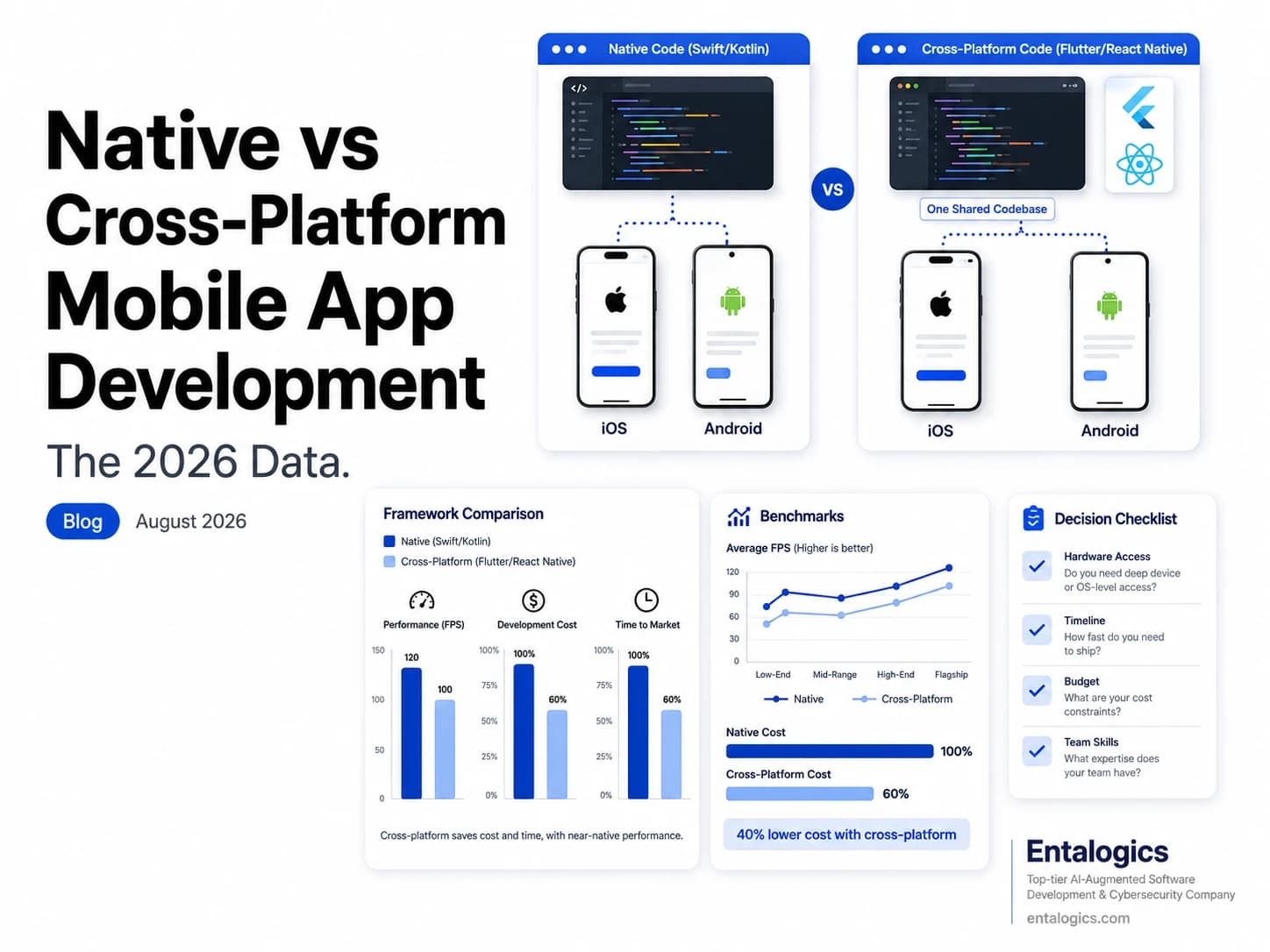
The 2026 data gives a clearer answer than it used to. Cross-platform development with React Native or Flutter is now the correct default for roughly 80% of new mobile app builds. Native wins the remaining 20% — and the cases where it wins are specific, not general.
Cross-platform development is the correct default for most app builds in 2026 — native wins only for deep hardware integration, sustained high-performance graphics, or platform-extension targets like CarPlay and watchOS.
That's a real shift from five years ago, when "native for performance, cross-platform if you're on a budget" was the standard advice. The performance gap has narrowed enough that for most business apps, it's no longer the deciding factor. What decides it now is what you're building, who's building it, and how fast you need to ship.
Native App Development: What You Get and What It Costs
Native development means building two separate apps — one for iOS using Swift, one for Android using Kotlin — each written directly against the platform's own SDK.
Native combined iOS + Android builds typically run $120,000 to $300,000+ for medium-to-high complexity apps, according to 2026 cost breakdowns. A single-platform native build runs $60,000 to $150,000 depending on scope.
That cost buys real advantages. Native apps get immediate access to new OS features the day they ship, integrate more directly with OS-level security controls, and deliver the highest possible performance ceiling for graphics-intensive or hardware-heavy work — camera pipelines, real-time audio processing, continuous background execution, and advanced biometric flows still lean toward native or near-native modules.
The tradeoff is duplication. Two codebases, two QA cycles, two teams (or one team working twice as hard), and a longer timeline before both platforms are live simultaneously.
Cross-Platform Development: What You Get and What It Costs
Cross-platform development uses a single codebase — written in Dart (Flutter) or JavaScript/TypeScript (React Native) — that compiles down to both iOS and Android.
Cross-platform builds typically cost 30-45% less than native, with MVP-scope apps landing between $20,000 and $80,000 depending on complexity, and full production builds still coming in meaningfully under the native combined cost. The savings concentrate in engineering — one team instead of two — which is where 40-45% of the total cost reduction comes from.
The timeline gain is just as significant. Cross-platform apps typically ship 40-50% faster, often in 2-4 months versus 7-12 months for a comparable dual-native build. For a startup validating an idea or a business racing a competitor to market, that gap can matter more than any performance benchmark.
The performance story has changed too. Flutter's Impeller rendering engine hits 58-60 FPS on complex UIs. React Native's new Fabric architecture — which finally removed the old JavaScript bridge bottleneck — hits 51 FPS and edges out Flutter on startup time and battery consumption. For roughly 90% of mobile applications, performance is no longer a meaningful differentiator between the two approaches.
Not sure which approach fits your app? We scope native vs cross-platform decisions as part of every mobile project — based on your actual feature set, not a default answer. Get in touch
Ship faster with senior engineers
Direct collaboration, AI-augmented delivery, and no agency markup.
Get in touchFlutter vs React Native: Choosing the Right Cross-Platform Framework
Deciding on cross-platform is only step one. The framework choice underneath it — Flutter or React Native — matters almost as much.
Flutter holds roughly 46% of the cross-platform market. React Native holds 35-38%. But market share doesn't tell the whole story. React Native powers apps serving over 2 billion users, including Meta's own app family, and its JavaScript ecosystem gives teams access to a talent pool 3 to 5 times larger than Flutter's. Flutter, meanwhile, drives Google's own products and consumer apps like BMW's connected app — and it's the clearer choice if your roadmap extends to desktop or embedded devices, since it renders its own UI rather than relying on platform-native components. If you want the engineering detail on what changed under React Native — JSI, Fabric, Hermes, Expo vs bare — our React Native architecture guide covers it.
The practical split in 2026 looks like this:
- Flutter wins for graphics-intensive apps, pixel-perfect UI consistency across platforms, and animation-heavy interfaces
- React Native wins for apps with heavy third-party native SDK integration, teams already invested in the React/JavaScript ecosystem, and projects where hiring speed matters
- Both are near-parity for standard business apps — e-commerce, fintech dashboards, SaaS products, internal tools
A useful real-world example: a logistics company building a driver app used React Native for 95% of the build — route management, delivery confirmation, messaging — but wrote the barcode scanner module natively because the cross-platform camera libraries weren't fast enough for their scan volume. Total build time: 4 months, versus an estimated 7-8 months for two separate native apps. That hybrid pattern — cross-platform by default, native modules where a specific feature demands it — is how most experienced teams approach the decision in practice, rather than treating it as all-or-nothing.
When Native Is Still the Right Call
Cross-platform being the default for 80% of builds means native is still the right call for a meaningful slice of projects. The pattern is specific, not vague:
- Deep hardware integration — LiDAR, Bluetooth peripherals, and sensor-heavy features that need direct hardware access
- Sustained high-performance graphics — games or AR/VR apps holding 60fps+ continuously, where any rendering overhead compounds
- Platform-extension targets — CarPlay, watchOS, and other extensions that live outside the standard phone app surface
- Single-platform-only apps — if you're only ever shipping to iOS or only to Android, cross-platform's main advantage disappears
- Regulated industries with strict compliance needs — native's tighter OS-level security integration means fewer layers between your code and sensitive data, which matters more in fintech and healthcare builds
If your app falls into more than one of these categories, native is worth the added cost. If it doesn't, cross-platform is very likely the better use of your budget.
What This Means for Startups and Businesses Choosing an Approach
The mobile app development decision isn't really "which technology is better." It's "which approach matches this specific app's requirements, team, and timeline."
The useful framework for making that call:
- Start by listing the features that actually require deep hardware access — if the list is short or empty, cross-platform is your default
- Weigh your timeline pressure — if you need to be live on both platforms simultaneously, cross-platform's 40-50% timeline advantage is hard to ignore
- Check your budget against the real cost split — native's $120K-$300K+ combined build versus cross-platform's $20K-$80K+ range is a significant difference for most startups
- If you land on cross-platform, choose Flutter or React Native based on your team's existing skills and your app's UI demands, not on which framework is trending
- Plan for the hybrid pattern — most production apps end up with a handful of native modules inside a mostly cross-platform build, and that's normal, not a failure of the cross-platform approach
If you're scoping a mobile build and want a framework recommendation based on your actual feature list rather than a generic answer, that's exactly the kind of decision our mobile app development team scopes on every discovery call — before any code gets written, not after. And if you'd rather add engineers to your own team than commission a build, you can hire cross-platform app developers who work in Flutter and React Native day to day.
The native vs cross-platform debate isn't about which technology wins. It's about matching the approach to what you're actually building. In 2026, that match points toward cross-platform far more often than it used to — but the 20% of cases where native still wins are worth getting right the first time.