
JULY 12, 2026
Healthcare Mobile App Development: Security
Mobile app development for healthcare must secure patient data on phones and tablets. NIST shows how providers can share information more safely.

By Asad, Senior Content Writer at Entalogics · Software Development
Why healthcare mobile apps need security first
Health care providers increasingly use mobile devices increasingly use mobile devices to receive, store, process, and transmit patient clinical information. That shift makes mobile app development for healthcare a security problem from day one, not a feature you add after launch.
NIST says mobile devices can present vulnerabilities can present vulnerabilities in a health care organization's networks. That matters because the app is not just a screen. It is a path into protected records, referrals, and prescriptions.
Mobile devices can present vulnerabilities in a health care organization's networks. can present vulnerabilities
The practical lesson is simple: if your app touches clinical data, treat device policy, identity, and data flow as part of the product design. Not as an operations footnote.
What NIST says about mobile app development for healthcare
NIST's guide is a modular varying sizes and information technology sophistication, open, end-to-end reference design that can be tailored and implemented by health care organizations of varying sizes and information technology sophistication. That makes it useful for small clinics and large systems alike.
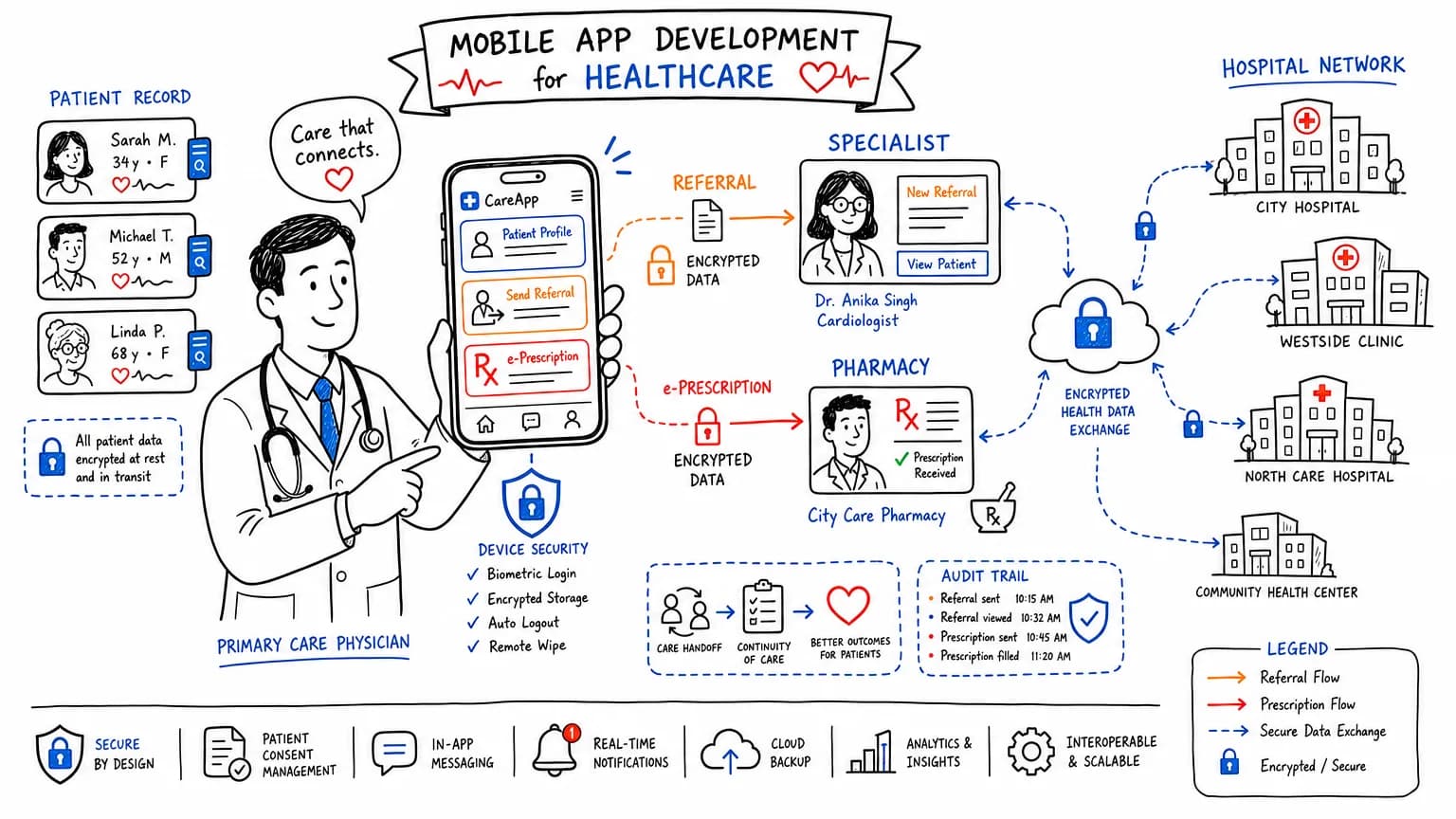
The guide shows how providers can more securely share patient information among caregivers using mobile devices more securely share patient information among caregivers using mobile devices. In plain terms, it focuses on the workflow that matters most: moving clinical information between people who need it, without exposing it on the way.
The guide's scenario is a hypothetical primary care physician primary care physician; referral; electronic prescription to a pharmacy using a mobile device for recurring tasks such as sending a referral to another physician or sending an electronic prescription to a pharmacy. That is a realistic test case for any healthcare app team.
The guide shows how health care providers can more securely share patient information among caregivers using mobile devices. more securely share patient information among caregivers using mobile devices
If your app supports similar flows, map each step: who authenticates, where the data is stored, how it is transmitted, and what happens if the device is lost or compromised.
Secure design patterns for healthcare mobile apps
The NIST publication is built around open source and commercially available tools and technologies that are consistent with cybersecurity standards. It does not give you a single product recipe. It gives you a structure.
That structure matters because healthcare apps often have to work across different device fleets, different identity systems, and different clinical workflows. A single clinic may need one setup; a multi-site health system may need another. The guide is designed for that range.
For mobile app development for healthcare, the first design questions should be:
- Where does patient data live on the device?
- What happens when the device is shared, replaced, or stolen?
- Which actions require re-authentication?
- Which parts of the app can work without storing clinical data locally?
- How do you separate patient data from app logs and analytics?
These are not abstract security questions. They shape the UX, the backend, and the deployment model.
If you are already thinking about broader platform concerns, our mobile app performance optimization guide is a useful complement. Fast apps still need safe data handling, but slow apps often push teams toward unsafe shortcuts.
Common risk points in healthcare mobile app development
NIST's risk framing is blunt: mobile devices can create network vulnerabilities. In healthcare, that risk usually shows up in a few predictable places.
First, devices are often used before privacy and security safeguards are fully implemented. At the 2012 Health and Human Services Mobile Devices Roundtable, participants said mobile devices were already being used by many providers for health care delivery before they had implemented safeguards for privacy and security 2012; many providers; before they had implemented safeguards. That sequence is still a warning sign.
Second, the app may make clinical workflows easier while quietly widening access to sensitive data. A referral may go to the right physician, but the app may also cache identifiers, message history, or attachments in places the team never audits.
Third, healthcare apps often cross boundaries between personal devices and managed devices. That creates policy problems, especially when the same phone holds both patient information and consumer apps with weak controls.
Fourth, integrations can move data into systems the mobile team does not directly own. When your app sends a prescription or referral, your security boundary extends beyond the app store build.
If your team needs a structured review of those risks, the AI Code Security Audit service page explains how a focused security review can catch issues before a release goes live.
Ship faster with senior engineers
Direct collaboration, AI-augmented delivery, and no agency markup.
Get in touchMobile security controls that matter most
A healthcare app does not need every control in every context. But it does need a clear minimum set.
Start with identity. Users should authenticate before they can see patient data, and sensitive actions should trigger stronger checks. Then limit what is kept on the device. If the app must store records locally, protect that store and define a short retention window.
Next, separate clinical content from everything else. App telemetry, crash reports, and debug logs should not become a shadow copy of patient information.
Then protect transport. Clinical information moving between caregivers should be encrypted in transit and handled through approved paths, especially when the workflow includes referrals or electronic prescriptions.
Finally, plan for device loss. A phone will be lost eventually. The real question is whether that loss becomes a reportable incident or just an inconvenience.
The guide's value is that it ties these controls to a real healthcare workflow instead of treating security as a generic checklist.
When to use a reference design instead of guessing
The NIST guide is a reference design for health care organizations of varying sizes and information technology sophistication varying sizes and information technology sophistication. That is the right model when teams are trying to build a secure mobile workflow but do not want to invent policy from scratch.
Use a reference design when:
- your app handles patient clinical information
- multiple caregivers need access to the same workflow
- mobile devices are part of daily care delivery
- your team needs a common security baseline across departments
- you want a design that can be adapted instead of copied blindly
This is especially important in regulated environments, where product decisions are also compliance decisions. The publication was created on July 27, 2018 July 27, 2018 and updated on May 7, 2026 created July 27, 2018; updated May 7, 2026, which makes it a stable reference point rather than a short-lived blog post.
For teams comparing broader software architecture choices, building scalable SaaS architecture can help connect app design to backend and access-control decisions.
What healthcare app teams should do next
If you build mobile app development for healthcare products, do not wait for a post-release review to ask where patient data flows. Draw the workflow first.
Start with the physician task, not the screen. If the app supports a referral or an electronic prescription, list every system that touches that data. Then decide what must be on the device, what must stay server-side, and what must be erased after use.
Review the mobile device policy before launch. If staff are already using phones to move clinical data, the policy must exist before broad rollout, not after a security event.
Test the app in the same conditions clinicians will use it. Lost connectivity, shared devices, account switching, and emergency access all change the risk profile.
Most of all, treat mobile as part of the care path. In healthcare, the app is not just software. It is part of the record.
Build from a reference design. Verify the data path. Minimize local storage. Audit the handoff between caregivers. Those steps will not solve every issue, but they will prevent the most common ones.
This is the same discipline behind our broader healthcare software development work — compliance and clinical accuracy designed in from the first line of code, not bolted on before a release.