
SEPTEMBER 3, 2026
Enterprise AI Security Needs New Architecture
Enterprise AI security must be built into architecture now: AI/ML transactions rose 83% year-over-year, and 39% of access attempts were blocked.

By Asad, Senior Content Writer at Entalogics · Cybersecurity
Why enterprise AI security has to move into architecture
Enterprise AI use is no longer a pilot program. It is part of daily work. Zscaler’s 2025 telemetry shows enterprise AI/ML transactions increased 83% year-over-year, while data transfer to AI tools rose 93% year-over-year. That is not a side channel. It is a core workflow.
The scale matters. The report draws on nearly 1 trillion AI and ML transactions observed throughout 2025 across Zscaler’s security cloud. ThreatLabz also expanded its analysis to over 3,400 applications generating AI/ML traffic. In other words, this is not a small set of novelty tools. It is a broad enterprise surface.
Enterprise organizations still blocked 39% of all AI/ML access attempts in 2025.
That single number says a lot. Some of that blocking reflects policy. Some of it reflects risk. The report’s own language points to unresolved risk rather than simple resistance to AI. If your security model still treats AI as a few approved SaaS apps, you are already behind the way employees actually use it.
What the 2025 AI traffic data shows
The report gives a clear picture of where AI lives inside the enterprise. Finance and Insurance generated 23.3% of enterprise AI/ML activity. Manufacturing followed at 19.5%. Those are not software-only sectors. AI is now embedded in operations, analysis, customer support, and development workflows.
The most widely used applications were Grammarly, ChatGPT, and Microsoft Copilot. Codeium also ranked among the top applications by transaction volume. That mix matters. It shows AI is not isolated to chat prompts. It is inside writing, editing, translation, coding, and day-to-day business work.
The report says this activity translates to hundreds of thousands of AI transactions per organization per day. That scale changes the security problem. You are not reviewing a rare event. You are managing continuous traffic, continuous data movement, and continuous policy decisions.
The other key fact is simple: AI adoption and data risk are linked. When data transfer to AI tools rises 93% year-over-year, the attack surface rises with it. Sensitive text, code, documents, and business context all move through the same paths that drive productivity.
The report draws on nearly one trillion AI and ML transactions observed throughout 2025.
Why perimeter controls are not enough
A traditional app security approach assumes you can identify the app, classify it, and put a control box around it. AI breaks that model.
The report notes that embedded AI features often activate by default, run continuously in the background, and interact with enterprise data without being labeled or governed as AI. That means security teams may not even see the AI layer if they are only inventorying obvious tools.
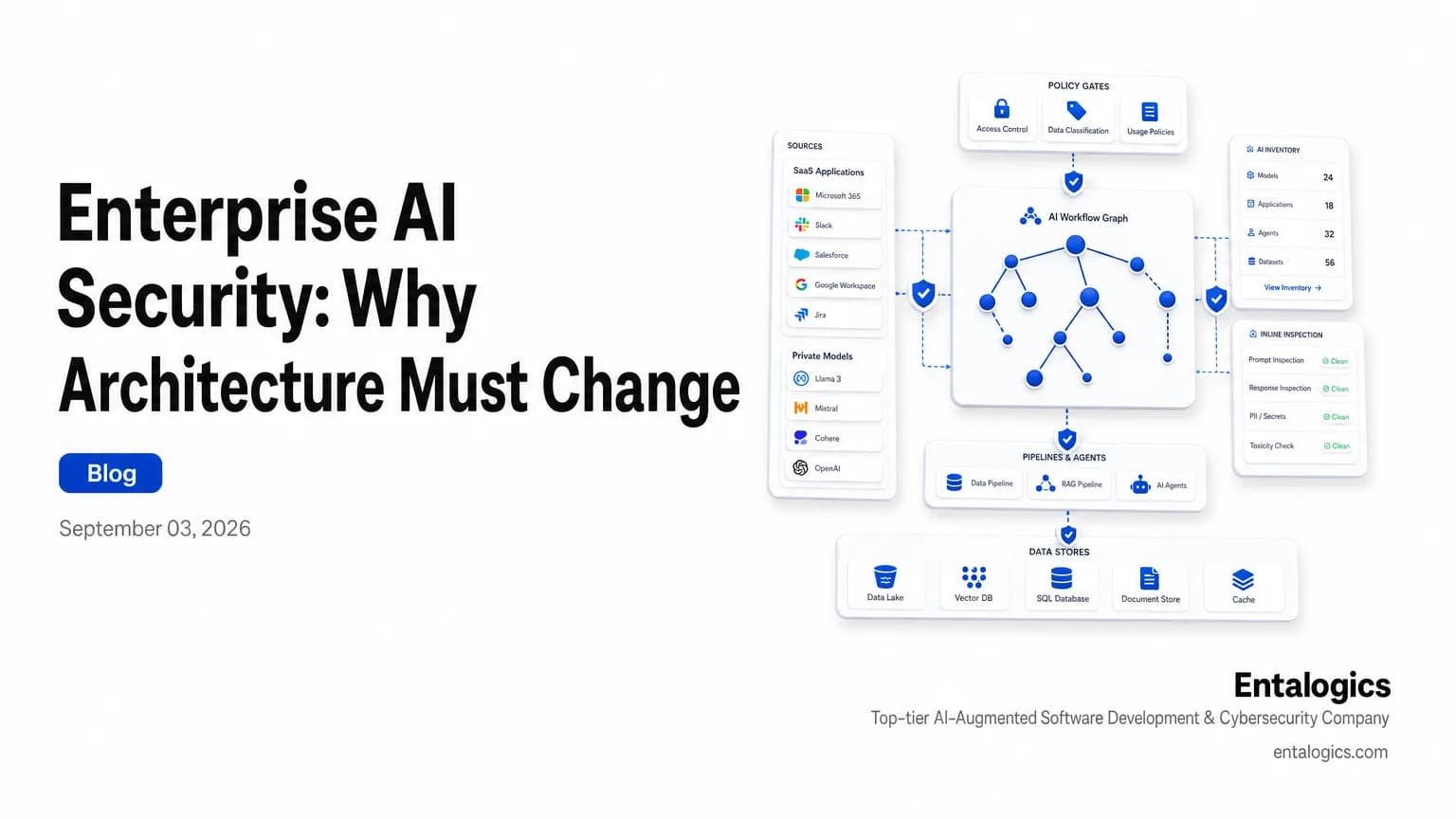
This is where AI governance must become architectural. It cannot sit in a policy PDF or a quarterly review. It needs to exist in the flow of work. That means controls around the models, the pipelines, the agents, and the infrastructure that supports them.
Zscaler’s guidance is explicit: enterprises need controls that extend beyond traditional app security, from public GenAI tools to private models, pipelines, agents, and supporting infrastructure. A tool-by-tool checklist is not enough when the behavior you care about is distributed across the stack.
For a practical framing of what to audit first, see AI Coding Tools and AppSec Risk: What to Audit Now. The core lesson is the same: if AI can move data, generate code, or make decisions, it needs the same architectural scrutiny as any other production dependency.
Ship faster with senior engineers
Direct collaboration, AI-augmented delivery, and no agency markup.
Get in touchHow enterprise AI security failures show up
ThreatLabz red team testing found that every enterprise AI system tested failed at least once under realistic adversarial pressure. That is not a narrow bug report. It is a warning about the assumptions baked into current deployments.
The report also says attackers are already using AI across the attack chain: initial access, social engineering, evasion, and malware development. Campaigns analyzed in the report include AI-assisted social engineering, fake personas, and signs of AI-assisted code generation. Those are different attack stages, but they share one pattern: AI makes malicious activity easier to scale and harder to distinguish from normal work.
That matters for defenders because the old questions are not enough. It is no longer sufficient to ask whether an app is allowed. You also need to ask whether it can be manipulated, whether its inputs are trusted, whether its outputs are safe, and whether the system has any real runtime guardrails.
If your team is already moving toward autonomous assistants or task-specific agents, Enterprise AI Agents: How to Secure Them in 2026 is the next useful step. Agents widen the gap between “approved” and “safe” unless architecture keeps up.
What strong AI governance looks like in practice
The report’s recommendations point toward a simple model: visibility, inventory, inline inspection, and runtime hardening.
Start with full visibility into how AI behaves across the system. That includes usage, exposure, and dependencies across applications, models, pipelines, and supporting infrastructure. An AI-BOM is useful here because it forces teams to inventory more than the front-end app. It captures the pieces that actually move data and trigger behavior.
Next, inspect prompts and responses inline. That is where sensitive data leaves the organization, where unsafe outputs re-enter workflows, and where policy needs to be enforced in real time. If you only inspect after the fact, the data is already gone.
Then harden the runtime itself. The report calls for vulnerability detection across models and pipelines, adversarial red team testing, and defenses against prompt injection, data poisoning, and unsafe use of sensitive information. Those controls are important because AI systems do not fail only at the edge. They fail at the point where inputs, model behavior, and trust boundaries meet.
This is also the place where architecture and governance become the same problem. You cannot govern what you cannot see. You cannot secure what you never inspect. And you cannot rely on manual review when traffic is measured in hundreds of thousands of AI transactions per organization per day.
For organizations asking how deep that review should go, the answer is usually “deeper than the app layer.” If you need help defining the boundary between acceptable use and hidden exposure, our AI Code Security Audit is built for that problem.
The architecture decisions to make now
The right move is not to freeze AI adoption. The right move is to build controls into the architecture before usage outruns governance.
Three decisions matter most.
First, treat AI as infrastructure, not just software. That means model access, data routing, prompt handling, and output filtering belong in the system design, not as add-ons.
Second, make visibility continuous. If AI features can turn on by default and run in the background, your monitoring needs to catch them without waiting for a ticket or a complaint.
Third, align policy with data movement. The biggest risk in the report is not abstract model drift. It is the movement of sensitive enterprise data through AI tools at scale, with broad use across writing, coding, and operational workflows.
The report’s telemetry makes the point plain. Enterprises saw AI/ML traffic rise 83% year-over-year, data transfer rise 93% year-over-year, and continued blocking at 39% of all AI/ML access attempts. Those numbers describe a system that is already under strain.
Build for that reality. Inventory every AI dependency. Inspect prompts and responses inline. Hardening must cover models, pipelines, agents, and supporting infrastructure. And if your current controls cannot see embedded AI features, close that gap now rather than after data has already moved through them.
The takeaway is simple: enterprise AI security and governance are no longer post-deployment tasks. They are architectural requirements.