
JULY 15, 2026
Securing Enterprise AI Agents in 2026: What Works
NIST’s AI agent security report found widespread agreement on novel threats, core controls, and three government roles for safer enterprise adoption.

By Asad, Senior Content Writer at Entalogics · Cybersecurity
NIST’s AI Agent Security Report Sets the Baseline
A new NIST report, published May 18, 2026, says enterprise AI agents are already creating a security problem that slows adoption. The report is NIST Special Publication 800-5, and it summarizes responses to a Request for Information on AI agent security.
The core message is simple. AI agents do not need a brand-new security program from scratch, but they do need tighter controls around access, monitoring, and deployment. Commenters broadly agreed that AI agents introduce novel security threats and that those concerns are a barrier to adoption. They also agreed that core cybersecurity principles still apply, but only if teams adapt them to the way agents actually behave.
That matters because most enterprises are not just asking, “Can this agent do the job?” They are also asking, “What can it touch, what can it see, and what happens when it makes a bad decision?”
Commenters widely agreed that AI agents present novel security threats and that these security concerns present a barrier to adoption.
The RFI itself focused on 3 areas: threats facing AI agents, mitigation and assessment practices, and support the government could offer to help secure adoption. That framing is useful for security teams. It tells you where to spend your review time first.
What NIST Asked About AI Agent Security
NIST released the RFI on January 12, 2026. The comment period closed on March 9, 2026 at 11:59 PM Eastern Time, and comments were filed under docket number NIST-2025-0035.
The questions were practical. NIST asked commenters about the security threats facing AI agents, the practices used to mitigate and assess those threats, and the kinds of government support that could help teams adopt them securely. It also explicitly sought input on interventions in deployment environments, including methods to constrain and monitor the extent of agent access in the deployment environment.
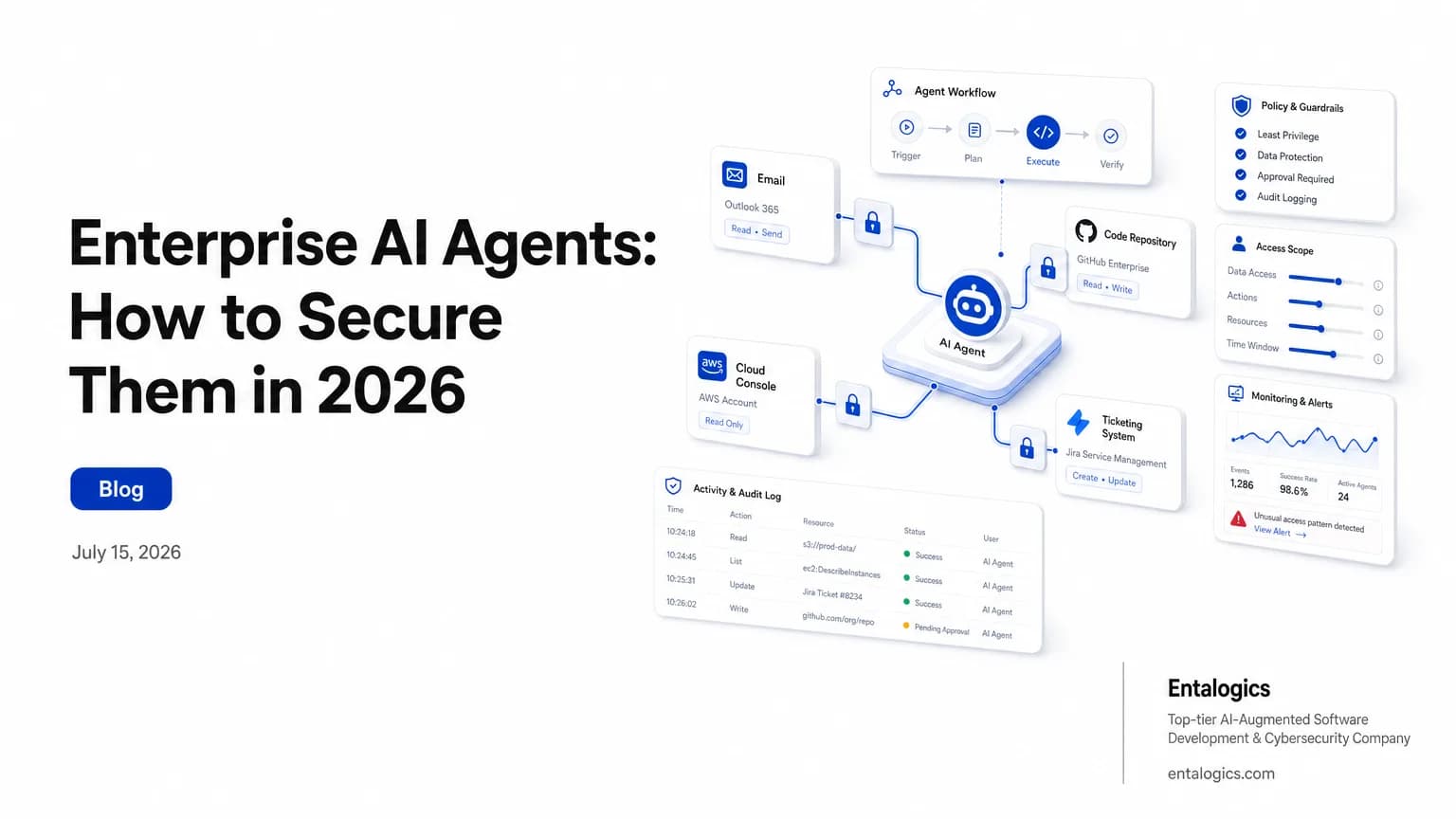
That last point is where many real deployments will live or die. An agent is not just a model. It is software with permissions. If you give it access to internal systems, ticketing, email, code, or cloud consoles, the security problem becomes one of scope, observability, and guardrails.
How Enterprise AI Agents Become an Attack Surface
The NIST summary does not list a single exploit chain. Instead, it shows a pattern: enterprises should expect agents to expand the attack surface because they combine language models, tools, context, and actions in one system.
That changes the threat model in a few ways:
- The agent can act on behalf of a user or service account.
- The agent can move data between systems.
- The agent can be tricked by hostile prompts, poisoned context, or bad tool output.
- The agent can make decisions fast enough that a mistake scales before a human notices.
This is why commenters said the old rules still apply, but need adaptation. Authentication still matters. Authorization still matters. Logging still matters. Segmentation still matters. But an AI agent adds new questions:
- Which tools can it call?
- Which resources can it reach?
- Which outputs can it trust?
- How do you detect when it starts using access outside its intended task?
If your answer is “the model will know,” you do not have a control.
The strongest control may be the simplest one: constrain and monitor the extent of agent access in the deployment environment.
That sentence from the RFI matters because it shifts the discussion away from model quality alone. Enterprises often focus on prompt quality, eval scores, and user experience. Those are useful. But if an agent can reach too much, too broadly, or too quietly, the enterprise still owns the breach.
A good comparison is Senior Developers vs Junior Developers in the Age of AI: output speed changes faster than judgment. AI agents can increase speed in the same way. Security teams need controls that keep pace with that speed.
Security Controls for AI Agents in Production
NIST’s response summary points to a familiar but stricter control set. Start with access limits. Then layer monitoring. Then test how the agent behaves under failure.
Here is the practical order:
The RFI’s emphasis on constraining and monitoring access maps cleanly to least privilege and continuous oversight. That is good news for teams that already run mature programs. It means you can extend existing controls instead of inventing a parallel process.
It is also a warning. If your identity and access setup is weak, an AI agent will not fix it. It will expose it faster.
For teams that need a structured review of permissions, logging, and deployment boundaries, an AI Code Security Audit can help answer the first hard question: what can this system actually do in production?
Ship faster with senior engineers
Direct collaboration, AI-augmented delivery, and no agency markup.
Get in touchWhy Core Cybersecurity Principles Still Matter
One of the most useful findings in the NIST summary is that commenters did not call for a total rewrite of security practice. They said fundamental cybersecurity principles remain relevant.
That means the basics still apply:
- Least privilege
- Strong identity controls
- Segmentation
- Monitoring and alerting
- Secure change management
- Incident response planning
The difference is that AI agents blur the line between software and operator. A normal app usually follows a fixed workflow. An agent may choose steps, call tools, and revise its approach based on new input. That flexibility is useful, but it also means your controls need to tolerate less predictability.
Treat agent security like a control problem, not a novelty problem. If you can describe the agent’s allowed actions, monitor those actions, and stop out-of-policy behavior, you are already ahead of most deployments.
This is also why standards matter. Teams need a shared way to describe acceptable access, logging depth, escalation paths, and review requirements. Without that, every deployment becomes a one-off debate.
Government Support, Standards, and the Road Ahead
The summary also says commenters identified 3 roles for government action: implementation guidance, information-sharing, and standards promotion.
That is a practical list. It suggests the market does not just need warnings. It needs repeatable guidance that teams can use when they move an agent from demo to production.
NIST also said the input will inform future voluntary guidelines and best practices for AI agent security. It will also contribute to CAISI’s ongoing research and evaluations of agent security. In other words, this is the first layer of a longer standard-setting process, not the final word.
For enterprise teams, that means one thing. You do not have to wait for the perfect framework before you act. You can start with access limits, logging, approval gates, and scoped deployments now.
What Security Teams Should Do Next
The most useful takeaway from this NIST report is not a warning. It is a checklist.
Start here:
- Inventory every AI agent in use, including shadow deployments.
- Map each agent to the systems, data, and tools it can access.
- Reduce permissions until each agent can do only one job well.
- Log tool calls, outputs, and approvals.
- Require human review for high-impact actions.
- Re-test access whenever prompts, tools, or integrations change.
If your team cannot answer those questions clearly, the agent is already too broad.
The NIST summary makes the same point in policy language. Enterprises can adopt AI agents, but only if they treat access and monitoring as first-class security controls. That is the real shift. Not more hype. Not more definitions. Just tighter boundaries around software that can act.
If you are shipping agents into production this quarter, use this rule: constrain the access, watch the tool calls, and assume every new integration widens the attack surface until proven otherwise.