
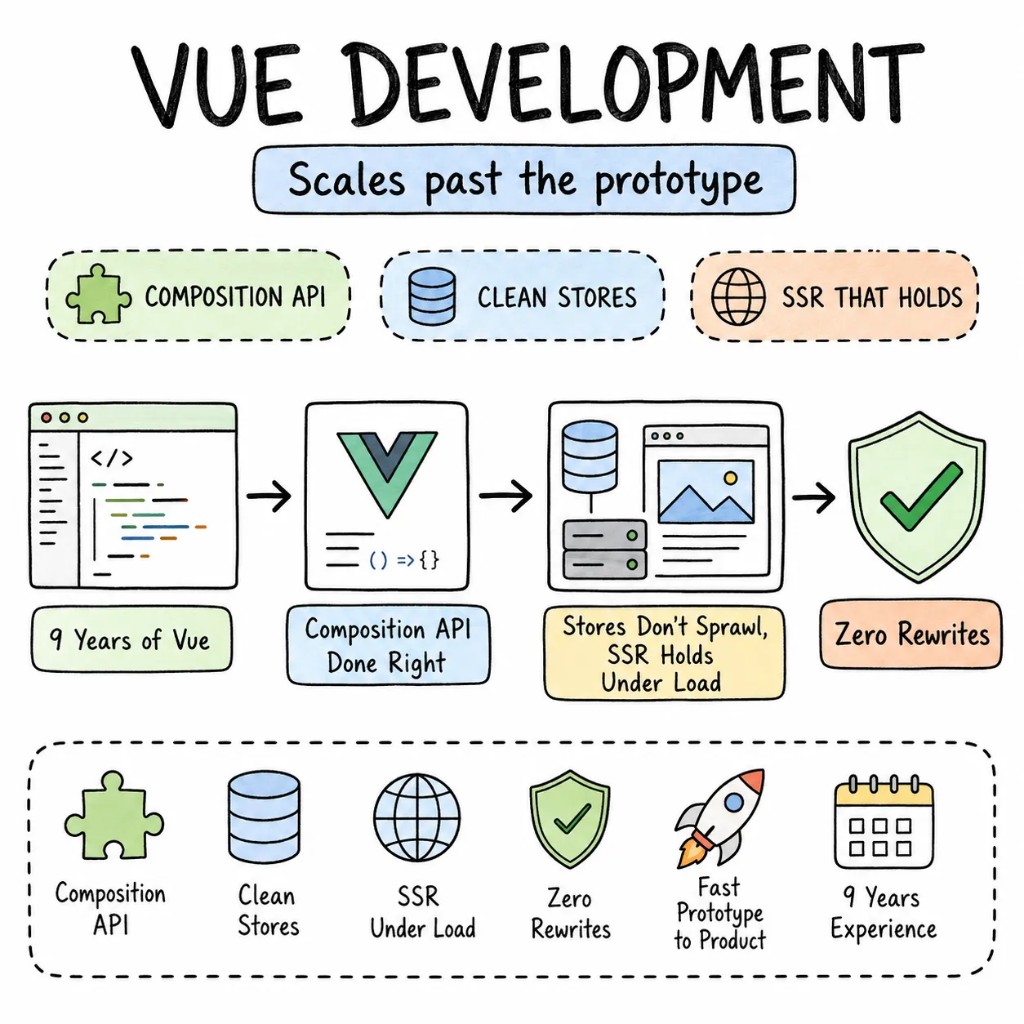
Vue that scales past the prototype.

Nine years of Vue, zero rewrites. Composition API done right, stores that don't sprawl, SSR that doesn't crack under load. The decisions that separate a fast prototype from a fast product.

  • Composition API
  • Sub-1s LCP
  • Typed end-to-end
  • SSR-ready

Why Entalogics for Vue

Four things every Vue
app actually needs.

Most teams pick Vue for the gentle learning curve and ship something fast — then hit a wall at month six when the Options API components are 800 lines long and nobody knows where state lives. We bring the decisions that keep Vue fast to ship at month eighteen, not just month one.

Performance01

Sub-1s LCP, built into the architecture.

Nuxt's hybrid rendering, route-level code splitting, Suspense for async boundaries, and image discipline from day one. Vue's reactivity system is remarkably efficient — but it still rewards engineers who understand when to use shallowRef, when to avoid unnecessary watchers, and when the virtual DOM is doing work it shouldn't be.

Architecture02

Composables, not component soup.

The Composition API is the single biggest unlock in Vue's history — and most teams underuse it. We build composable libraries that encapsulate domain logic completely: the component owns the template, the composable owns the behaviour. Five engineers can ship one product without stepping on each other, because the boundaries are clear before the first PR.

State03

Pinia, used with discipline.

Pinia is small, typed, and devtools-friendly. It's also easy to abuse. We keep stores thin — actions coordinate, getters derive, components don't mutate. URL state for shareables. Server state via useAsyncData or TanStack Query. Client store only for what genuinely needs to live globally. Less state, fewer bugs, faster pages.

Type safety04

TypeScript strict, component props included.

Vue 3's TypeScript support is first-class when you use it right. defineProps with proper generics, typed emits, end-to-end contracts from API to component prop. Volar in strict mode. A refactor that used to mean grepping through templates now takes minutes — because the compiler does the boring half of the review.

When Vue, when not

Vue is a tool.
Not a religion.

An honest decision matrix. We'll tell you on the first call whether Vue is the right call for your problem — or whether your budget is better spent elsewhere.

PICK VUE WHEN

  • You want a pragmatic full-stack JavaScript framework with a gentle learning curve and genuine production depth
  • Your team is small to mid-sized and you want fast iteration without a steep framework tax
  • SSR, SSG, and hybrid rendering are requirements — Nuxt handles this better out of the box than most alternatives
  • You're building a content-rich product that also needs interactive UI — Vue sits in that gap cleanly

CONSIDER OTHERS WHEN

  • You're building a complex enterprise product with 30+ engineers — Angular's enforced structure earns its cost at that scale
  • Your existing team ships React well and there's no strategic reason to change — Vue won't pay back the switching cost
  • You need a massive hiring pool as a primary constraint — React's ecosystem advantage is real and Vue won't match it in most markets

WE SAY NO WHEN

  • "We want Vue because it's easier than React." Easier to start is not the same as easier to scale — and we're not interested in setting you up for a rewrite.
  • "We need a four-page brochure site." Vue is overkill — and we'll tell you that in the first fifteen minutes.
  • "We want to migrate our React app to Vue because someone read an article." That's not a reason. That's an expensive distraction.

What we build with Vue

Six product surfaces.
One quality bar.

The shapes of Vue work we ship most often. Each integrates cleanly into your existing stack if you already have one.

  • S01

    Marketing & growth surfaces

    High-traffic landing pages, docs, blog — CMS-driven, edge-rendered in Nuxt, instrumented from day one. Vue's template compiler produces lean output. Nuxt Content makes editorial workflows fast without sacrificing performance.

    NUXTSTORYBLOKCONTENTFULVERCEL
  • S02

    SaaS dashboards & admin

    Multi-tenant UIs, role-aware navigation, table-heavy workflows, real-time updates. Pinia for cross-feature state, TanStack Table for data grids, Radix Vue for accessible primitives that don't fight your design system.

    NUXTPINIATANSTACKRADIX-VUE
  • S03

    AI & streaming UIs

    Streaming chat interfaces, tool-call inspectors, long-running task UIs. Vue's reactivity model handles streaming state updates cleanly — progressive rendering without the boilerplate.

    NUXTVERCEL-AIPINIASHADCN-VUE
  • S04

    E-commerce storefronts

    Headless PDP, PLP, cart, and checkout. Nuxt's hybrid rendering gives you static product pages where it matters and dynamic cart state where it needs to be. Sub-second mobile LCP on the critical path.

    NUXTSHOPIFYALGOLIATAILWIND
  • S05

    Internal tooling

    Replace the spreadsheet. Replace the five spreadsheets. Replace the Airtable view that three teams are editing and nobody owns.

    NUXTPINIADRIZZLETAILWIND
  • S06

    Design systems & component libraries

    Radix Vue primitives, design tokens, MDX docs, Storybook, versioned releases. The shared component language your Vue teams stop debating every sprint.

    STORYBOOKRADIX-VUETOKENS-STUDIOHISTOIRE

The playbook

Patterns we
ship on repeat.

The architectural patterns that show up on almost every Vue engagement. Not invention — convention, applied carefully.

  • P01

    Server components first

    Default to Nuxt's server rendering. Lean on useAsyncData and useFetch for server-side data. Client-side hydration only where interactivity earns it. Smaller bundles, faster pages, simpler mental model.

  • P02

    Typed contracts

    tRPC with Nuxt server routes, Zod for API validation, or generated types from an existing OpenAPI spec. The API boundary is checked at compile time — not discovered at runtime by a user reporting a bug.

  • P03

    Composable-first logic

    Business logic lives in composables, not components. useInvoices, usePermissions, usePagination — each testable in isolation, each composable with each other. Components become thin shells that own the template and nothing else.

  • P04

    Design tokens

    Colour, spacing, and typography as code — not screenshots in Figma comments. Light/dark, density, and brand variants fall out for free. The design system and the running application are the same source of truth.

  • P05

    Visual + integration tests

    Playwright for critical user paths, Histoire or Storybook for component states, a handful of well-chosen Vitest unit tests for composable logic. Catches the regressions humans miss. Runs in CI in under five minutes.

  • P06

    Incremental SSR adoption

    Bring Nuxt into an existing Vue SPA one route at a time. No big-bang rewrite. The current product keeps shipping while SSR coverage grows. Users get faster pages incrementally — not all at once after a six-month freeze.

Signature case

A SaaS dashboard,
migrated from Vue 2 Options API to Nuxt 3..

A B2B analytics platform on Vue 2 with the Options API — 5.1s LCP, a Vuex store with 14 modules nobody dared touch, component files averaging 900 lines, and a build process so slow the team had stopped running it locally. We migrated to Nuxt 3 with Composition API and Pinia in 11 weeks. Without a feature freeze.

Before

p75 LCP 5.1s · bundle 1.4 MB · Vuex 14 modules · average component 900 lines · 4-minute local build

After

p75 LCP 0.91s · bundle 310 kB gz · Pinia 6 stores · average component 180 lines · 34-second local build

  • p75 LCP improvement−82%
  • route bundle size−78%
  • to fully migrated11wk
  • shipped regressions0

Engagement shape

Eight to ten weeks
to a measurable ship.

A typical Vue engagement, end-to-end. We migrate route by route — never flag-day. The current app keeps shipping while we work.

  • W01

    Audit + RFC

    Two senior Vue engineers in the codebase. Bundle analysis, Vuex dependency graph, Options API complexity inventory, render-blocking audit. You leave week one with a ranked, dollarized RFC — not a list of opinions.

  • W02–03

    Foundation + first route

    Nuxt 3 baseline, TypeScript strict, Pinia replacing the first Vuex module, one production route migrated end-to-end. Real metrics in your dashboards — not a local demo on a fast machine.

  • W04–08

    Migrate by route, not flag-day

    Route by route under feature flags. Vue 2 and Nuxt 3 run side-by-side. Kill-switch on every cutover. Your product roadmap keeps shipping — we never ask for a freeze.

  • W09+

    Cleanup + handoff

    Delete the old. Composable library documented. Storybook or Histoire. Playwright integration tests on critical paths. Runbook handed to your team — or we stay on retainer.

Stack

Tools we
reach for first.

Picked by problem, not by resume. Happy to slot into your stack — but greenfield, this is the default.

  • FrameworkNuxt 3 · Vue 3 · Vite · Analog.js
  • LanguageTypeScript (strict) · Zod · ESLint + biome
  • StylingTailwind · UnoCSS · Radix Vue · shadcn-vue · vanilla-extract
  • StatePinia · TanStack Query · VueUse · Nuxt server state
  • TestingPlaywright · Vitest · Vue Testing Library · Storybook · Histoire
  • InfraVercel · Cloudflare Workers · Netlify · AWS · Datadog · Sentry

Engagement

Three ways
to work with us.

No hourly retainer that bills for "thinking time." Pick a lane that matches your stage; everything is fixed-quote or transparently rated.

FIXED SCOPEone-off build

Ship a Vue app, end-to-end.

A defined product, a fixed price, a senior-only team. From RFC to launch in 8–14 weeks.

$15k–$30k

FIXED SCOPE

  • Senior engineers only
  • Fixed quote in week 1
  • Code, infra, runbook — yours
Plan a fixed build
DEDICATED TEAMmonthly

Hire dedicated Vue developers.

Embedded engineers in your Slack, your Linear, your standups. A scaled pod of senior Vue engineers, augmenting your team. Pause, resize, end with 30 days' notice.

$5k / eng / mo

PER ENGINEER

  • Same senior bar as fixed-scope
  • Embedded in your team
  • Founder-direct escalation
Hire dedicated Vue devs
ENGAGEMENTcustom

Strategic Vue partnership.

A long-term partner for product orgs that need both delivery and judgement — design system, performance program, hiring help.

custom

PROCUREMENT-FRIENDLY

  • Multi-quarter roadmap
  • Architecture & hiring partner
  • Procurement-friendly paper
Speak to the founder
FAQ

Sharp questions,
straight answers.

Nuxt vs SPA, Vue 2 migrations, Pinia — the questions we get on every Vue discovery call.
Depends on what you're building. If SEO, SSR, or hybrid rendering matter — Nuxt. It handles routing, server rendering, data fetching, and deployment configuration out of the box. If you're building a pure client-side SPA — a dashboard, an internal tool, an admin panel — plain Vue with Vite is leaner and faster to set up. We'll tell you which one fits in the first call, not after a week of scoping.
Yes, and this is most of what we do. We use Vue's migration build and a route-by-route strategy — Vue 2 and Vue 3 coexist during the migration, each route goes live under a feature flag, and there's a kill-switch on every cutover. Your product roadmap keeps moving throughout. We've never asked a team for a feature freeze to do this work.
For most of what lives inside a single feature, Vue's Composition API and composables are enough. Pinia earns its place when you need state shared across multiple features, devtools visibility, or SSR-compatible stores. We don't reach for it by default — we add it where it genuinely reduces complexity, not because it's the expected answer.
Yes. The engineers who write the RFC are the engineers who ship the code. No handoff to a junior team mid-engagement. No account manager between you and the people doing the work. Direct access throughout.
Yes. We've worked inside existing Vuetify, PrimeVue, Element Plus, and fully custom component systems. We adapt to your conventions — we don't ask you to throw away working components to fit our preferences. If your library has structural problems that will slow the engagement down, we'll flag it in the RFC. If it doesn't, we build on top of it.

Founder-direct

Tell us whatyou're building.

Thirty minutes with the founder. We'll bring a senior Vue lead, the relevant playbook, and a candid read on whether your problem is one we should take.