
Ship a Redis/Valkey deployment, end-to-end.
A defined scope, a fixed price, a senior-only team. From architecture to production in 4–8 weeks.
$15k–$30k
FIXED SCOPE
- Senior engineers only
- Fixed quote in week 1
- Code, infra, runbook — yours
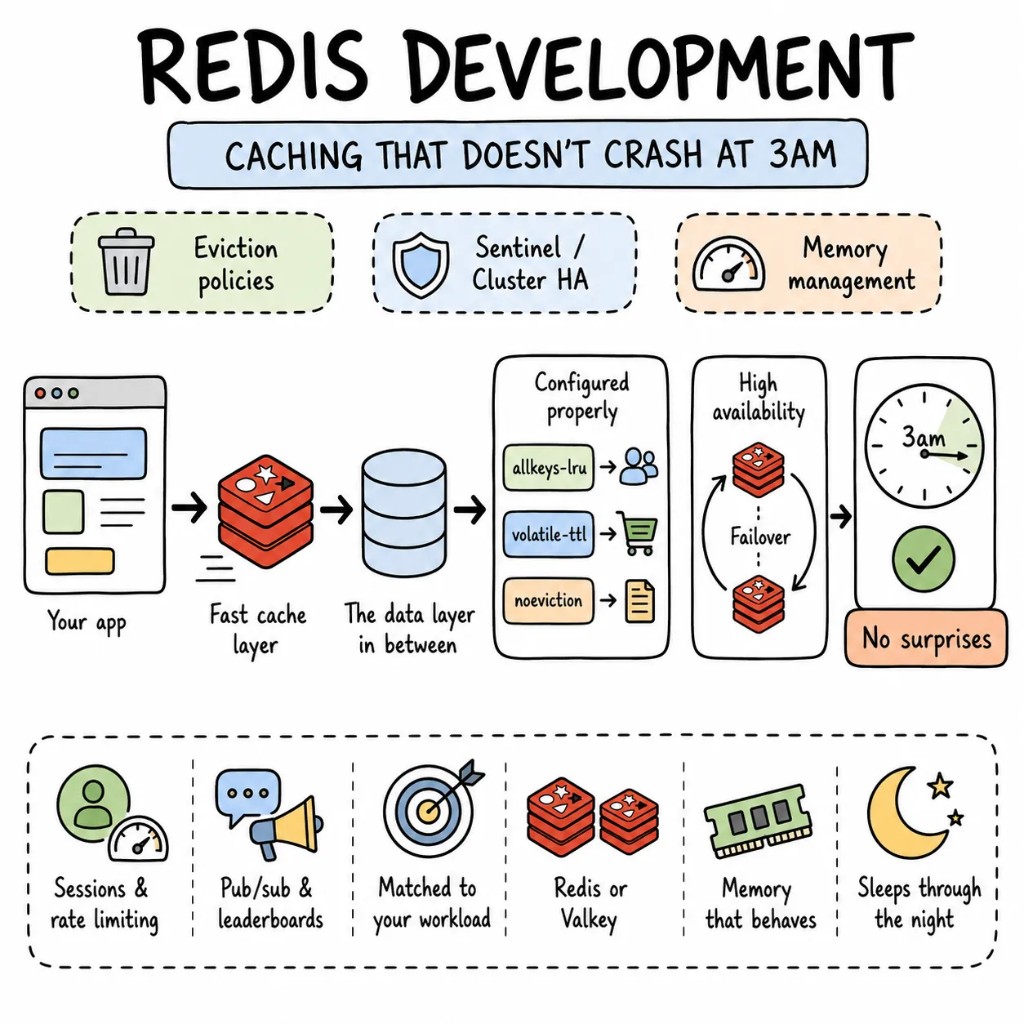
Redis development services for teams that need caching, sessions, rate limiting, pub/sub, and real-time leaderboards — the data layer between your application and your database. Redis or Valkey configured properly — eviction policies matched to your workload, Sentinel or Cluster for HA, and memory management that doesn't surprise you at 3am.
Why Entalogics for Redis
The Redis deployments we audit always have the same problems — no eviction policy so Redis OOMs and crashes, no Sentinel so a node failure takes the cache layer down, keys without TTL accumulating for months, and no monitoring so nobody knows until the application times out.
Default Redis rejects all writes when memory is full — your application breaks. We configure `allkeys-lru` or `volatile-ttl` based on your workload. TTL on every key that isn't permanent. `maxmemory` set with headroom.
A single Redis node is a single point of failure for your entire cache layer. Sentinel for automatic failover with 3+ nodes. Cluster for horizontal sharding when data exceeds single-node memory. Tested quarterly — not assumed to work.
Cache-aside for read-heavy data. Write-through when consistency between cache and database matters. Write-behind for write-heavy workloads where eventual consistency is acceptable. Each pattern chosen for the access pattern it serves.
`INFO` metrics exported to Prometheus or Datadog. Hit rate below 80% means your cache isn't working. Evictions climbing means your memory is too small. Connected clients climbing means your connection pooling is broken.
When Redis, when Valkey
Redis changed to AGPL in 2024. Valkey forked as the BSD-licensed alternative. AWS ElastiCache now defaults to Valkey. The technical choice is the same — the licensing and governance question is new. We'll tell you on the first call which fits.
USE REDIS WHEN
USE VALKEY WHEN
WE SAY NO WHEN
What we build on Redis
The shapes of Redis/Valkey development we deliver most. Each configured for production — not left on defaults.
Cache-aside with proper TTL, eviction, and invalidation. The layer between your app and your database that cuts query load by 80–95%.
Centralised sessions across application instances. Rate limiting per user, per IP, per API key. Sliding windows, token buckets — implemented in Redis, not in your app.
Redis Pub/Sub for real-time notifications. Redis Streams for persistent messaging with consumer groups. The messaging layer that doesn't need Kafka.
Sentinel for automatic failover. Cluster for horizontal sharding. Configured, tested, and monitored — not just deployed and forgotten.
Drop-in migration for standard workloads. Module dependency audit for RediSearch/RedisJSON users. Zero-downtime cutover via replica promotion.
Memory analysis, key distribution audit, pipeline batching, Lua script optimisation. The Redis that handles 500K ops/sec — not the one that OOMs at 50K.
The playbook
Redis patterns from real production deployments — not `SET`/`GET` tutorials.
P01
No key without an expiration unless it's genuinely permanent. `SETEX` and `EXPIRE` on every write. No memory leak from forgotten keys accumulating for months.
P02
`allkeys-lru` for general caching. `volatile-ttl` for mixed permanent and temporary keys. `noeviction` only when you've sized memory to fit the entire dataset.
P03
Multiple commands batched in a single round trip. 100 individual `GET` calls replaced with one pipeline. Latency drops from 100ms to 2ms.
P04
Quorum-based failover. Sentinel monitoring every replica. Failover tested quarterly with measured recovery time. Not assumed to work.
P05
`service:entity:id:field` naming. Consistent namespaces. Scannable patterns. No flat keys that collide across services.
P06
Memory usage, hit rate, evictions, connected clients, replication lag — all exported and alerted. Cache health visible before the application notices a problem.
Signature case
A B2B SaaS platform using Redis as the API cache — `noeviction` policy causing OOM crashes twice a month, no Sentinel so each crash meant 5 minutes of downtime, 40% of keys without TTL accumulating for 8 months, and no monitoring beyond application timeouts. Configured `allkeys-lru`, deployed Sentinel with 3 nodes, added TTL to all keys, and wired Prometheus monitoring in 5 weeks. Zero OOM crashes since. Cache uptime at 99.99%.
Before
noeviction · OOM crash 2x/month · single node · 40% keys no TTL · no monitoring
After
allkeys-lru · 0 OOM crashes · Sentinel 3-node · TTL on all keys · Prometheus dashboard
Engagement shape
A typical Redis engagement. We configure and deploy node by node — the current cache stays live while we work.
Two senior Redis engineers. Memory analysis, key TTL audit, eviction policy review, HA configuration check. A ranked, dollarized RFC.
Eviction policy configured, TTL enforced, Sentinel or Cluster deployed. Measurable stability improvement in week two.
Pipeline batching, Lua scripts, monitoring configured, Valkey migration if applicable. Your application keeps running.
Prometheus dashboard live. Sentinel tested. Runbook handed to your team — or we stay on retainer.
Stack
Our default Redis development stack — picked for production.
Engagement
No hourly retainer that bills for "thinking time." Pick a lane that matches your stage; everything is fixed-quote or transparently rated.
A defined scope, a fixed price, a senior-only team. From architecture to production in 4–8 weeks.
$15k–$30k
FIXED SCOPE
Embedded engineers in your team. Senior backend engineers specialising in caching architecture. Pause, resize, end with 30 days' notice.
$5k / eng / mo
PER ENGINEER
A long-term partner for data-layer performance — cache architecture, Valkey migration, Pub/Sub scaling, hiring help.
custom
PROCUREMENT-FRIENDLY
Founder-direct
Thirty minutes with the founder. We'll bring a senior Redis engineer, the relevant playbook, and a candid read on whether Redis, Valkey, or a different caching architecture fits your data layer best.