
React.js development services,shipped to production.

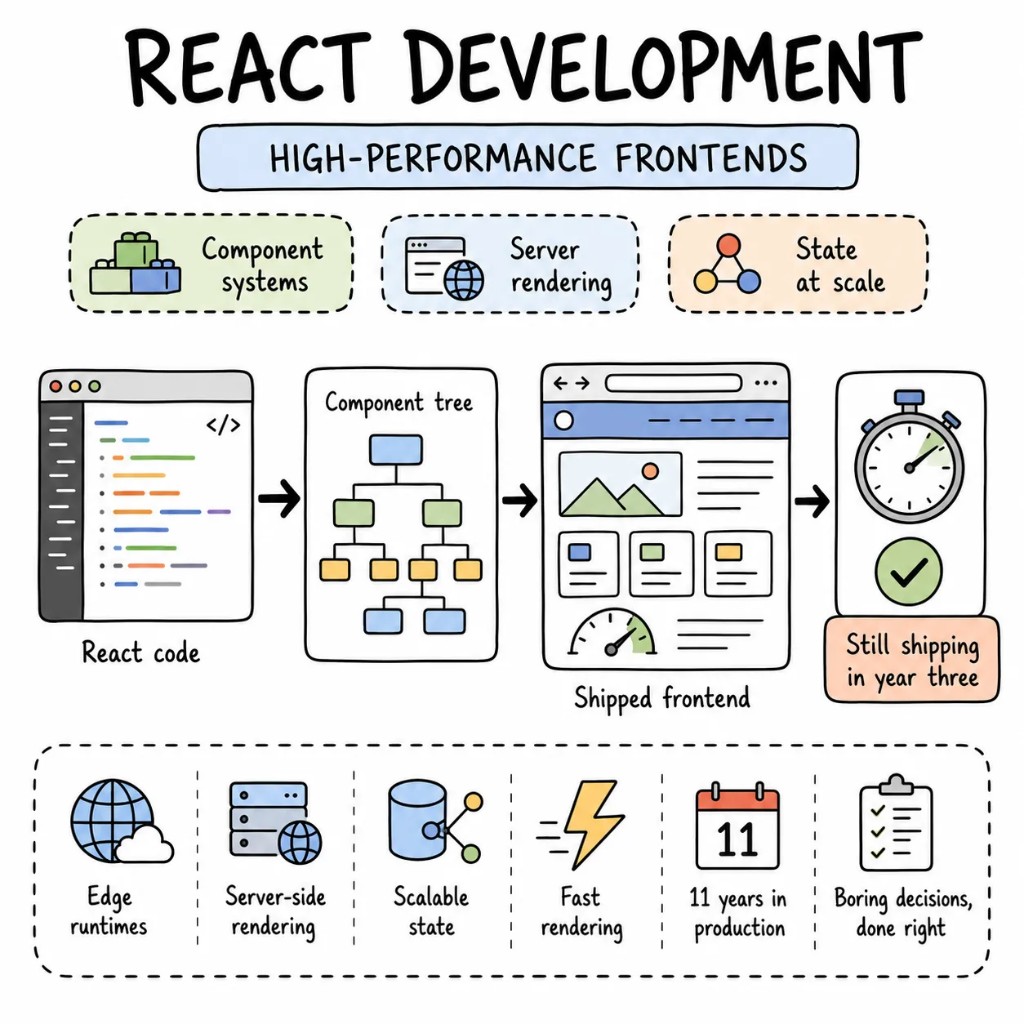
Most React development services stop at tutorial-shaped basics — a demo that works until real traffic hits it. Ours don't. Eleven years of shipping production React means we've already made the boring calls on component architecture, server rendering, edge runtimes, and state management that decide whether your app can still ship features in year three.

  • RSC + App Router
  • Sub-1s LCP
  • Typed end-to-end

Why Entalogics for React

Four things every React
app actually needs.

Most teams hire React developers and end up with React-shaped problems instead. Real React development services fix the boring decisions before they become expensive ones.

Performance01

Sub-1s LCP, by construction.

A sub-1s LCP isn't a target we chase after the fact — it's the only path we build. Streaming, route-level code splitting, and font/image discipline get decided in the architecture, so the team physically can't ship a slow path even by accident.

Architecture02

Component systems, not component soup.

Component soup happens when five engineers each build their own version of the same button. A real design system — tokens, variants, accessibility, built on Radix or shadcn primitives — means five engineers ship one coherent product instead of five stapled-together ones.

State03

State where it belongs, not everywhere.

Most state bugs come from state living in the wrong place. Shareable state goes in the URL. Server state lives in the cache. Client state only shows up where it's actually earned a reason to exist — less Redux, fewer bugs, pages that load faster because they're not dragging around state that doesn't belong to them.

Type-safety04

TypeScript strict, end to end.

Strict TypeScript runs unbroken from the database schema through the API contract to the component prop. When that chain is intact, a refactor that would take weeks of manual checking takes hours, because the compiler catches the boring half of code review before a human has to.

When React, when not

React is a tool.
Not a religion.

An honest decision matrix, not a pitch for React development services you don't actually need. We'll tell you on the first call whether this stack is right for your problem, or whether your budget is better spent elsewhere.

PICK REACT WHEN

  • Your product lives or dies on rich interactivity — dashboards, editors, real-time updates
  • Hiring matters to you, and React's talent pool is the deepest one out there
  • You want one codebase spanning web, native (React Native), and desktop (Electron/Tauri)
  • You're building for the next three-plus years, not a six-week sprint

CONSIDER OTHERS WHEN

  • Content-heavy marketing sites or docs at real scale — Astro or 11ty carry less weight for the same job
  • A five-page brochure site doesn't need a framework at all — plain HTML wins outright
  • Your green-field team already ships well in Vue or Svelte — don't fight momentum that's already working

WE SAY NO WHEN

  • "Everyone else moved to React" isn't a migration plan, it's peer pressure
  • A four-page brochure site doesn't need React, and it doesn't need us either
  • A two-slide spec and a one-week deadline isn't a scope — it's a different conversation entirely

What we build with React

Six product surfaces.
One quality bar.

The shapes of React application development we ship most — single-page apps, dashboards, and everything in between, each slotting cleanly into a stack you already have.

  • S01

    Marketing & growth surfaces

    Landing pages, docs, and blog content built to take real traffic — CMS-driven, rendered at the edge, with instrumentation wired in from the first deploy, not bolted on after launch.

    NEXT.JSSANITYCONTENTFULVERCEL
  • S02

    SaaS dashboards & admin

    Multi-tenant interfaces where navigation changes by role, tables carry the real workload, and updates show up live — offline-capable as a PWA when the workflow genuinely needs it.

    NEXT.JSTRPCTANSTACKRADIX
  • S03

    AI & agent UIs

    Chat interfaces that stream, tool-call inspectors that show what the agent actually did, eval dashboards, and UIs built for tasks that keep running after the request ends.

    VERCEL-AIRSCSHADCN
  • S04

    Commerce storefronts

    A fully headless product page, listing page, cart, and checkout on Hydrogen or Next.js — built to hit sub-second LCP on mobile, not just desktop.

    HYDROGENNEXT.JSALGOLIA
  • S05

    Internal tooling

    One spreadsheet becomes five. Five become an unmaintainable Notion doc holding it all together. We replace all of it with something built to be internal tooling, not a workaround.

    NEXT.JSTRPCPRISMATAILWIND
  • S06

    Design systems & libs

    A component library your team actually owns — tokens, primitives, MDX-documented, versioned, and demoed in Storybook, not scattered across five different Figma files.

    STORYBOOKRADIXTOKENS-STUDIO

The playbook

Patterns we
ship on repeat.

The architectural patterns that show up on almost every React engagement. Not invention — convention, applied carefully.

  • P01

    Server components first

    RSC is the default, and client components are the exception — added only where interactivity actually earns its cost. Smaller bundles, faster pages, a mental model that doesn't need a flowchart to explain.

  • P02

    Typed contracts

    The boundary between frontend and backend gets checked by the compiler, not discovered in production. tRPC, Zod, or generated GraphQL types turn a broken contract into a build failure, not a runtime surprise.

  • P03

    Cache-first data

    Client-side data lives in TanStack Query. Server-side data lives in the RSC cache with revalidation. Neither approach tolerates request waterfalls or a UI that quietly shows stale data.

  • P04

    Design tokens

    Color, spacing, and typography live in code, not in a screenshot someone eyeballed. Light mode, dark mode, density, and brand variants all fall out of that decision for free instead of costing a redesign.

  • P05

    Visual + integration tests

    A handful of well-chosen Playwright and snapshot tests catch the regressions a human reviewer misses on the fifth PR of the day — and the whole suite runs in CI in under five minutes, not overnight.

  • P06

    Strangler-fig migrations

    React gets introduced one route at a time inside an app that already exists — never a flag-day cutover. The current product keeps shipping features the entire time we're migrating it.

Signature case

A SaaS dashboard,
route by route..

A B2B platform on a legacy SPA — 4.8s LCP, two-second route transitions, bundle creeping past 1.2 MB. We migrated to a typed Next.js App Router setup in 10 weeks. Without a feature freeze.

Before

p75 LCP 4.8s · bundle 1.2 MB · client state in 11 stores

After

p75 LCP 0.84s · bundle 280 kB gz · server-cache + URL state

  • p75 LCP improvement−83%
  • route bundle size−77%
  • to fully migrated10wk
  • shipped regressions0

Engagement shape

Eight to ten weeks
to a measurable ship.

A typical React development engagement, start to finish. Migration happens route by route, never in one flag-day cutover — the current app keeps shipping the whole time.

  • W01

    Audit + RFC

    Two senior engineers spend week one inside your actual codebase — a bundle analysis, a render-blocking inventory, a state-management audit. You come out of it with an RFC ranked by impact and priced in dollars, not a vague roadmap slide.

  • W02–03

    Foundation + first route

    Design tokens get set up, the type-safety baseline gets established, and one real production route migrates start to finish. The metrics that show up are in your actual dashboards, not a staged demo built to look good.

  • W04–08

    Migrate by route, not flag-day

    Every remaining route migrates one at a time behind a feature flag, old and new versions running side by side. Every cutover ships with a kill-switch. Your product roadmap doesn't pause for any of it.

  • W09+

    Cleanup + handoff

    The old code gets deleted, not left as dead weight. Component library docs get written, Storybook gets set up, visual and integration tests get built in. The runbook goes to your team directly, or we stay on retainer if that's the better fit.

Stack

Tools we
Tools we reach
reach for for first.

Picked by problem, not by resume. Happy to slot into your stack — but green-field, this is the default.

Framework
Next.js 15 (App Router) · React 19 · Remix · Vite
Language
TypeScript (strict) · Zod · ESLint + biome
Styling
Tailwind · CSS Modules · vanilla-extract · Radix · shadcn/ui
Data
tRPC · TanStack Query · GraphQL · Drizzle · Prisma
Testing
Playwright · Vitest · React Testing Library · Storybook
Infra
Vercel · Cloudflare Workers · AWS · Datadog · Sentry

Engagement

Three ways
to work with us.

No hourly retainer billing for "thinking time." Pick the lane that matches your stage — every path is fixed-quote or transparently rated.

FIXED SCOPEone-off build

Ship a React app, end-to-end.

One product, scoped up front, priced once, built entirely by senior engineers — no junior rotation. RFC to launch inside 8 to 14 weeks.

$15k–$30k

FIXED SCOPE

  • Zero juniors on client work
  • Fixed quote in week 1
  • Code, infra, runbook — yours
Plan a fixed build
DEDICATED TEAMmonthly

Hire dedicated React developers.

A pod of senior React engineers embedded directly in your Slack, your Linear, your standups — sized to what your team actually needs, resized or paused with 30 days' notice, no long lock-in.

$5k / eng / mo

PER ENGINEER

  • Same senior bar as fixed-scope
  • Embedded in your team
  • Founder-direct escalation
Hire dedicated React devs
ENGAGEMENTcustom

Strategic React consulting partnership.

For product orgs that need more than a delivery team — a long-term React consulting partner who also brings judgement: design system ownership, an ongoing performance program, help hiring your own team when the time comes.

custom

PROCUREMENT-FRIENDLY

  • Multi-quarter roadmap
  • Architecture & hiring partner
  • Procurement-friendly paper
Speak to the founder
FAQ

Sharp questions,
straight answers.

Framework choices, upgrades, team shape — the questions we get on every discovery call.
For most product teams, that's Next.js with the App Router. For marketing or commerce sites living at the edge, Next or Remix both work. For internal tools where server rendering doesn't pull its weight, Vite is the better call. We make that decision on day one of discovery, and we explain exactly why.
Yes — and the old app stays live the entire time. We migrate route by route behind a feature flag rather than cutting over all at once. Most React.js upgrades from an older version or CRA land in 6 to 10 weeks of senior engineering time.
No. RSC is our starting assumption, not a rule we won't break. Plenty of routes have good reasons to stay client-rendered, and we make that call route by route, explaining why each time.
Yes. There's no staffing swap partway through and no handoff to an offshore relay team. The same senior engineer who runs your audit in week one is writing production code in week eight and owns the runbook at handoff.
Yes, and if you don't have one yet, we'll build it with you — tokens, Radix or shadcn primitives, MDX documentation, Storybook, versioned releases. Built so your team can keep evolving it without needing us in the room.

Founder-direct

Tell us whatyou're building.

Thirty minutes with the founder. We'll bring a senior React lead, the relevant playbook, and a candid read on whether your problem is one we should take.