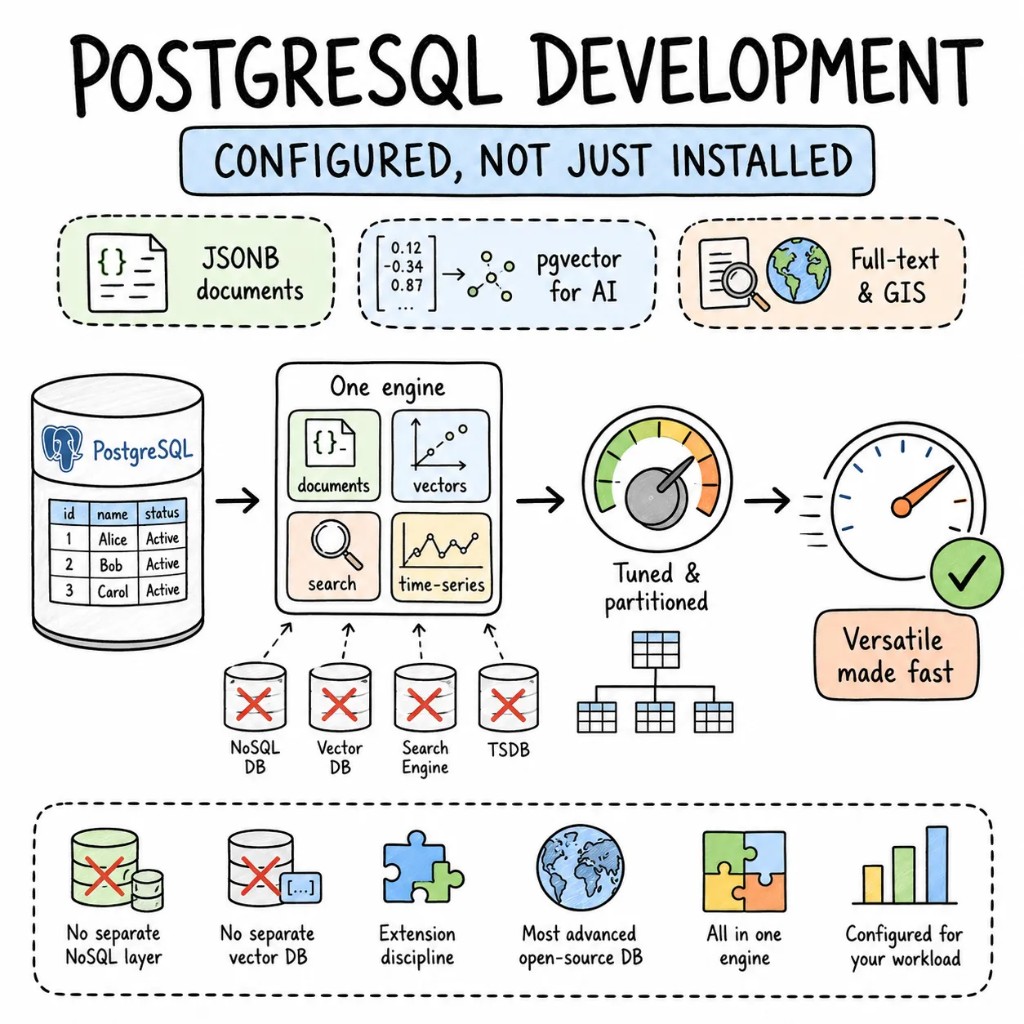
PostgreSQL Development Services.PostgreSQLDevelopment Services.Configured,Not Just Installed.Configured,Not Just Installed.
Our PostgreSQL development services and consulting cover teams building on the most advanced open-source relational database. JSONB for document workloads without a separate NoSQL layer. pgvector for AI embeddings without a separate vector database. Full-text search, GIS, time-series — all in one engine. We build on PostgreSQL with the tuning, partitioning, and extension discipline that turns a versatile database into a fast one.
What every PostgreSQL development company should fix before scaling.
Every PostgreSQL database we audit has the same problems — autovacuum configured at defaults that can't keep up with write volume, no partitioning on tables past 100 million rows, connection pooling absent so every request opens a new connection, and `shared_buffers` at 128MB on a 64GB server. PostgreSQL can do almost anything. Most installations let it do almost nothing well.
Vacuum01
Autovacuum ran on defaults that couldn't keep pace with real write volume.
Dead tuples accumulate, bloat grows, query plans degrade — all quietly, until performance falls off a cliff. We tune autovacuum thresholds per table based on actual write volume, not one setting applied uniformly across the entire database.
Partitioning02
A table crossed 100 million rows before anyone thought about partitioning it.
Range partitioning for time-series, list partitioning for multi-tenant, hash partitioning for even distribution. Added before the table becomes unmanageable, not after queries start timing out and the maintenance window isn't long enough anymore.
Connections03
Every service opened a raw connection, and the server spent more time managing them than running queries.
PostgreSQL forks a process per connection. At 500 concurrent connections, that overhead alone becomes the bottleneck. PgBouncer or Supavisor in front of every production database — connection pooling isn't optional once you're past a handful of clients.
Extensions04
The extension ecosystem sat unused while the team reached for a separate specialized database.
pgvector for AI embeddings, PostGIS for geospatial, TimescaleDB for time-series, Citus for horizontal sharding. The right extensions turn PostgreSQL into a specialized database without needing a separate one running alongside it.
When PostgreSQL, when not
PostgreSQL is a tool. The most versatile one available.
PostgreSQL handles OLTP, JSONB documents, vector search, geospatial queries, and time-series in one engine. That versatility creates the trap of using it for everything without tuning it for anything. We'll tell you honestly on the first call which workloads belong in PostgreSQL and which don't.
PICK POSTGRESQL WHEN
It's greenfield with no database dependency — PostgreSQL is the strongest default relational database in 2026
Mixed workloads are the reality — relational, JSONB, vector, full-text search — without running four separate databases
Open source with no vendor lock-in matters — no Oracle, no licensing surprises, community-governed
AI-native applications need pgvector to keep embeddings next to relational data in one query
CONSIDER ALTERNATIVES WHEN
An existing MySQL application has no real pain — migration cost may exceed the benefit
Global distribution with sub-10ms multi-region reads is the requirement — Cosmos DB or DynamoDB are purpose-built for this
"PostgreSQL for everything because it can do everything" — versatile doesn't mean optimal for every workload
"Migrate from MySQL just because PostgreSQL is better" — if MySQL works, tune it, don't rewrite the data layer
"No connection pooling, we'll just increase max_connections" — that's how you kill the server
What we build on PostgreSQL
PostgreSQL development services and consulting we deliver.
Eight ways this work shows up for real clients. Each one tuned and production-ready.
S01
Application database design and tuning
Application database design and tuning
Schema design, index strategy, query tuning, autovacuum configuration. The relational database layer your application deserves — fast, correct, and maintainable.
POSTGRESQL 17INDEXESEXPLAINPG_STAT_STATEMENTS
S02
AI and vector search with pgvector
AI and vector search with pgvector
Embeddings stored alongside relational data. HNSW indexes for similarity search. Hybrid queries combining vector distance with SQL filters. RAG without a separate vector database.
PGVECTORHNSWEMBEDDINGSRAG
S03
PostgreSQL high availability
PostgreSQL high availability
Streaming replication, Patroni for automatic failover, PgBouncer for connection pooling. HA that's tested, not just configured.
PATRONIPGBOUNCERSTREAMING REPLICATIONWAL
S04
PostgreSQL migration services
PostgreSQL migration services
On-prem to RDS, Aurora PostgreSQL, Cloud SQL, or Supabase. MySQL, Oracle, or SQL Server data remodeled for PostgreSQL. Performance baselined, extensions validated, zero-downtime cutover.
RDSAURORASUPABASECLOUD SQL
S05
Time-series and geospatial on PostgreSQL
Time-series and geospatial on PostgreSQL
TimescaleDB for IoT and metrics. PostGIS for location queries. PostgreSQL as the single database for relational, time-series, and geospatial workloads at once.
TIMESCALEDBPOSTGISPARTITIONINGHYPERTABLES
S06
PostgreSQL database security
PostgreSQL database security
Role-based access control, encryption at rest and in transit, audit logging, and privilege review — security built into the database layer, not bolted on afterward.
RBACSSL/TLSAUDIT LOGGINGPGAUDIT
S07
PostgreSQL training
PostgreSQL training
Hands-on training for engineering teams on query tuning, indexing strategy, and the operational discipline that keeps a database healthy long after we hand it off.
EXPLAININDEXINGDOCUMENTATIONHANDOFF
S08
PostgreSQL upgrades, support, and maintenance
PostgreSQL upgrades, support, and maintenance
Major version upgrades, extension compatibility testing, bloat remediation, and ongoing monitoring — so a tuned database doesn't quietly drift back into the mess we were hired to fix.
PG_UPGRADEEXTENSIONSVACUUMMONITORING
The playbook
PostgreSQL development patterns we ship on repeat.
Patterns from real production databases, not pgAdmin tutorials.
P01
pg_stat_statements on every database
Enabled from day one. Top queries by total time, mean time, and call count reviewed weekly. The single most valuable PostgreSQL tuning tool that most teams never turn on.
P02
Autovacuum tuned per table
Write-heavy tables get aggressive thresholds. Read-heavy tables get relaxed ones. Not one global setting pretending every table behaves the same.
P03
Connection pooling mandatory
PgBouncer or Supavisor in front of every production database. Transaction-mode pooling for serverless workloads. No raw connections from application servers.
P04
Partitioning before it's urgent
Range partitioning on time-series tables, list partitioning for multi-tenant, implemented before a table reaches the size where the maintenance window stops being long enough.
P05
pgvector with HNSW
HNSW indexes for sub-50ms similarity search at millions of vectors. Quantization with halfvec for memory-constrained deployments. One database for relational and vector workloads together.
P06
EXPLAIN ANALYZE before production
Every new query profiled with `EXPLAIN (ANALYZE, BUFFERS)`. Sequential scans on large tables caught in code review. Index recommendations based on actual execution, not theory.
Signature case
A SaaS platform, tuned from connection exhaustion to 3ms p99.
A B2B SaaS platform on PostgreSQL 14 — connection exhaustion at 200 concurrent users, no PgBouncer, autovacuum falling behind on the events table (800M rows, unpartitioned), and queries timing out during peak hours. Added PgBouncer, partitioned the events table by month, tuned autovacuum, and upgraded to PostgreSQL 17 in 8 weeks. Connection limit gone. p99 query latency at 3ms.
We've delivered PostgreSQL development services for healthcare, finance, telecommunications, and SaaS platforms — anywhere mixed workloads, AI-native features, or regulatory data handling genuinely matter.
PostgreSQL development — questions we get on every call.
PostgreSQL vs MySQL, pgvector, hosting choice, migrations, cost — in roughly the order people ask.
PostgreSQL for most greenfield projects — richer data types, better JSONB support, pgvector for AI, PostGIS for geospatial, and no Oracle ownership. MySQL when your framework or CMS requires it specifically. In 2026, PostgreSQL is the stronger default.
Yes. pgvector with HNSW indexes handles millions of vectors with sub-50ms similarity search. For most applications, this eliminates the need for a separate vector database — embeddings live next to relational data in one query.
RDS for straightforward managed PostgreSQL. Aurora for high-availability and read scaling at enterprise traffic. Supabase for startups that want PostgreSQL plus auth, storage, and real-time out of the box. Self-managed only when cloud isn't an option.
Yes. Schema, stored procedures, and data types remodeled for PostgreSQL equivalents. Oracle's PL/SQL and SQL Server's T-SQL both require real translation work, not a mechanical dump-and-load — we validate performance against the source system before cutover.
A typical tuning or migration engagement runs $15K-$30K over 6-10 weeks, depending on database size and scope. The week-one audit gives you real numbers specific to your environment.
Yes. We audit what's there, tune what's slow, partition what's too large, and pool what's exhausting connections. No rip-and-replace.
Founder-direct
Tell us whatyou're building.
Thirty minutes with the founder — a senior PostgreSQL engineer, the relevant playbook, and a candid read on whether PostgreSQL is the right database, or your workload needs something else.