
FIXED SCOPEone-off build
Ship a GCP deployment, end to end.
Fixed scope, fixed price, senior-only team. Landing zone to production workloads in 8-14 weeks.
FIXED SCOPE
- Zero juniors on client work
- Fixed quote in week 1
- Code, infra, runbook — yours
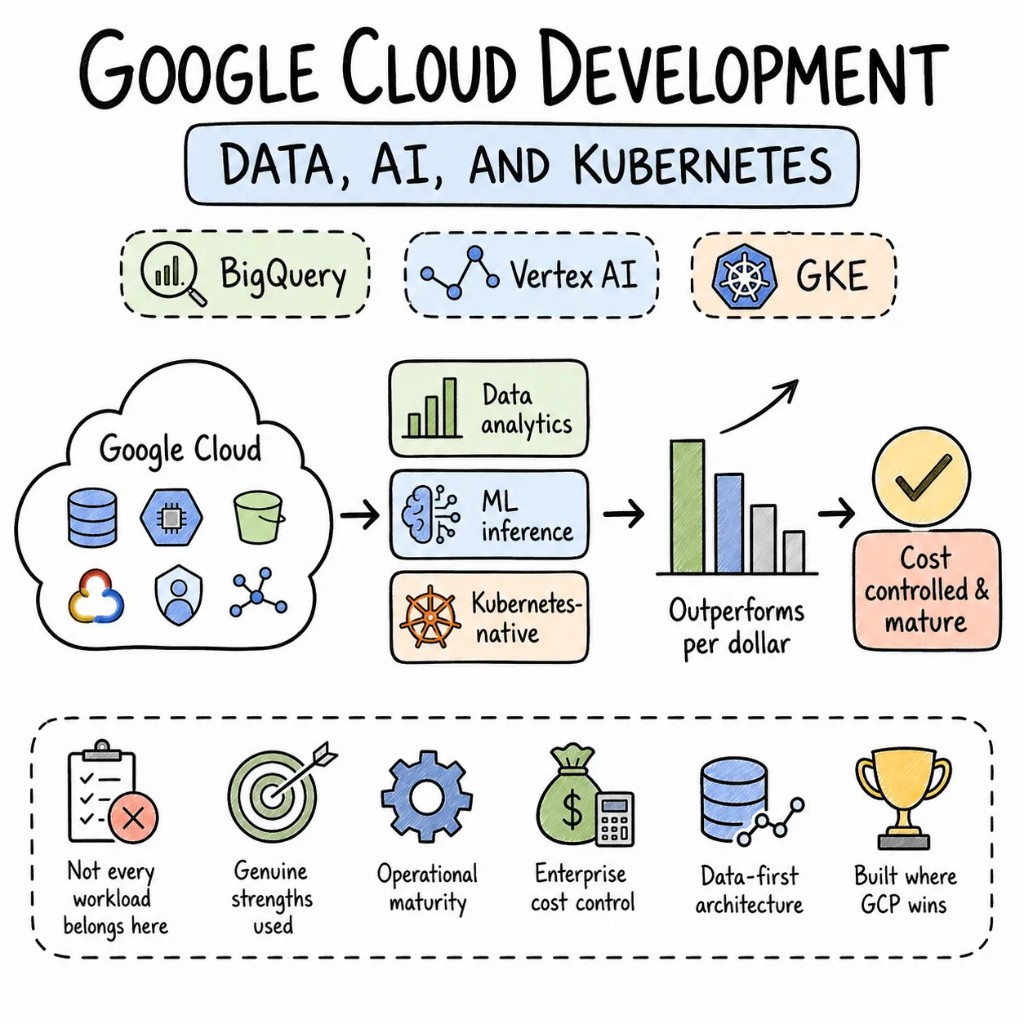
Not every workload belongs on Google Cloud. Our Google Cloud development services exist for the ones that genuinely do — data analytics, ML inference, and Kubernetes-native platforms, where GCP outperforms everyone else per dollar. We build on BigQuery, Vertex AI, and GKE with the cost controls and operational maturity enterprise data teams actually need.
Why Entalogics for Google Cloud
GCP is the cleanest cloud for data and Kubernetes — and the most punishing for teams that don't understand its billing model. Every GCP estate we audit has BigQuery scanning full tables instead of partitioned ones, GKE running on default node pools nobody sized, and committed use discounts that don't match the actual workload.
BigQuery bills by bytes scanned, not by time. A `SELECT *` on an unpartitioned table can burn through your monthly budget in one dashboard refresh. We partition, cluster, and enforce query governors from day one, before an analytics team accidentally spends five figures on a report.
Autopilot handles node provisioning, scaling, and security patching automatically. Standard mode earns its place only when GPU workloads or custom machine types genuinely require it. Same Kubernetes API, far less operational overhead, and most teams never actually need the extra control.
Cloud SQL for relational data. Firestore for documents. Pub/Sub for messaging. BigQuery for analytics. GCP's managed services are strongest in the data layer specifically — we lean into that and don't fight the platform where it's weaker.
Every resource lives in Terraform, stored in git, deployed through Cloud Build or GitHub Actions. No manual console changes surviving a PR. The infrastructure stays auditable because it's version-controlled, not because someone remembers what they clicked.
When GCP, when not
GCP wins decisively on data, AI, and Kubernetes. It has fewer managed services than AWS and less enterprise integration than Azure everywhere else. We'll tell you on the first call which side of that line your workload actually falls on.
PICK GCP WHEN
CONSIDER AWS WHEN
WE SAY NO WHEN
What we build on Google Cloud
Seven ways this work shows up for real clients. Each one deployed with cost controls and observability from day one, not added after the first surprising invoice.
Partitioned, clustered tables. Scheduled queries. BI Engine for sub-second dashboards. Query governors that stop an accidental full-table scan before it reaches your bill.
Model training, fine-tuning, and deployment on Vertex AI. TPU access for large-scale training. Gemini and open-source model serving through MLOps pipelines that run in production, not just a notebook.
Autopilot for most workloads, Standard mode for GPU and custom node pools, Istio for service mesh, ArgoCD for GitOps. GKE treated as a platform decision, never a default hosting choice.
Cloud Functions for lightweight event handling, Cloud Run for containerized serverless, Pub/Sub for messaging, Eventarc for routing. Pay for what actually executes.
Dataflow for streaming and batch, Dataproc for Spark workloads, Cloud Composer for orchestration. Pipelines that process at real scale and fail loudly the moment something breaks.
On-prem to GCP, AWS to GCP, or a legacy GCP estate modernized properly. Workload by workload with Migrate to Containers and Database Migration Service.
Ongoing monitoring, cost reviews, and incident response after go-live — so the environment that launched clean doesn't quietly drift back into the mess we were hired to fix in the first place.
The playbook
Patterns from real production GCP deployments — not a Qwiklab exercise dressed up as a case study.
P01
Every resource in Terraform modules, state in GCS with locking, no console changes surviving past a PR. Drift detection through Terraform Cloud or Atlantis.
P02
Partitioning and clustering on every table. Custom quotas per project. Maximum bytes billed enforced on every query, so no accidental full-table scan ever reaches an invoice.
P03
Autopilot for every workload that doesn't specifically need GPU or custom node configuration. Pod-level billing, no idle node cost, Google managing the nodes instead of your team.
P04
CUDs applied to stable baseline compute. Preemptible VMs for batch jobs and CI. Sustained use discounts captured automatically, every discount mechanism matched to what it's actually built for.
P05
Threat detection and security posture live before an incident forces the question. Organization-level policies, findings prioritized by real severity and exposure.
P06
Build in Cloud Build, deploy through ArgoCD to GKE, stage-gated with approval gates and rollback. No manual `kubectl apply` reaching production.
Signature case
A B2B analytics company running Redshift, a self-managed Spark cluster, and a separate ML training environment on EC2 — $54k/mo, three ops teams, data duplicated across systems, and a 6-hour ETL pipeline that broke weekly. Consolidated into BigQuery for analytics, Dataflow for ETL, and Vertex AI for model training in 10 weeks. Monthly spend dropped 41%. ETL runs in 22 minutes.
Before
Redshift + Spark + EC2 ML · $54k/mo · 3 ops teams · 6hr ETL · weekly pipeline failures
After
BigQuery + Dataflow + Vertex AI · $31.8k/mo · 1 ops team · 22min ETL · zero failures in Q1
Industries we serve
We've delivered Google Cloud development services for finance, media, retail, and data-driven SaaS — anywhere BigQuery's analytics engine or Vertex AI's model infrastructure is already part of the roadmap.
Engagement shape
Workload by workload. The current infrastructure stays live the entire time we work.
BigQuery cost analysis, GKE cluster review, IAM audit, billing structure assessment. A ranked, dollarized plan, not a list of vague concerns.
Terraform landing zone deployed, org policies enforced, first production workload live with monitoring and cost tagging. Real cost data in your dashboard by week three.
Each workload deployed or migrated with right-sized compute, BigQuery guardrails, and Security Command Center enabled. Your product keeps running throughout.
Cost dashboard live, security posture green. Runbook handed over, or we stay on for GCP managed services.
Stack
Our default Google Cloud development stack — picked for production.
Engagement
No hourly billing for thinking time. Fixed quote or a transparent monthly rate.
Fixed scope, fixed price, senior-only team. Landing zone to production workloads in 8-14 weeks.
FIXED SCOPE
Senior cloud architects specializing in GCP data and Kubernetes, embedded in your Slack, your standups. Pause, resize, or exit with 30 days' notice.
PER ENGINEER
A standing partner for data-driven organizations — BigQuery optimization, Vertex AI pipelines, GKE platform engineering, hiring help.
PROCUREMENT-FRIENDLY
Founder-direct
Thirty minutes with the founder — a senior GCP architect, the relevant playbook, and a candid read on whether Google Cloud is the right platform, or AWS and Azure actually fit your workload better.