Dynamics 365 Development Services.Dynamics 365Development Services.One Platform, Built Right.One Platform, Built Right.
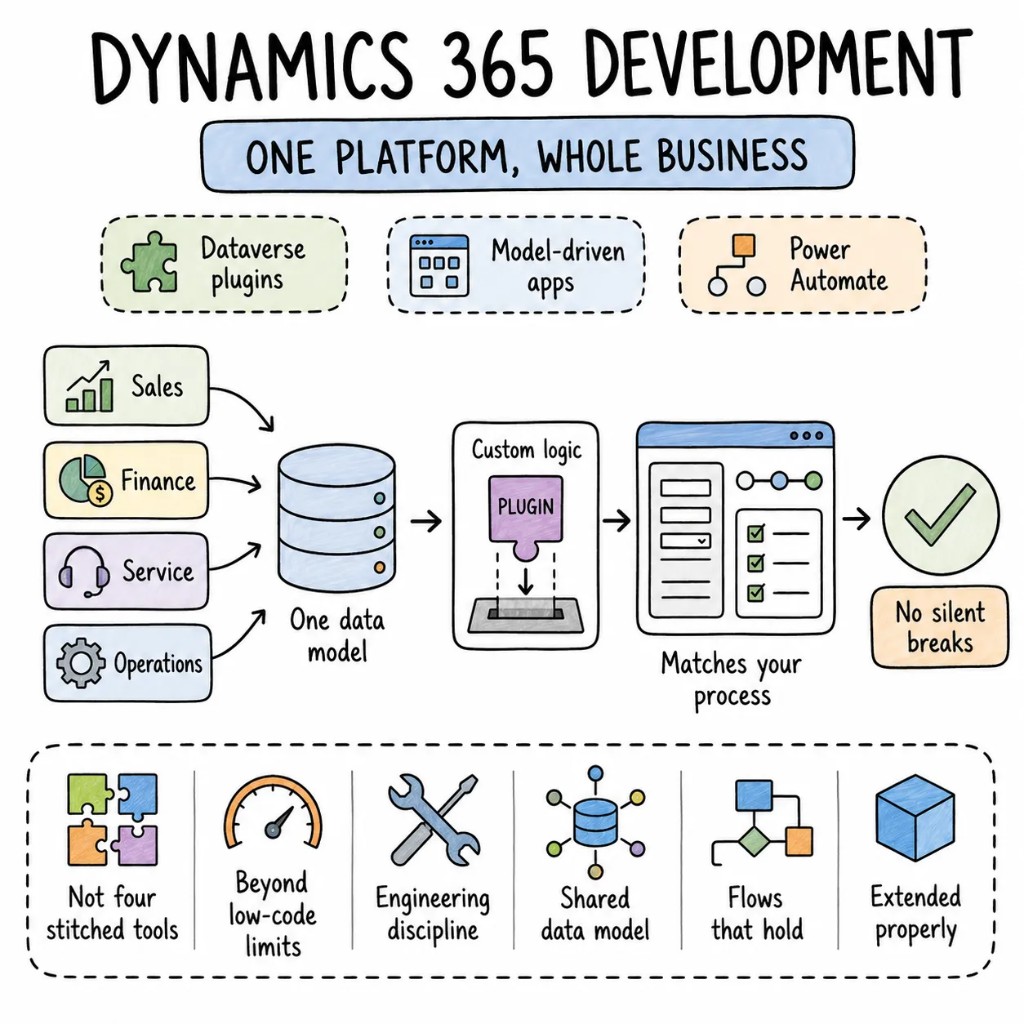
Sales, finance, service, and operations sharing one data model instead of four disconnected tools — that's the actual pitch of Dynamics 365, and most implementations never get there. Our Dynamics 365 development services and consulting cover Dataverse plugins for logic low-code can't touch, model-driven apps that match how your team actually works, and Power Automate flows that fail loudly instead of silently.
What every Dynamics 365 development company should fix before extending anything.
Every D365 instance we inherit has the same four problems — and most Dynamics 365 consulting firms build new modules on top of them instead of stabilizing the foundation first.
Architecture01
Plugins fired on every event because nobody scoped them.
A plugin registered on all messages "just in case" slows every transaction and makes debugging a guessing game. We register pre-validation for blocking logic, pre-operation for data changes, and post-operation for side effects — each one earning its place, not fired reflexively.
Data02
80 fields got crammed onto one Account entity because nobody wanted to build a new table.
Dataverse is a real relational database. We model custom entities where the business domain genuinely needs them, with proper relationships, option sets, and security roles — not every business fact stretched thin across a default entity that was never designed to hold it.
Automation03
Power Automate was doing a job that belonged in the transaction pipeline.
Async automation can't guarantee a real-time integration or a validation that has to block a save. C# plugins handle logic that must execute inside Dataverse's transaction pipeline. Power Automate handles everything else — approvals, notifications, cross-system orchestration. Each tool doing the job it was built for.
ALM04
Customizations lived unmanaged in production, so every release wave was a gamble.
200 unmanaged customizations is how a routine Microsoft release wave turns into a multi-day incident. We move everything into managed solutions, promoted through pipelines from dev to test to production. No editing live. Release waves upgrade cleanly instead of breaking something new every time.
When Dynamics 365, when not
Dynamics 365 is a platform. Not a cheap CRM.
D365 licensing starts at $65 per user per month and scales fast with modules. That's justified for mid-to-large enterprises and overkill for a team that just needs a contact database. We'll tell you honestly on the first call which one you are.
BUILD ON DYNAMICS 365 WHEN
Sales, service, finance, and operations need one connected data model on Dataverse
You're already a Microsoft organization — M365, Azure AD, and Power Platform are in place
Complex processes like CPQ, territory management, or field service scheduling are things D365 handles natively
Compliance and audit requirements the Microsoft ecosystem addresses out of the box matter to you
CONSIDER ALTERNATIVES WHEN
CRM alone is the requirement — HubSpot or Salesforce may be simpler and cheaper for pure sales tracking
You're under 50 users — D365 licensing doesn't scale down well for small teams
Your organization isn't in the Microsoft ecosystem — the integration value disappears without M365 and Azure already in place
WE SAY NO WHEN
"D365 for our 10-person startup" — the licensing alone costs more than a custom solution would
"Customize every entity and form" — that's how upgrades become impossible
"Go live in three weeks" — a proper implementation takes 10-16 weeks minimum
What we build on Dynamics 365
Dynamics 365 development services and consulting we deliver.
Eight ways this work shows up for real clients. Each one built upgrade-safe with proper ALM — not customizations that turn the next release wave into a fire drill.
S01
Dynamics 365 Sales implementation
Dynamics 365 Sales implementation
Lead-to-opportunity pipeline, CPQ configuration, territory management, Copilot-assisted forecasting dashboards. Sales processes configured to how your team actually sells, not a generic template.
D365 SALESDATAVERSEPOWER BICOPILOT
S02
Dynamics 365 Customer Service implementation
Dynamics 365 Customer Service implementation
Case management, SLA enforcement, omnichannel routing, knowledge articles, and a customer portal built on Power Pages. Service workflows that close tickets, not just create them.
D365 SERVICEOMNICHANNELPOWER PAGESCOPILOT
S03
Dynamics 365 Finance and Operations development
Dynamics 365 Finance and Operations development
GL configuration, AP/AR, budgeting, supply chain — F&O customization with X++ only where standard modules genuinely fall short.
D365 F&OX++POWER BIAZURE
S04
Dynamics 365 plugin development
Dynamics 365 plugin development
C# plugins for transaction-level business logic, real-time validation, and integrations that can't tolerate async delay. Registered properly, scoped tightly, tested thoroughly before anything ships.
C# PLUGINSDATAVERSEPIPELINEUNIT TESTS
S05
Dynamics 365 and Power Platform integration
Dynamics 365 and Power Platform integration
Model-driven apps, canvas apps, Power Automate flows, and Power BI dashboards extending D365 beyond what's available out of the box.
MODEL-DRIVENCANVASPOWER AUTOMATEPOWER BI
S06
Dynamics 365 migration services
Dynamics 365 migration services
On-prem to cloud, CRM 2016 to D365 Online, Dynamics AX to F&O. Data migrated, customizations rebuilt upgrade-safe, integrations rewired to cloud APIs.
MIGRATIONDATAVERSEALMAZURE
S07
Dynamics 365 training
Dynamics 365 training
Hands-on training for admins and power users — Dataverse fundamentals, Power Platform extensions, and the customization patterns that keep an instance upgrade-safe after we hand it off.
DATAVERSEPOWER PLATFORMALMDOCUMENTATION
S08
Dynamics 365 support and maintenance
Dynamics 365 support and maintenance
Ongoing monitoring, release wave readiness checks, plugin health reviews, and performance tuning — so the managed, upgrade-safe instance we built doesn't quietly drift back into unmanaged chaos.
SOLUTION CHECKERALMAZURE DEVOPSMONITORING
The playbook
Dynamics 365 development patterns we ship on repeat.
Patterns from real enterprise Dynamics 365 implementations — not sandbox experiments that fall apart at scale.
P01
OOB before custom
Business rules, calculated fields, and standard workflows first. Plugin code only when OOB genuinely can't handle it. Every customization documented and justified before it ships.
P02
Managed solutions with ALM
All customizations in managed solutions, promoted via pipelines. No unmanaged layers in production, no editing live entities directly.
P03
Plugins scoped tightly
Pre-validation for blocking logic. Pre-operation for data modification. Post-operation for side effects. No plugin registered on every message "just in case."
P04
Security roles by function
Custom security roles matching real business functions. Field-level security on sensitive data. No shared admin accounts, audit logging enabled everywhere it matters.
P05
Power BI on Dataverse via Synapse Link
Operational reporting without touching Dataverse performance. Synapse Link for near-real-time analytics, Direct Lake for sub-second dashboard queries.
P06
Upgrade readiness testing
Solution Checker before every release wave. Regression tests on custom plugins. Sandbox validation before production update. Upgrades take hours, not weeks.
Signature case
A sales organisation, migrated from CRM 2016 on-prem to D365 Online.
A B2B manufacturing company on Dynamics CRM 2016 on-prem — custom plugins with no documentation, 200 unmanaged customisations, no ALM, and a server nearing end-of-life. Migrated to D365 Online with managed solutions, ALM pipelines, and rebuilt plugins in 12 weeks. Sales pipeline visibility improved. Release wave upgrades now take a Saturday morning.
Before
CRM 2016 on-prem · 200 unmanaged customisations · undocumented plugins · no ALM · server EOL
We've delivered Dynamics 365 development services for manufacturing, healthcare, financial services, and professional services — anywhere sales, service, and operations genuinely need one connected data model instead of four disconnected tools.
Dataverse API · Azure Functions · Logic Apps · MuleSoft
Analytics
Power BI · Synapse Link · Direct Lake · Fabric
VOICES
What founders say on the record.
Verified feedback from Upwork, Clutch, and reference calls we're happy to set up before you sign anything.
Evan Kanouse
CEO, Modestly
Entalogics has successfully delivered extension prototypes on time, and we are impressed with their project management and the finished product. The client communicates with Entalogics via virtual meetings, email, and messaging apps.
Adam Strock
Founder, Flourish Schools
Collaborating with Entalogics was a great experience. Communication was clear, we aligned quickly, and their team delivered high-quality code on time with thoughtful technical decisions.
Giles Whitman
CTO, SentryBay
Their Chromium expertise helped us ship a hardened browser with live threat controls and enterprise rollout support. Security operations became significantly faster.
George Irvin
Founder, G3 Ventures LLC
Entalogics delivered our custom Electron browser in six months with isolated profile workflows and stable policy sync. Agent onboarding improved by 55% after rollout.
Dani Keo
Project Manager, Sociall
Entalogics built our iOS Chromium-based mobile app with a smooth native feel, stable media rendering, and reliable sync. We shipped faster and improved engagement after launch.
Project Manager
RozmeriGPT
The web dashboard and Chrome extension now share prompts, billing, and analytics in one platform. Our content turnaround improved 4x after launch.
Ilya Khodakovsky
Project Manager, Omni Browser
Entalogics built our Omni Browser on top of Chromium with deep product-level execution. They implemented an integrated VPN and Omni Crypto Wallet directly in the browser, made strong architectural decisions, and delivered quality code on schedule with clear communication.
Sherzod Khabibullayev
Project Manager, Digital Office: Aura
Entalogics built Digital Office: Aura as a custom Chromium-based authentication platform. Their team modified Chromium internals and integrated our manual custom authentication flow with reliable implementation, fast delivery, and consistent communication.
Engagement
Three ways to hire Dynamics 365 developers at Entalogics.
No hourly billing for thinking time. Fixed quote or a transparent monthly rate.
FIXED SCOPEone-off build
Ship a Dynamics 365 project, end to end.
Fixed scope, fixed price, senior-only team. RFC to production in 10-16 weeks.
Dynamics 365 development — questions we get on every call.
D365 vs Salesforce, plugins vs Power Automate, migrations, cost, training — in roughly the order people ask.
D365 if you're a Microsoft organization and need CRM and ERP on one Dataverse platform with native M365 integration. Salesforce if CRM is your only requirement and AppExchange ecosystem depth matters more than Microsoft integration. We'll tell you which fits on the first call.
Power Automate for async orchestration — approvals, notifications, cross-system flows. C# plugins when logic must execute inside the Dataverse transaction pipeline — real-time validation, calculations, or integrations that can't tolerate async delay.
Yes. Data migrated through the Dataverse SDK, customizations rebuilt as managed solutions, integrations rewired to cloud APIs. The on-prem system stays running until D365 Online is validated and live.
Licensing starts at $65 per user per month and scales with modules. A fixed-scope implementation typically runs $15K-$30K over 10-16 weeks. The week-one audit gives you real numbers specific to your scope, not a generic estimate.
Yes. We train your admins and power users on Dataverse fundamentals, Power Platform extensions, and the customization patterns that keep the instance upgrade-safe once we've handed it off.
Yes. The engineers who write the RFC ship the implementation. No handoff mid-engagement, no account manager in between.
Senior engineers
Tell us whatyou're building.
Thirty minutes with a senior D365 consultant, the relevant playbook, and a candid read on whether Dynamics 365 is the right platform, or a lighter CRM serves your business better.