Cosmos DB Development Services.Cosmos DBDevelopment Services.Globally Fast, Locally Cheap.Globally Fast, Locally Cheap.
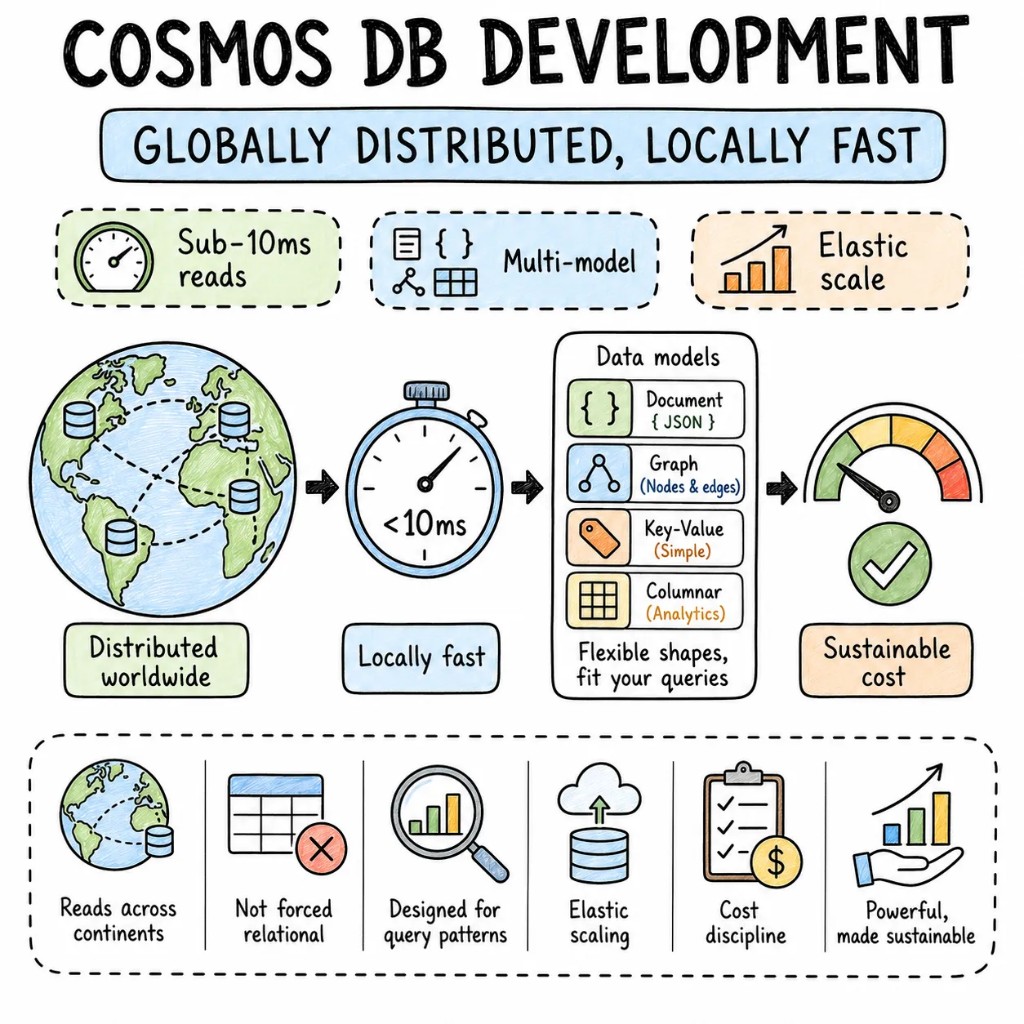
Our Azure Cosmos DB development services and consulting exist for applications that need sub-10ms reads across continents, multi-model flexibility, and elastic scale that relational databases can't match. Data models designed around your actual query patterns, not forced into a relational shape. We build on Cosmos DB with the cost discipline that turns a powerful database into a sustainable one.
What every Cosmos DB development company should model before provisioning.
Every Cosmos DB account we audit has the same problems — a partition key chosen by guessing, cross-partition queries running on every hot path, and a monthly bill climbing 30% with no traffic growth behind it. Cosmos DB is powerful. Most implementations pay for that power without actually using it.
Partition Key01
A guessed partition key turned into an $8,000 monthly bill.
A bad partition key creates hot partitions that burn through 80% of your provisioned RUs while everything else sits idle. We model access patterns before provisioning and choose partition keys that distribute reads and writes evenly — usually the entire difference between a $500 and a $5,000 monthly Cosmos bill.
Data Model02
The schema got designed on a whiteboard, not around how the app actually queries data.
Cosmos DB isn't relational. Joins are expensive, cross-partition queries are expensive. We model documents around real read patterns — embedding related data, using change feed for materialized views, keeping every hot-path query aligned to a single partition.
Indexing03
The default indexing policy was silently taxing every single write.
Indexing every property by default burns RUs on writes nobody asked it to optimize. We define policies that index only the fields your queries actually filter on — write-heavy workloads typically see 40-60% RU savings from this change alone.
Throughput04
Throughput mode got picked once and never revisited.
Autoscale for traffic that spikes unpredictably. Provisioned throughput for stable, known patterns. Serverless for development and low-traffic apps. Each tier chosen from measurement, not left on whatever was selected during setup.
When Cosmos DB, when not
Cosmos DB is a tool. Not the right database for everything.
Cosmos DB excels at global distribution, elastic scale, and sub-10ms latency — and it punishes a bad data model harder than any relational database ever will. We'll tell you honestly on the first call if Cosmos DB actually fits.
PICK COSMOS DB WHEN
Global distribution with single-digit-millisecond latency across regions is the actual requirement
Traffic is elastic and unpredictable — autoscale handles millions of requests without manual capacity planning
Multi-model flexibility matters — NoSQL, MongoDB, Cassandra, Gremlin, or Table API from one account
AI and RAG workloads need vector search alongside operational data — Cosmos DB's integrated vector indexing skips a separate vector database entirely
CONSIDER ALTERNATIVES WHEN
Relational data with complex joins and transactions is the core need — Azure SQL or PostgreSQL is simpler and cheaper
The application is single-region with predictable traffic — Cosmos DB's global distribution value disappears
Budget is tight and data volume is small — Cosmos DB's minimum cost exceeds what managed PostgreSQL handles for less
WE SAY NO WHEN
"Cosmos DB because it's NoSQL" — that's a category, not a reason
"Migrate our SQL Server to Cosmos" — relational workloads rarely benefit from a document database
"We'll figure out the partition key later" — later means a full re-architecture and a data migration
What we build on Cosmos DB
Cosmos DB development services and consulting we deliver.
Eight ways this work shows up for real clients. Each one modeled for real query patterns and cost-optimized from day one.
S01
Real-time application backends
Real-time application backends
eCommerce, gaming, social platforms — high-throughput read/write with sub-10ms latency. Documents modeled around access patterns, not entity relationships copied from an ERD.
COSMOS NOSQLCHANGE FEEDAUTOSCALESDK V3
S02
IoT data platforms
IoT data platforms
Device telemetry ingestion at millions of events per second. Hierarchical partition keys combining device ID and date. TTL for automatic expiration, change feed for real-time analytics.
COSMOS NOSQLHIERARCHICAL KEYSTTLCHANGE FEED
S03
Cosmos DB for AI and vector search
Cosmos DB for AI and vector search
Vector indexing built directly into Cosmos DB, powering semantic search, recommendation engines, and RAG pipelines alongside your operational data — without standing up a separate vector database.
VECTOR SEARCHAZURE OPENAIRAGEMBEDDINGS
S04
Multi-region global applications
Multi-region global applications
Active-active multi-region writes with conflict resolution. Users in Tokyo, London, and New York each get sub-10ms reads from their own local replica.
MULTI-REGIONMULTI-WRITECONFLICT RESOLUTIONSLA
S05
MongoDB API on Cosmos DB
MongoDB API on Cosmos DB
Existing MongoDB workloads running on Cosmos DB's managed infrastructure with zero code changes. Global distribution and elastic scale without managing replica sets yourself.
MONGODB APICOSMOS DBGLOBAL DISTRIBUTIONMANAGED
S06
Cosmos DB cost optimization
Cosmos DB cost optimization
Accounts with runaway costs. Partition key analysis, indexing policy tuning, throughput right-sizing, and change feed for materialized views that eliminate cross-partition queries entirely.
RU ANALYSISINDEXING POLICYAUTOSCALECOST TUNING
S07
Relational to Cosmos DB migration
Relational to Cosmos DB migration
SQL Server or PostgreSQL data modeled properly for Cosmos DB. Documents denormalized around real query patterns. Change feed replacing triggers. Migration validated against real performance numbers.
DATA MODELINGMIGRATIONCHANGE FEEDSDK V3
S08
Cosmos DB support and maintenance
Cosmos DB support and maintenance
Ongoing RU monitoring, indexing policy reviews, and cost audits — so the account we optimized doesn't quietly drift back into the runaway bill we were hired to fix.
RU MONITORINGCOST AUDITSINDEXING REVIEWSUPPORT
The playbook
Cosmos DB development patterns we ship on repeat.
Patterns from real production deployments, not quickstart tutorials.
P01
Partition key modeling before provisioning
Access patterns documented. Read/write ratios measured. Partition key chosen for even distribution and query alignment, never chosen by field name alone.
P02
Custom indexing policy
Only the fields your queries actually filter on get indexed. Composite indexes for ORDER BY queries. Spatial indexes only where geo-queries genuinely exist. The default policy replaced on day one.
P03
Change feed for materialized views
A write-optimized container plus change-feed-projected read containers. Every query stays partition-aligned. Cross-partition fan-out eliminated from hot paths.
P04
Hierarchical partition keys for multi-tenant
Tenant ID as the first level, entity type as the second. Data isolated per tenant. Queries scoped to a single logical partition, no cross-partition reads for tenant-specific data.
P05
Autoscale with budget caps
Autoscale with a known max RU/s ceiling. Budget alerts wired into Azure Cost Management. No surprise bill from a traffic spike that permanently provisioned 100,000 RU/s.
P06
SDK V3 with bulk and batch
Bulk operations for high-throughput ingestion. Transactional batch for multi-document atomicity within a partition. SDK configured with direct mode and TCP for the lowest latency available.
Signature case
An e-commerce backend, remodelled from hot partitions to even distribution.
A B2C e-commerce platform on Cosmos DB — monthly bill at $8,200, single partition absorbing 78% of traffic, cross-partition queries on the product listing page, and default indexing policy burning RUs on 40 unused fields. Remodelled the partition key, custom indexing policy, change feed for materialised product views, and autoscale with budget caps in 6 weeks. Monthly bill dropped to $3,100. Latency unchanged at 7ms.
Before
$8,200/mo · hot partition at 78% · cross-partition product queries · default indexing · no autoscale cap
After
$3,100/mo · even distribution · partition-aligned queries · custom indexing · autoscale with cap
Monthly cost−62%
Hot partition load78% → even
To fully optimised6wk
Latency unchanged7ms
Industries we serve
Cosmos DB development across industries.
We've delivered Cosmos DB development services for eCommerce, gaming, IoT, healthcare, and financial platforms — anywhere global latency requirements and elastic scale genuinely matter, including HIPAA and PCI-relevant workloads Cosmos DB is built to support.
Container by container. Your current data stays live the entire time we work.
W01
Audit + RFC
Two senior Cosmos DB engineers. Partition key analysis, RU consumption profiling, indexing policy review, cost breakdown. A ranked, dollarized plan.
W02–03
Data model + first container
Access patterns modeled, partition keys chosen, indexing policy defined, first container deployed with SDK integration. Real RU consumption measured.
W04–08
Container by container
Each container modeled, migrated, and validated. Change feed wired for materialized views. Autoscale configured. Your application keeps running throughout.
W09+
Handoff
Cost dashboard live, indexing policies tuned. Runbook handed to your team — or we stay on for Cosmos DB support and maintenance.
Stack
Tools we Tools we reach reach for for first.
Our default Cosmos DB development stack — picked for production.
Database
Cosmos DB NoSQL API · MongoDB API · Cassandra API · Table API
Verified feedback from Upwork, Clutch, and reference calls we're happy to set up before you sign anything.
Evan Kanouse
CEO, Modestly
Entalogics has successfully delivered extension prototypes on time, and we are impressed with their project management and the finished product. The client communicates with Entalogics via virtual meetings, email, and messaging apps.
Adam Strock
Founder, Flourish Schools
Collaborating with Entalogics was a great experience. Communication was clear, we aligned quickly, and their team delivered high-quality code on time with thoughtful technical decisions.
Giles Whitman
CTO, SentryBay
Their Chromium expertise helped us ship a hardened browser with live threat controls and enterprise rollout support. Security operations became significantly faster.
George Irvin
Founder, G3 Ventures LLC
Entalogics delivered our custom Electron browser in six months with isolated profile workflows and stable policy sync. Agent onboarding improved by 55% after rollout.
Dani Keo
Project Manager, Sociall
Entalogics built our iOS Chromium-based mobile app with a smooth native feel, stable media rendering, and reliable sync. We shipped faster and improved engagement after launch.
Project Manager
RozmeriGPT
The web dashboard and Chrome extension now share prompts, billing, and analytics in one platform. Our content turnaround improved 4x after launch.
Ilya Khodakovsky
Project Manager, Omni Browser
Entalogics built our Omni Browser on top of Chromium with deep product-level execution. They implemented an integrated VPN and Omni Crypto Wallet directly in the browser, made strong architectural decisions, and delivered quality code on schedule with clear communication.
Sherzod Khabibullayev
Project Manager, Digital Office: Aura
Entalogics built Digital Office: Aura as a custom Chromium-based authentication platform. Their team modified Chromium internals and integrated our manual custom authentication flow with reliable implementation, fast delivery, and consistent communication.
Engagement
Three ways to hire Cosmos DB developers at Entalogics.
No hourly billing for thinking time. Fixed quote or a transparent monthly rate.
FIXED SCOPEone-off build
Ship a Cosmos DB deployment, end to end.
Fixed scope, fixed price, senior-only team. Data modeling to production in 6-12 weeks.
A standing partner for data-intensive applications — cost optimization, global distribution architecture, AI/vector search strategy, migration planning, hiring help.
Cosmos DB development — questions we get on every call.
Partition keys, runaway costs, database choice, AI/vector search, pricing — in roughly the order people ask.
Model your access patterns first. The partition key should align with your most frequent query filter and distribute data evenly. A bad key creates hot partitions that waste RUs. We model before provisioning, since changing a partition key after deployment means a full data migration.
Usually three things: hot partitions wasting provisioned RUs, cross-partition queries on hot paths, and a default indexing policy indexing fields nobody queries. Fixing those three issues alone typically cuts bills 40-60%.
Cosmos DB for global distribution, elastic scale, and sub-10ms latency on document workloads. Azure SQL for relational data with complex joins and transactions. Most applications don't actually need Cosmos DB, and we'll tell you honestly if yours does.
Yes. Cosmos DB's integrated vector indexing supports semantic search, RAG, and recommendation engines directly alongside your operational data, without standing up and syncing a separate vector store.
A typical engagement runs $15K-$30K over 6-12 weeks, depending on data volume and how many containers need modeling or migration. The week-one audit gives you real numbers specific to your workload.
Yes. We audit partition keys, indexing policies, throughput settings, and query patterns. Most existing deployments have 30-60% cost reduction available without changing a line of application code.
Senior engineers
Tell us whatyou're building.
Thirty minutes with a senior Cosmos DB engineer, the relevant playbook, and a candid read on whether Cosmos DB is the right database, or Azure SQL, PostgreSQL, or DynamoDB fits your workload better.