
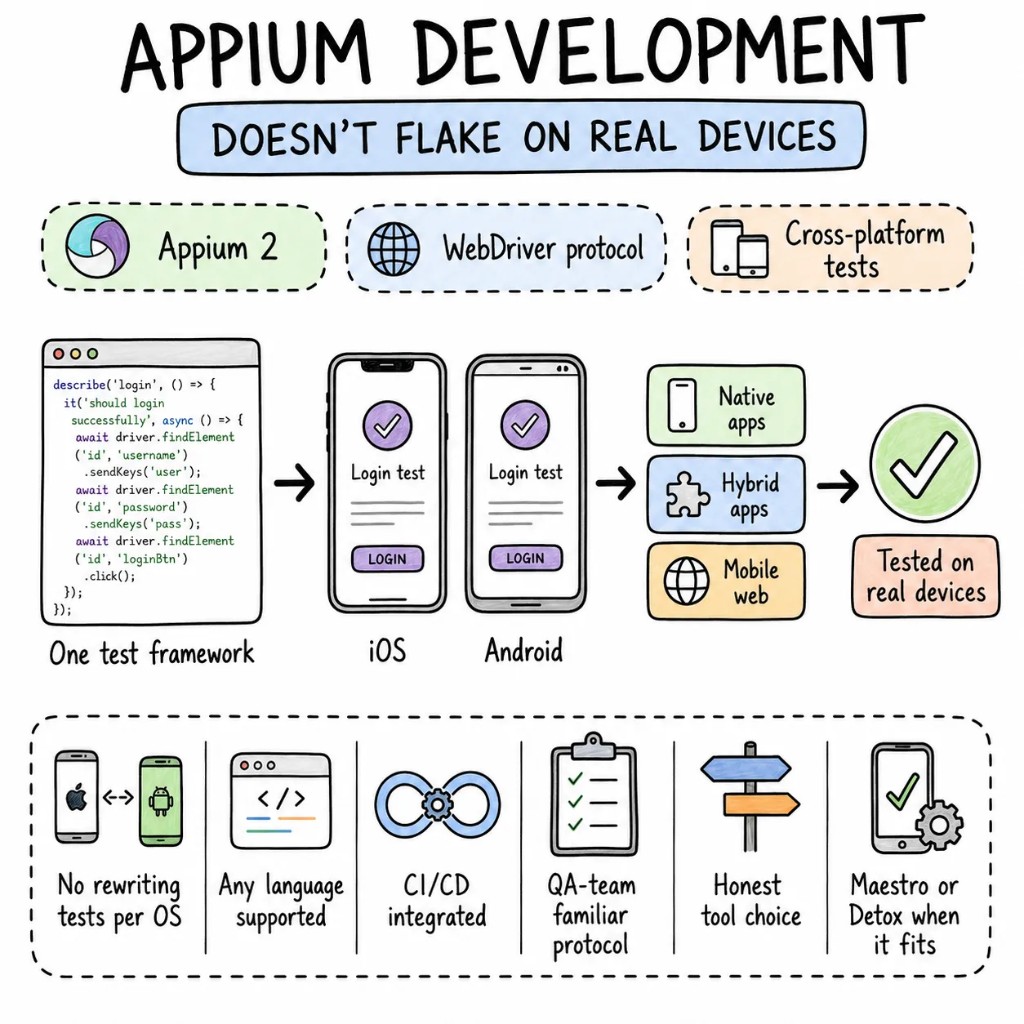
Appium suites that don't flakeon real devices.

One test framework, both platforms, any language. Appium testing services for teams that need cross-platform mobile test automation without rewriting tests for each OS. Native apps, hybrid apps, mobile web — tested on real devices with the WebDriver protocol your QA team already knows. And when Maestro or Detox is the better fit, we'll say that on the first call.

  • Appium 2
  • Real device testing
  • Cross-platform
  • CI/CD integrated

Why Entalogics for Appium

Four things every
Appium test suite
actually needs.

The Appium suites we inherit always have the same problems — 45-minute test runs on a single emulator, XPath selectors that break on every UI change, no Page Object Model for screens, and a setup so complex that only one person on the team can run them locally. Appium is powerful. Most implementations waste that power.

Reliability01

Accessibility IDs, not XPath selectors.

XPath selectors are the number one source of Appium test flakiness. We use accessibility IDs on both platforms — stable across UI changes, fast to locate, and better for app accessibility as a side benefit.

Architecture02

Screen Object Model — Page Objects for mobile.

Every screen gets a class. Platform-specific locators behind a shared interface. Tests read like user flows, not selector chains. When the UI changes, you update one screen object.

State03

Parallel execution on real devices, not one emulator.

BrowserStack, Sauce Labs, or a local device farm running tests in parallel across iOS and Android. A 45-minute sequential run drops to 8 minutes across real devices.

Type safety04

Typed screen objects in Java, Python, or TypeScript.

Strongly typed screen objects with typed return values. `loginAs()` returns a `HomeScreen`, not void. Navigation mistakes caught by the compiler — not by a 20-minute test run.

When Appium, when not

Appium is a tool.
Not always the right one in 2026.

Appium is the most versatile mobile testing framework — any platform, any language, any app type. That versatility costs setup complexity and execution speed. We'll tell you on the first call if Appium is genuinely the right fit.

STAY ON APPIUM WHEN

  • You test native iOS, Android, and mobile web from one framework — no other tool covers all three
  • Your QA team writes Java or Python — Appium's multi-language support is unmatched in mobile
  • You need real device testing across dozens of device/OS combinations via cloud device farms
  • Existing Appium suite with stable tests — migration cost exceeds benefit

CONSIDER ALTERNATIVES WHEN

  • React Native only — Detox is faster, less flaky, and purpose-built for RN
  • You want simpler setup — Maestro uses YAML with 10-minute time-to-first-test
  • iOS only — XCUITest is faster and more stable for a single-platform suite
  • Android only — Espresso offers superior speed with built-in synchronisation

WE SAY NO WHEN

  • "Appium for unit testing our mobile app." Appium is E2E — use XCTest or JUnit for units.
  • "Set up Appium in a day." The setup is genuinely complex. Budget a week minimum.
  • "Automate every screen with Appium." Not every test needs real device E2E. API tests are faster.

What we build with Appium

Six product surfaces.
One quality bar.

The shapes of Appium test automation we deliver most. Each leaves you with a mobile test suite CI actually trusts.

  • S01

    Cross-platform native app testing

    iOS and Android from one test codebase. Accessibility ID locators, Screen Object Model, parallel execution on BrowserStack or Sauce Labs.

    APPIUM 2BROWSERSTACKSCREEN OBJECTSTESTNG
  • S02

    Hybrid app testing

    Ionic, Capacitor, and Cordova apps tested through native and WebView contexts. Context switching handled cleanly — no flaky transitions between native and web layers.

    APPIUMWEBVIEW CONTEXTIONICCAPACITOR
  • S03

    Mobile web testing

    Chrome on Android, Safari on iOS — mobile browser testing via Appium's WebDriver protocol. Same framework as your native tests, one CI pipeline.

    APPIUMMOBILE CHROMEMOBILE SAFARIREAL DEVICES
  • S04

    Device farm integration

    BrowserStack, Sauce Labs, or AWS Device Farm connected to your CI pipeline. Tests run on 20+ device/OS combinations in parallel on every PR.

    BROWSERSTACKSAUCE LABSAWS DEVICE FARMCI/CD
  • S05

    Appium suite stabilisation

    XPath to accessibility ID migration, implicit to explicit waits, Screen Object refactoring, parallel execution setup. Turn a 25% flaky suite into one QA trusts.

    APPIUMACCESSIBILITY IDSEXPLICIT WAITSSCREEN OBJECTS
  • S06

    Appium to Maestro migration

    When simpler is the right answer. Test by test migration to Maestro's YAML-based framework. Appium keeps running until every test earns its migration.

    MAESTROAPPIUMMIGRATIONYAML

The playbook

Patterns we
ship on repeat.

Appium patterns from real mobile QA — not a Udemy walkthrough.

  • P01

    Accessibility IDs everywhere

    Every interactive element tagged with testID on React Native, accessibilityIdentifier on iOS, content-description on Android. No XPath. No CSS. Selectors that survive UI redesigns.

  • P02

    Screen Object Model

    Every screen a class. Platform-specific locators behind `@AndroidFindBy` / `@iOSXCUITFindBy`. Tests never touch selectors directly.

  • P03

    Parallel on real devices

    BrowserStack or Sauce Labs with parallel test distribution. 20 device/OS combos tested simultaneously. A 45-minute suite runs in under 10 minutes.

  • P04

    Appium 2 with driver isolation

    Appium 2's driver architecture — install only the drivers you need. UiAutomator2 for Android, XCUITest for iOS. No bloated server with unused drivers.

  • P05

    API setup, Appium verification

    Use API calls to create test data and app state. Appium verifies the UI renders correctly. Tests run 10x faster because setup doesn't go through the UI.

  • P06

    Allure reporting with device screenshots

    Screenshot on failure. Device logs attached. Step-by-step execution trace. Reports that QA leads read and developers actually trust.

Signature case

A fintech mobile app,
stabilised from 28% flaky to 3% across 24 devices.

A B2C fintech app tested on Appium — 28% flaky rate, XPath selectors on every screen, sequential execution on two emulators taking 52 minutes, no Screen Object Model. Migrated to accessibility IDs, Screen Object architecture, parallel execution on BrowserStack across 24 real devices in 7 weeks. Flaky rate dropped to 3%. Suite runs in 9 minutes.

Before

XPath selectors · 28% flaky · 2 emulators · 52min sequential · no screen objects

After

Accessibility IDs · 3% flaky · 24 real devices · 9min parallel · full Screen Object Model

  • Flaky test rate28% → 3%
  • Suite runtime52min → 9min
  • Device coverage2 → 24
  • To fully stabilised7wk

Engagement shape

Eight to ten weeks
to a measurable ship.

A typical Appium test automation engagement. We stabilise or build test by test — the current suite keeps running while we work.

  • W01

    Audit + RFC

    Two senior mobile SDETs. Flaky test analysis, selector audit, device coverage review, execution time profiling. A ranked, dollarized RFC.

  • W02–03

    Foundation + first screens

    Screen Object baseline, accessibility ID migration started, BrowserStack or device farm wired, first screens stabilised. Real flaky rate in your CI dashboard.

  • W04–08

    Screen by screen

    Selectors migrated, screen objects extracted, parallel execution enabled. The existing suite keeps running — stabilised tests replace originals one module at a time.

  • W09+

    Handoff

    Allure reporting live. Device farm stable. Flaky rate under 5%. Runbook handed to your team — or we stay on retainer.

Stack

Tools we
reach for first.

Our default Appium test automation stack — picked for production mobile QA.

  • FrameworkAppium 2 · UiAutomator2 · XCUITest driver
  • LanguageJava · Python · TypeScript · WebDriverIO
  • StructureScreen Object Model · TestNG · Pytest · Mocha
  • DevicesBrowserStack · Sauce Labs · AWS Device Farm · Local farm
  • ReportingAllure · ReportPortal · ExtentReports
  • CI/CDJenkins · GitHub Actions · GitLab CI · Azure DevOps

Engagement

Three ways
to work with us.

No hourly retainer that bills for "thinking time." Pick a lane that matches your stage; everything is fixed-quote or transparently rated.

FIXED SCOPEone-off build

Build or fix an Appium framework, end-to-end.

A defined scope, a fixed price, a senior-only team. From audit to stable mobile test suite in 6–10 weeks.

$15k–$30k

FIXED SCOPE

  • Senior engineers only
  • Fixed quote in week 1
  • Code, infra, runbook — yours
Plan a fixed build
DEDICATED TEAMmonthly

Hire dedicated Appium QA engineers.

Embedded engineers in your Slack, your standups. Senior mobile SDETs who build and maintain Appium at scale. Pause, resize, end with 30 days' notice.

$5k / eng / mo

PER ENGINEER

  • Same senior bar as fixed-scope
  • Embedded in your team
  • Founder-direct escalation
Hire dedicated mobile QA devs
ENGAGEMENTcustom

Strategic mobile QA partnership.

A long-term partner for mobile testing — framework architecture, device farm strategy, Maestro evaluation, hiring help.

custom

PROCUREMENT-FRIENDLY

  • Multi-quarter roadmap
  • Architecture & hiring partner
  • Procurement-friendly paper
Speak to the founder
FAQ

Sharp questions,
straight answers.

Appium vs Maestro, flaky tests, suite speed — the questions we get on every Appium discovery call.
Appium if you need multi-language support, test native + hybrid + mobile web, or your QA team writes Java/Python. Maestro if you want the simplest setup, YAML-based tests, and your team prioritises speed-to-first-test over language flexibility.
Replace XPath with accessibility IDs. Replace implicit waits with explicit waits. Isolate test data. Run on real devices instead of emulators. Most Appium flakiness is selector and wait strategy problems — not framework bugs.
Fast enough that developers get results before their next task. For a 500-test suite, that means under 15 minutes with parallel execution on a device farm. If it takes an hour, nobody waits.
Yes. The engineers who write the RFC ship the framework. No handoff mid-engagement. Direct access throughout.
Yes. We adapt to your screen object structure, test runner, and device farm setup. If something needs refactoring — like migrating from XPath to accessibility IDs — we flag it in the RFC.

Founder-direct

Tell us whatyou're building.

Thirty minutes with the founder. We'll bring a senior mobile SDET, the relevant playbook, and a candid read on whether Appium is the right mobile testing tool — or whether Maestro, Detox, or native frameworks serve your app better.