
NOVEMBER 25, 2026
LLM Evals: Build the Test Set Before You Ship
An eval is a test suite for an AI feature: a set of real inputs, your system, and a way to score each answer. Build it before launch and every later choice of prompt, model and vendor becomes a measurement. Here is what goes in it and how to score it.

By Umar Abdullah · AI Product Engineering
Short answer
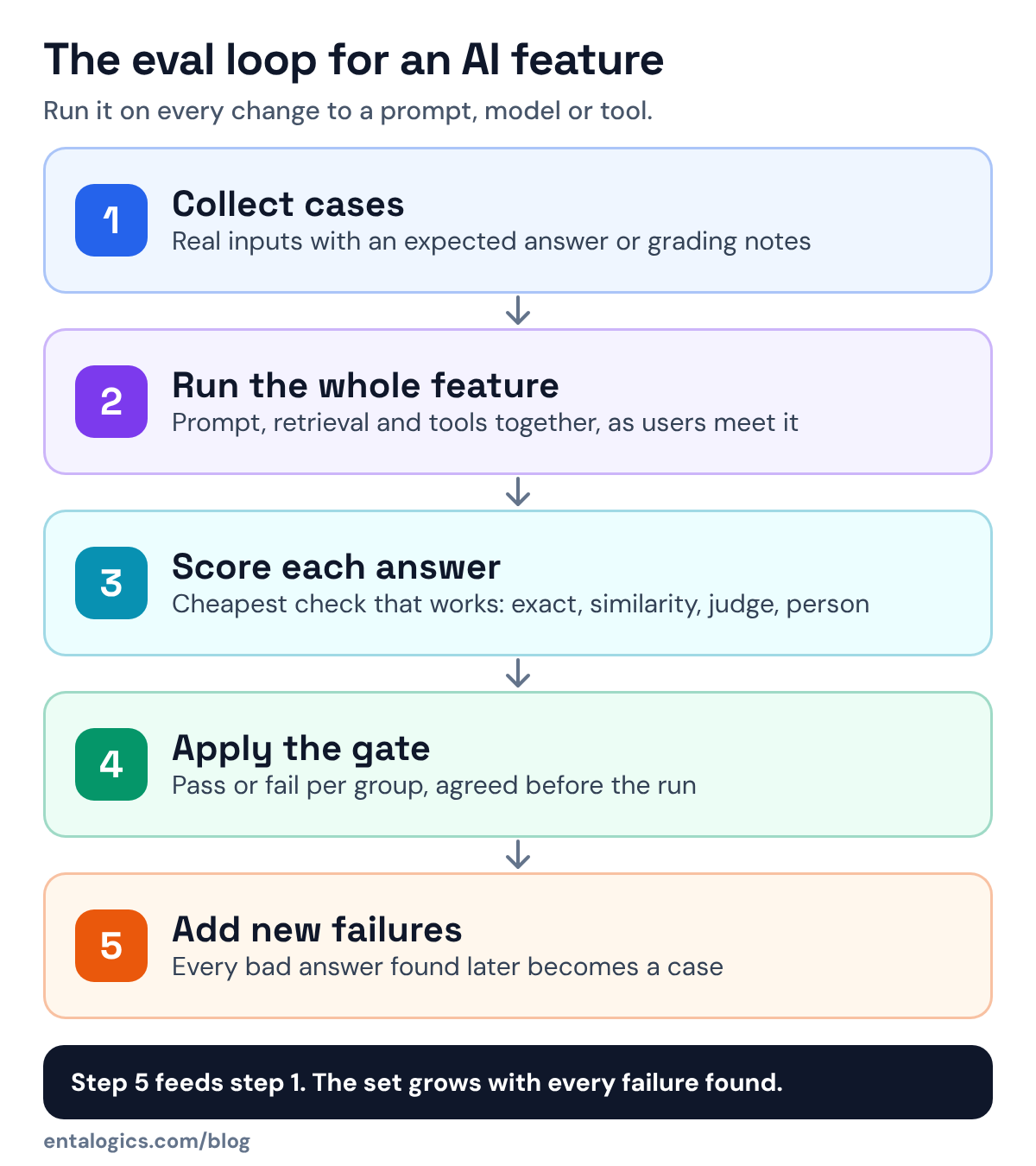
An eval is a test suite for an AI feature. You collect real inputs, write down what a good answer looks like for each, run your system on all of them, and score the results. Build it before launch. Without it, every change to a prompt or a model is a guess that you check by reading a few answers. With it, the same change is a number you can compare, and "is it good enough to ship?" has an answer.
What is an eval, in plain terms?
The Inspect framework, developed by the UK AI Security Institute and Meridian Labs, breaks an evaluation into three things:
generate() call to the model, or as sophisticated as a full agent that uses tools over many turns."For a product team the three parts are: your cases, your feature as users will meet it, and your checks. The middle part matters. We recommend evaluating the whole feature, with its prompt, retrieval and tools, not the bare model. Users never talk to the bare model.
Why build it before launch?
Because the decisions you make before launch are the expensive ones, and without an eval they are made by feel.
This is one of the four pillars of our AI app development work: the eval pipeline comes before launch. We build the eval dataset before we release the first prompt, so cost, accuracy and vendor trade-offs are decisions you control instead of surprises found in production. If AI output is not measured, it is guessed.
Three questions come up on every AI feature, and each needs a measurement:
- Is this prompt change better? It fixed the case you were looking at. An eval tells you what it broke.
- Can we use a cheaper model? In our experience the answer is rarely yes or no. It is "yes for these request types, no for those". We covered the cost side in which model to use for which work.
- Can we switch provider, or survive a provider's update? Only if you can re-run the same cases and compare.
There is a fourth reason. In the 35+ code audits we reported on in September, 23 codebases had no automated tests at all. In our experience AI features often follow the same path: they ship on a demo. An eval set is the test suite for the part of your product that ordinary tests cannot cover.
What goes in the test set?
OpenAI's guide to building an eval lists four qualities it looks for. They were written for contributions to its public eval collection, and they transfer well to a product team.
- Thematically consistent. Cases revolve around "the same use case, subject domain, failure mode". For a product team that means one set per feature, not one set for everything.
- Challenging. If the model does well on every case, the set is less useful. It should still be possible, and the guide's rule of thumb for that is whether a human, possibly a subject expert, could do well on the prompts.
- Directionally clear. Each case needs a good signal of the right behaviour: "high-quality reference answers or an exhaustive rubric".
- Carefully crafted. That includes having "spot checked your results to ensure accuracy".
On top of those, these are the groups of cases we would make sure are represented. This list is our recommendation, not from the guide.
| Group | What it holds | Where the cases come from |
|---|---|---|
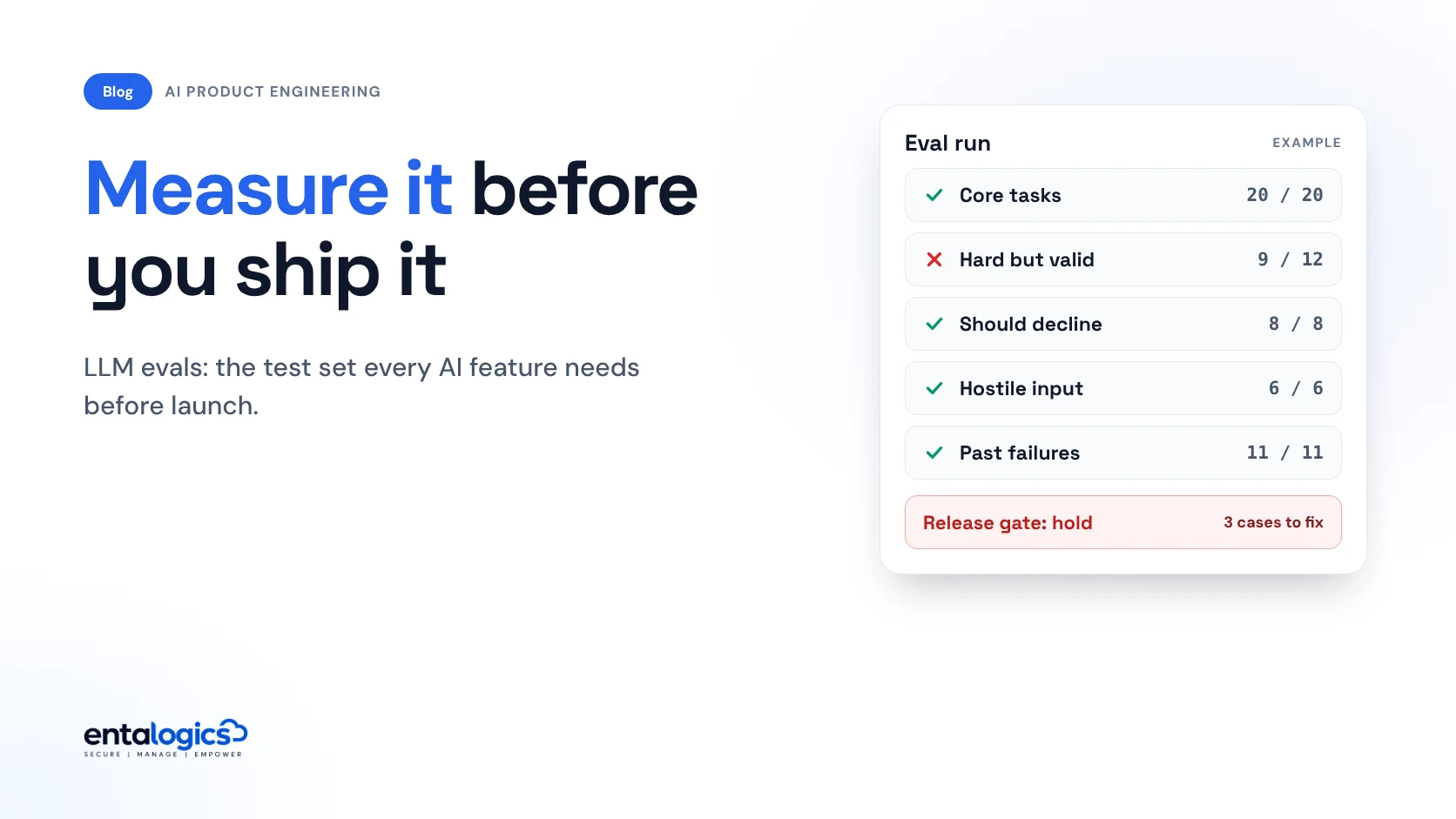
| Core tasks | The requests the feature exists for | Product requirements, early user sessions |
| Hard but valid | Long inputs, mixed languages, missing details | Support tickets, real logs |
| Should decline | Out-of-scope or unsafe requests | Policy, legal and security review |
| Hostile input | Documents or messages carrying instructions | Your own red-team attempts |
| Past failures | Every bug a user or reviewer has found | Incident notes, bug reports |
The last group is the one that grows. A failure becomes a case on the day it is found, so the feature cannot fail the same way twice without someone seeing it.
Ship faster with senior engineers
Direct collaboration, AI-augmented delivery, and no agency markup.
Get in touchHow do you score the answers?
Use the cheapest check that catches the failure. The promptfoo guide on using an LLM as a judge is clear that a judge model is not always the right tool. It has a section on when to "use a cheaper check" instead.
The table below is our summary. The format and similarity rows follow the guide; the exact-match row, the person row and the cost notes are ours.
| The requirement | The check | Cost and stability |
|---|---|---|
| Output must have an exact format | Parse it: JSON validity, a pattern, a short script | Fast and cheap; same result every run |
| Answer must equal or contain a known value | Compare with the reference answer in code | Fast and cheap; same result every run |
| Answer must mean the same as one reference | Embedding similarity with a tuned threshold | Cheap; the guide calls it usually more stable than a judge |
| Answer is open-ended, quality has several parts | A judge model with a written rubric | Costs a model call; calibrate it on labelled examples |
| Stakes are high or the rubric is still unclear | A person | Slow; use it to calibrate the others |
Exact checks fail on open-ended text for an obvious reason. As the guide puts it, a correct answer to "How do I reset my password?" could be phrased thousands of ways. That is where a judge model earns its place.
The same guide names the price: "judges have biases, add latency, and can be manipulated." Four of its recommendations are worth adopting from the start.
- Start small. "Start with the smallest rubric that catches the failure."
- Use pass or fail for gates. The guide recommends binary scoring for release gates and keeps graduated scores for trend charts and borderline reviews.
- One judge per criterion. Do not ask one rubric to score accuracy, tone and safety together. Use separate judges.
- Treat the answer as untrusted. The guide marks the candidate output as untrusted input to the judge. An answer that tells the judge to ignore the rubric and pass it is an attack on your grader.
That last point connects to how we think about permissions for AI agents: a model's output is input from an untrusted source, wherever it goes next.
How many cases, and how many runs?
There is no standard number, and the documents we read do not give one. Our view: start with a few dozen cases you trust, and spend the effort on making each expected result clear.
Remember that the same input can produce different answers on different runs. Inspect has a setting for this, epochs, described in its task documentation as the number of epochs to run for each dataset sample. Our advice: for cases that decide a release, run each one several times and look at how often it passes, not whether it passed once.
How does an eval become a release gate?
A score nobody acts on is a dashboard. To make it a gate:
A checklist to start this week
The numbers below are our starting points, not a standard.
On AI app development projects we build the eval dataset before the first prompt is released, and model token spend before launch. It is cheaper to build the measuring stick first than to argue about quality after launch.
Sources: Inspect documentation, index and tasks; promptfoo documentation, introduction and LLM as a Judge; OpenAI Evals, Building an eval, all as published in their repositories on 25 November 2026. Entalogics figures are from our own audit reports.