SEPTEMBER 17, 2026
What to Verify Before Signing a White-Label Vendor
Most white-label software vendor pitches sound identical. What actually separates them is whether source ownership, developer-account control, and exit terms are written into the contract — or just implied. Here's the checklist to run before you sign.

By Umar Abdullah · Software Development

Short answer: Almost every white-label software vendor will tell you that you'll "own the product." Very few will put that in writing in a way that survives the relationship ending. Before signing, an enterprise buyer needs six things confirmed in the contract, not implied in a sales call: source code ownership with a real handoff trigger, developer accounts (Apple, Google, code-signing certificates) registered to your company rather than the vendor's, licensing and resale terms defined before work starts, rebrand depth verified at the source level rather than the UI, multi-tenant data isolation built into the architecture rather than promised for later, and a defined exit process if the relationship ends. Every one of these is where a white-label engagement quietly turns into vendor lock-in — and every one of them is checkable before you sign, not after.
Why this list exists
White-label software pitches all sound the same from the outside: "you get full ownership," "we build it, you brand it, it's yours." The difference between a vendor who means that and one who doesn't almost never shows up in the pitch. It shows up in the contract, and specifically in whether these six things have concrete, checkable language attached to them or just get nodded along to in a call.
This isn't a hypothetical risk list. It's the same list any procurement or legal team already runs for outsourced development work — source escrow, IP assignment, exit terms — applied specifically to white-label, where the stakes are higher because the entire product's brand identity depends on the vendor having actually done the rebrand at the source rather than the surface.
The six things to verify
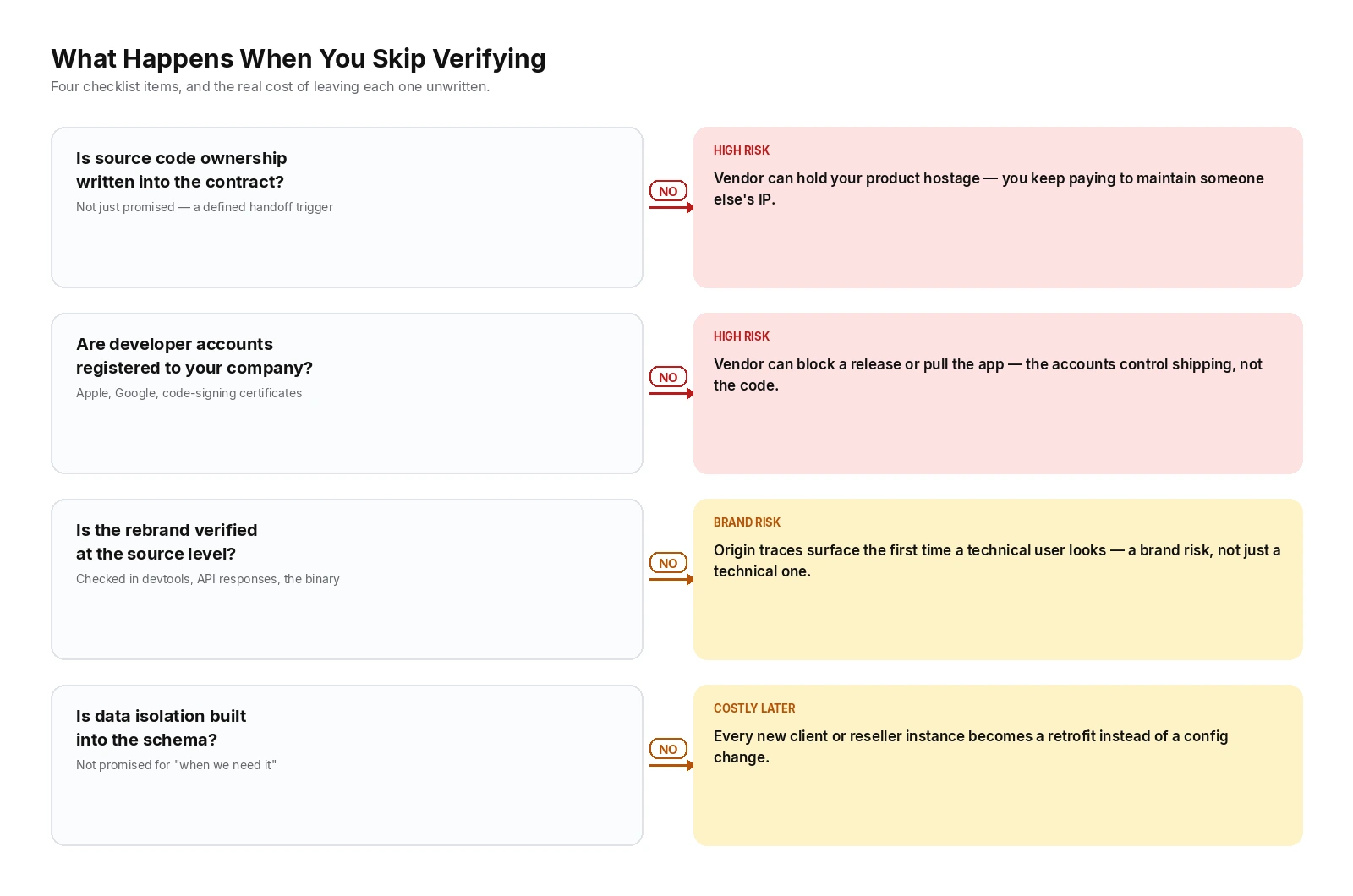
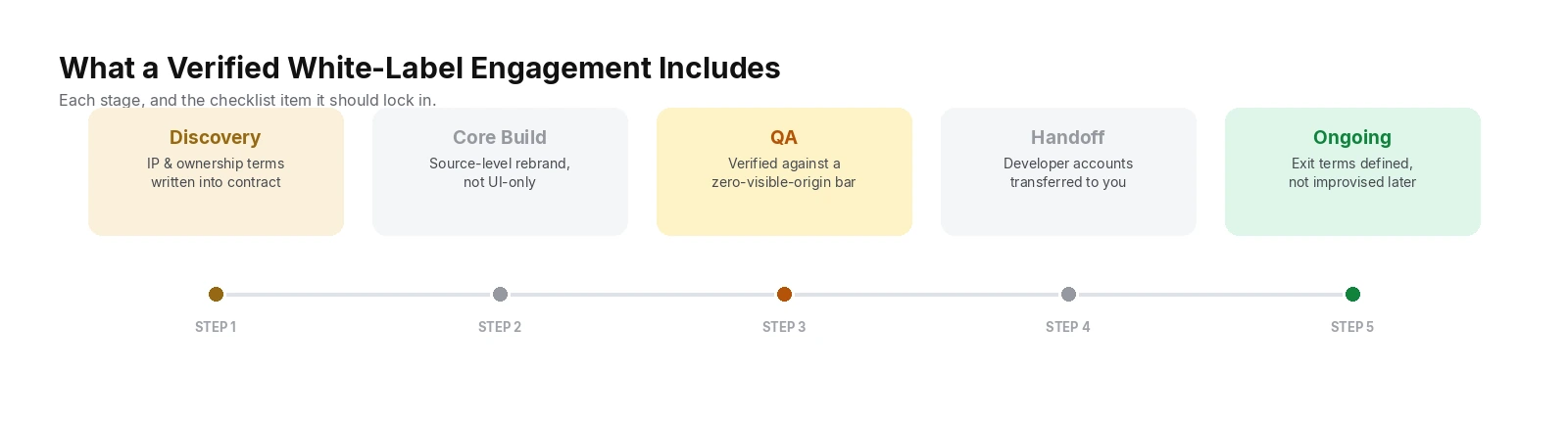
Source code ownership, with a defined trigger — not "you can request it." The weakest version of "you own it" is a vendor who will hand over code if asked, with no contract language saying when, how, or under what conditions. The strong version is a documented handoff built into the engagement from day one: full repository access, not a hosted black box you depend on the vendor to keep running. If the answer to "when exactly do we get the source" is vague, that's the tell.
Developer accounts registered to your company, not the vendor's. This is the one enterprise buyers miss most often because it's not obviously about code. Apple Developer, Google Play Console, Microsoft Partner Center, and code-signing certificates are the accounts that actually control whether your product can ship updates. If those are registered under the vendor's name "for convenience" and never transferred, the vendor — not you — holds the ability to push updates, pull the app, or block a release. Ownership of the code means nothing if you don't also hold the accounts that let you use it.
Licensing and resale terms written down before the engagement starts. If you plan to resell or sublicense the white-labeled product to your own downstream clients, what you're allowed to do with it needs to be contract language before development begins — not something assumed and argued about after the product ships. This matters even more for a standing multi-client relationship than a one-off build, since the terms compound across every new client instance.
Rebrand depth verified at the source, not just the interface. A logo swap and a new color variable is a reskin, not a white-label build — and it breaks the moment a technically curious user opens developer tools and finds the original product's name in the source, the API responses, or the binary. The real bar is zero visible trace of the underlying product at the code level, checked, not assumed. Ask the vendor directly: has this been verified in devtools, in network responses, in the compiled binary — or just visually?
Multi-tenant data isolation built into the schema, not promised for later. If the plan is ever to support more than one branded instance — resellers, regional deployments, acquired sub-brands — per-tenant data isolation needs to be an architectural decision made at the start, not a retrofit triggered by the first reseller who asks for their own instance. Retrofitting tenancy into a single-tenant schema after the fact is a real, expensive rebuild, not a config change.
A defined exit process if the relationship ends. This is the one general enterprise software procurement has been forced to take seriously by regulation, not just good practice — the EU's Data Act requires cloud and platform-service providers to remove technical and contractual barriers to switching providers, with all switching and data-egress charges required to be eliminated by January 12, 2027. That's a direct regulatory acknowledgment that vendor lock-in is a real, quantifiable risk, not a theoretical one. A white-label engagement should have the same discipline built in voluntarily: what happens to your source, your data, and your developer accounts if you and the vendor part ways — decided before you need the answer, not during a dispute.
What this looks like on a real build
Omni is the clearest example we can point to because the standard it was held to is the same standard this checklist describes, not a lower one for a smaller client. It's a full source-level rebrand of the Chromium/Brave engine — UI chrome, settings, about screens, default behaviors — shipped on Windows and Android with native VPN and MetaMask wallet integration built in. The verification bar wasn't "does it look different." It was zero visible trace of the Brave origin at the code level: no leftover strings, no traceable API calls, no dev-tools tell. That's the difference between a rebrand and a reskin made concrete.
AdsLogins is the second proof point, and it matters specifically because it answers the multi-tenant question honestly rather than in the abstract: it's the same rebrand discipline applied at scale, running hundreds of isolated account profiles in production under one white-labeled visual identity. A single flagship rebrand proves the technique works once. A production system running hundreds of isolated instances under it proves the architecture was actually built for scale from the start, not stretched to fit after the fact.
Neither project is offered here as a template you should expect verbatim — every white-label engagement's contract terms, ownership structure, and technical depth need to be negotiated for your own situation. What they show is what "verified" actually looks like when a vendor is telling the truth about it, which is the entire point of running this checklist before you sign rather than trusting the pitch.
Ship faster with senior engineers
Direct collaboration, AI-augmented delivery, and no agency markup.
Get in touchVerified vendor vs. red-flag vendor, side by side
| Checklist item | Verified vendor | Red-flag vendor |
|---|---|---|
| Source code | Full repository transfer at a defined handoff point, documented in the contract | "You can request it" — no defined trigger or timeline |
| Developer accounts | Apple/Google/code-signing accounts registered to your company from day one | Registered to the vendor "for convenience," transfer promised later |
| Licensing & resale terms | Written into the contract before development starts | Verbal assurance, no contract language, discussed after launch |
| Rebrand depth | Verified at the source/engine level — zero visible origin in devtools, API, or binary | UI-only — original product name or origin traceable by anyone who looks |
| Multi-tenant data isolation | Built into the schema from the first sprint | Promised "when we need it," retrofitted per client request |
| Exit terms | Documented handoff process if the relationship ends | Undefined — "we'll figure it out if it comes to that" |
Straight answers
Do I really need this checklist if I already trust the vendor? Trust isn't the thing this protects against — turnover, acquisition, and priority shifts on the vendor's side are. A vendor you trust today can be acquired, change ownership, or reprioritize away from your account in eighteen months. Contract language survives that. A verbal understanding doesn't.
What if a vendor pushes back on putting these terms in writing? That reaction is itself useful information. A vendor confident in their own ownership and handoff process has no reason to avoid writing down what they've already told you verbally — pushback on documenting standard terms is a stronger signal than anything in the sales deck.
Is source code escrow the same thing as source code ownership? No, and the difference matters. Escrow means a third party holds a copy of the source that releases to you only if specific trigger conditions are met (the vendor going out of business, for example) — useful as a backstop, but it's not the same as owning and holding the code yourself from the start. For a white-label build specifically, direct ownership with a documented handoff is the stronger position; escrow is a reasonable fallback when direct ownership isn't part of the deal.
Does the EU Data Act's switching requirement apply to a white-label software contract specifically? The Data Act's switching provisions are aimed at cloud and data-processing services, not custom software development contracts directly — so it doesn't automatically cover a white-label build. What it does show is that regulators now treat vendor lock-in and switching cost as a serious, quantifiable risk worth legislating against, which is exactly the reasoning that should apply voluntarily to a white-label engagement even where the law doesn't reach it yet.
How long does verifying all of this actually take before signing? A vendor with real, already-documented answers to all six items can usually get through this in one discovery conversation plus a contract review — a day or two of legal time, not a drawn-out process. If it's taking weeks to get straight answers to items on this list, that pace is itself part of the answer.
Evaluating a white-label vendor for your own product and want a straight answer on every item on this list? Our white-label software development team builds to exactly this standard — source ownership, developer accounts in your name, and licensing terms written into the contract before work starts. See how we work with larger organizations on our enterprise page, or talk to a senior engineer directly about what your build would actually require.
Sources: What is Source Code Escrow?, Escode; The EU Data Act's Switching Framework, Maples Group; Data Act explained, European Commission. Omni and AdsLogins project details from our own delivered work.