
JULY 12, 2026
Desktop Workflows Still Matter in Real Estate
Desktop workflows still matter in real estate tech: NAR data shows agents rely on eSignature, CRM, and broker tools more than emerging tech.

By Asad, Senior Content Writer at Entalogics · Software Development
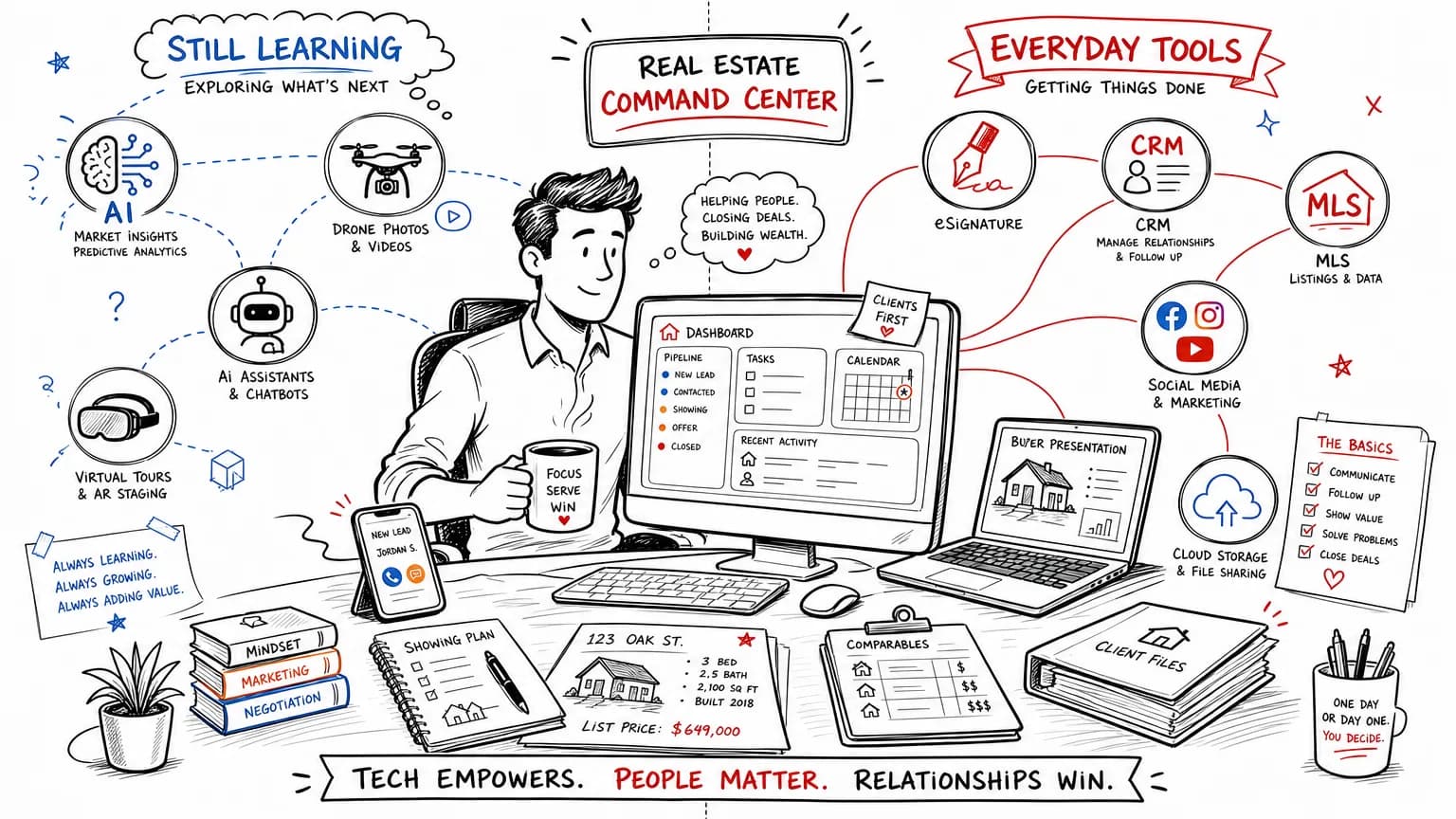
Real estate tech still runs on desktop work
NAR’s July 2025 survey of its members shows a simple product truth: real estate work is still built around tools people use at a desk. The most popular technology is eSignature, used by 79% of REALTORS®, followed by social media at 75% and drone photography/video at 52%.
That order matters. It says the core workflow is not novelty. It is document flow, communication, and presentation. Agents still need to move fast on contracts, leads, and listings. They are not waiting for a flashy new interface to replace the basics.
The most popular technology used by REALTORS® is eSignature (79%).
Only 10% observed a moderately positive impact from AR/VR on their real estate business.
For product teams, that means the roadmap should start with workflow reliability, not feature theater. Desktop workflows still win when the job requires long form entry, cross-tab comparisons, document review, and coordination across multiple systems.
What REALTORS® actually use every day
The survey is broad enough to show which tools have become routine. eSignature at 79% leads, which makes sense because real estate closes on documents. Social media at 75% sits close behind, which shows how much selling still depends on constant visibility. Drone photography/video at 52% rounds out the top three, pointing to a market where media support matters, but only after the basics are in place.
The same pattern appears in lead generation. Social media is the top lead-generating technology at 39%, followed by CRM at 23% and the local MLS at 17%. That is not a mobile-first story. It is a workflow story. Agents need systems that can hold contacts, track follow-ups, and connect listing activity to conversion.
The survey also shows that many tools are bought or supplied in fragments. 23% reported that lockbox/showing technology was supplied by their MLS or Association, while 39% received transaction management tools through their broker. Another 48% personally purchased cloud storage solutions, and 13% used social media tools available as freeware.
That mix should shape product design. Real estate teams do not live in one system. They stitch together broker tools, MLS tools, personal tools, and consumer-facing channels. Desktop workflows matter because they are where that stitching happens.
What the 2026 REALTOR® Technology Survey says about adoption
The survey also shows how people think about technology adoption, which is just as important as what they use. 66% embrace new technology primarily to save time. 64% do it to enhance the client experience. Those are practical motives. They are not driven by trend chasing.
The survey also suggests a maturity gap. 70% use some form of emerging technology, but 59% are still learning. Another 21% have heard of emerging technologies but have not used them. That means adoption is wide, but depth is uneven.
For product roadmaps, this is a useful constraint. If users are still learning, your interface cannot assume expert behavior. Desktop workflows need clear defaults, visible state, and easy undo. They need fewer hidden steps. They need a path from first use to repeat use without forcing the user to memorize a new mental model.
The broader survey population also matters. Sales agents make up 68% of respondents, while associate brokers make up 14%. Respondents had been active as real estate professionals for a median of 11 years. This is not a brand new audience learning software for the first time. It is an experienced audience using tools under time pressure.
That is one reason the median MLS core technology satisfaction score landed at 3 on a 1-to-5 scale. Neutral is not a compliment. It usually means the software is tolerated, not loved.
If you are mapping a product roadmap, that is the signal to fix the boring parts first. Login. Search. Save. Export. Shared notes. File handoff. Permission clarity. Desktop workflows tend to expose those pain points sooner than mobile screens do.
Ship faster with senior engineers
Direct collaboration, AI-augmented delivery, and no agency markup.
Get in touchAI, AR/VR, and the gap between interest and use
The survey gives a clear read on where emerging tools stand in daily work. 41% of REALTORS® are currently using AI/Generative AI, 6% use predictive consumer analytics, and 5% use smart contracts. The impact story is still modest: 33% found AI to have a moderately positive impact on their real estate business.
That is not a rejection of AI. It is a sign that AI has become a utility, not a destination. People use it where it saves time or drafts text faster. They do not yet treat it as the core system of record.
For a broader view of this shift, see our discussion of what AI-augmented software development is. The pattern is similar: adoption rises fastest when AI helps with existing work, not when it tries to replace the workflow.
AR/VR looks even less central. 88% have not actively tried to use AR/VR for their business. 83% said they have not observed the impact of AR/VR on their real estate business, while 10% have observed a moderately positive impact.
88% have not actively tried to use AR/VR for their business.
That tells product teams something useful: do not organize the roadmap around speculative features if the current market still prefers basic workhorse tools. If a workflow does not reduce time, reduce risk, or improve client handoff, it will struggle to compete with what already works.
What this means for product roadmaps
Real estate software teams should read this survey as a prioritization map.
First, build for desktop-first workflow density. When users spend their day managing listings, messages, documents, and lead follow-up, they need broad screens, keyboard shortcuts, easy multi-tasking, and stable file handling. That is where the work lives. Mobile matters for quick updates, but desktop still carries the heavy load.
Second, invest in the systems that sit closest to revenue. The survey points to social media, CRM, MLS, and transaction management as the daily stack. If you are building for this market, your product should either replace one of those tools, connect them, or remove friction between them. Anything else is decoration. That is the integration problem at the center of real estate software development — CRM, MLS, and portfolio tools that actually talk to each other instead of living as separate islands.
Third, design for mixed ownership. Some tools come from the broker. Some come from the MLS or Association. Some are personally purchased. That means integration and permission handling are not back-end chores. They are core product features.
Fourth, make the learning curve visible and shallow. With 59% still learning emerging technology, a product should teach as it works. Inline guidance, sensible defaults, and guided setup matter more than long feature lists.
If you need a structured way to evaluate your current app against those expectations, the AI Code Security Audit page explains how to review software systems before they grow more brittle. The same basic question applies here: does the tool make the workflow safer, faster, and easier, or does it add another layer to manage?
Related reading: if your team is deciding how much of the workflow should move into AI-assisted interfaces, our post on AI development trends for 2026 covers where AI fits best inside real products.
A practical takeaway for builders
The 2026 REALTOR® Technology Survey does not show a market that has moved beyond desktop work. It shows a market that still depends on it.
The numbers point in one direction. eSignature at 79%, social media at 75%, CRM at 23%, and broker-supplied transaction tools at 39% all point to the same conclusion. The winning products are the ones that help people finish real work.
That means the roadmap should favor speed, clarity, and interoperability. Make the desktop flow easier. Cut manual handoffs. Tighten integration with the systems agents already use. Add AI only where it shortens the task, not where it adds a new one.
In real estate, the best product is still the one that disappears into the workflow and lets the deal move.