
AUGUST 26, 2026
Outsourcing vs. In-House: What Actually Fits
Real cost numbers, real tradeoffs, and the questions that actually decide whether outsourcing or an in-house team is the right call for your software project.

By Asad, Senior Content Writer at Entalogics · Engineering Leadership
We get asked some version of this question on almost every new project: should this be built in-house, or should we bring in a team to outsource it to? It's usually coming from someone weighing hiring against outsourcing for the first time, and looking for a straight answer instead of a sales pitch. So here's ours — the real tradeoffs, backed by actual numbers, including the parts that don't always point toward outsourcing even though that's our own business.
What an in-house team actually costs
The obvious cost of in-house development is salary. The real cost is everything sitting underneath it that doesn't show up until year one is already underway.
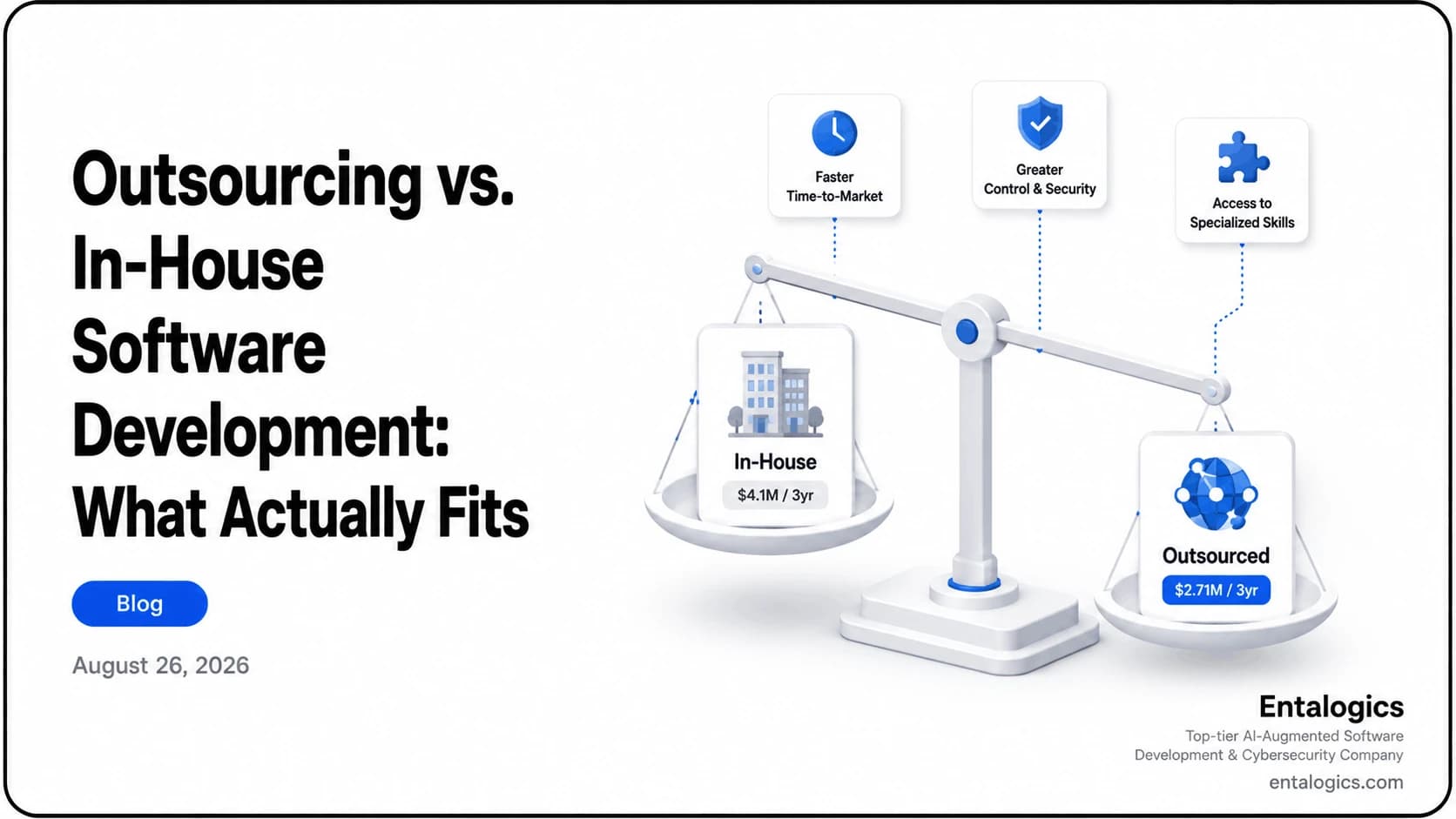
A detailed cost breakdown from Hatchworks on a 6-person U.S.-based team puts year-one cost at roughly $1.58M — $1.2M in salaries, plus $144K in recruitment costs, plus about $234K lost to ramp-up time while new hires get productive. Years two and three settle to around $1.26M annually once you factor in the ongoing cost of replacing the roughly 15% of the team that turns over in a typical year. Over three years, that's a total of about $4.1M for six people.
That's not a knock on in-house development — it buys you something real: full control over process, decisions made in real time without a vendor relationship in the loop, and a team that accumulates deep context about your product the longer they stay. We tell clients this upfront: "in-house is simpler" and "in-house is cheaper" are two different claims, and only one of them is usually true.
What outsourcing actually costs, and why the reason for doing it has changed
Using the same six-person comparison, a nearshore outsourced team runs closer to $0.91M in year one and about $0.90M annually after that — roughly $2.71M over three years, about 34% less than the in-house total, without the recruitment and benefits overhead baked into the in-house number.
But cost isn't actually the main reason companies come to us anymore, and that's a real shift worth knowing about. Deloitte's Global Outsourcing Survey found that for traditional outsourcing arrangements, "cutting costs" is still the top-cited driver at 57%, but it's now essentially tied with "access to new capabilities" at 51%. For companies using outsourcing more strategically (what Deloitte calls Operate and Managed Services), access to capabilities and keeping pace with technology outrank cost-cutting entirely — and 67% of executives surveyed said they plan to increase that kind of outsourcing spend over the next two years. Most of the clients who come to us aren't chasing a lower number. They need a skill set — a specific stack, AI integration experience, security expertise — that would take months to hire and build in-house from scratch, and they need it now.
Where in-house still clearly wins — even in our opinion
None of this makes outsourcing the automatic right answer, and we'll say so plainly when it isn't. In-house makes more sense when the software you're building is the actual product your business sells, not a supporting tool — that's the code you want deep, permanent institutional knowledge sitting on top of, not a rotating vendor relationship. It also wins when the work touches something you genuinely can't have leave the building: proprietary algorithms, sensitive customer data with strict compliance requirements, or IP you don't want walking out the door if a vendor relationship ends. And it wins when you need real-time, in-the-room decision-making on a fast-moving, ambiguous product direction — the kind of thing that's hard to hand off across a vendor contract, even a good one.
Where outsourcing clearly wins
Outsourcing is the stronger call when you need a capability you don't have and don't want to spend six months hiring for — a specific framework, a security specialization, AI integration work, a platform you're not going deep on again after this project. It's also the better fit for work with a defined start and end (a redesign, a migration, an MVP build) where keeping a permanent team on staff afterward doesn't make sense, and for anything where speed matters more than owning every decision — nearshore teams can typically be staffed and working within two to three weeks, versus months to source and onboard in-house hires.
Worth knowing the distinction here too: nearshore outsourcing means a team in a similar time zone, which is the model we work in and what the cost numbers above are based on. Offshore usually means a bigger time-zone gap and a bigger cost gap in the other direction — often cheaper still, but with more coordination overhead. Which one fits depends on how much real-time collaboration the work actually needs.
Ship faster with senior engineers
Direct collaboration, AI-augmented delivery, and no agency markup.
Get in touchThe honest middle ground most of our clients actually land on
The real-world answer for a lot of growing companies isn't "pick one." It's in-house for the core product — the thing that defines the business and needs people who live inside it every day — and an outsourced or nearshore team for defined projects, specialized skill gaps, and work that has a clear finish line. That's the setup we see most often, and it's less a compromise than it is matching the structure to the actual shape of the work, instead of forcing every project through the same staffing model because it's the one already in place.
The actual questions worth asking before you decide
Is this the core product, or a supporting project with an end date? Do you already have the specific skills this needs on your team, or would hiring for them take months? Does the work touch data or IP sensitive enough that it shouldn't leave your direct control? And honestly — do you have six months to hire and onboard, or do you need people working in three weeks? The answers to those four questions get you most of the way to the right call.
Common questions on outsourcing vs. in-house development
Is outsourcing software development actually cheaper than in-house? Usually, yes, on total cost of ownership — the numbers above show roughly a third lower cost over three years once recruitment, benefits, and turnover are counted in, though the gap narrows for short, well-scoped projects where in-house recruitment overhead never has time to build up.
What's the biggest risk of outsourcing software development? Communication and context loss — a vendor team that doesn't understand your product as deeply as people who live in it every day. It's manageable with the right vendor and clear scoping, but it's real, which is exactly why we recommend outsourcing for defined projects over a company's core, ever-evolving product.
Can you combine in-house and outsourced development? Yes, and most of our long-term clients do exactly that — a permanent in-house team on the core product, with us brought in for specific projects, skill gaps, or crunch periods. It's the normal, practical setup for a software development team that's grown past its earliest stage.
Does outsourcing mean losing control of the project? Not with the right structure — clear scope, regular check-ins, and code ownership terms in the contract keep control with you. What outsourcing changes is who's doing the day-to-day work, not who owns the outcome. That's how we structure every engagement.
If you're weighing this for a specific project, we're happy to look at the actual specifics with you and give you a straight answer — even if that answer is "keep this one in-house."