
AUGUST 31, 2026
LLMs Understanding Code: SemBench Shows the Gap
LLMs understanding code looks weaker than benchmarks suggest: SemBench found 80.42% accuracy at best, with a clear gap from code generation scores.

By Asad, Senior Content Writer at Entalogics · Artificial Intelligence
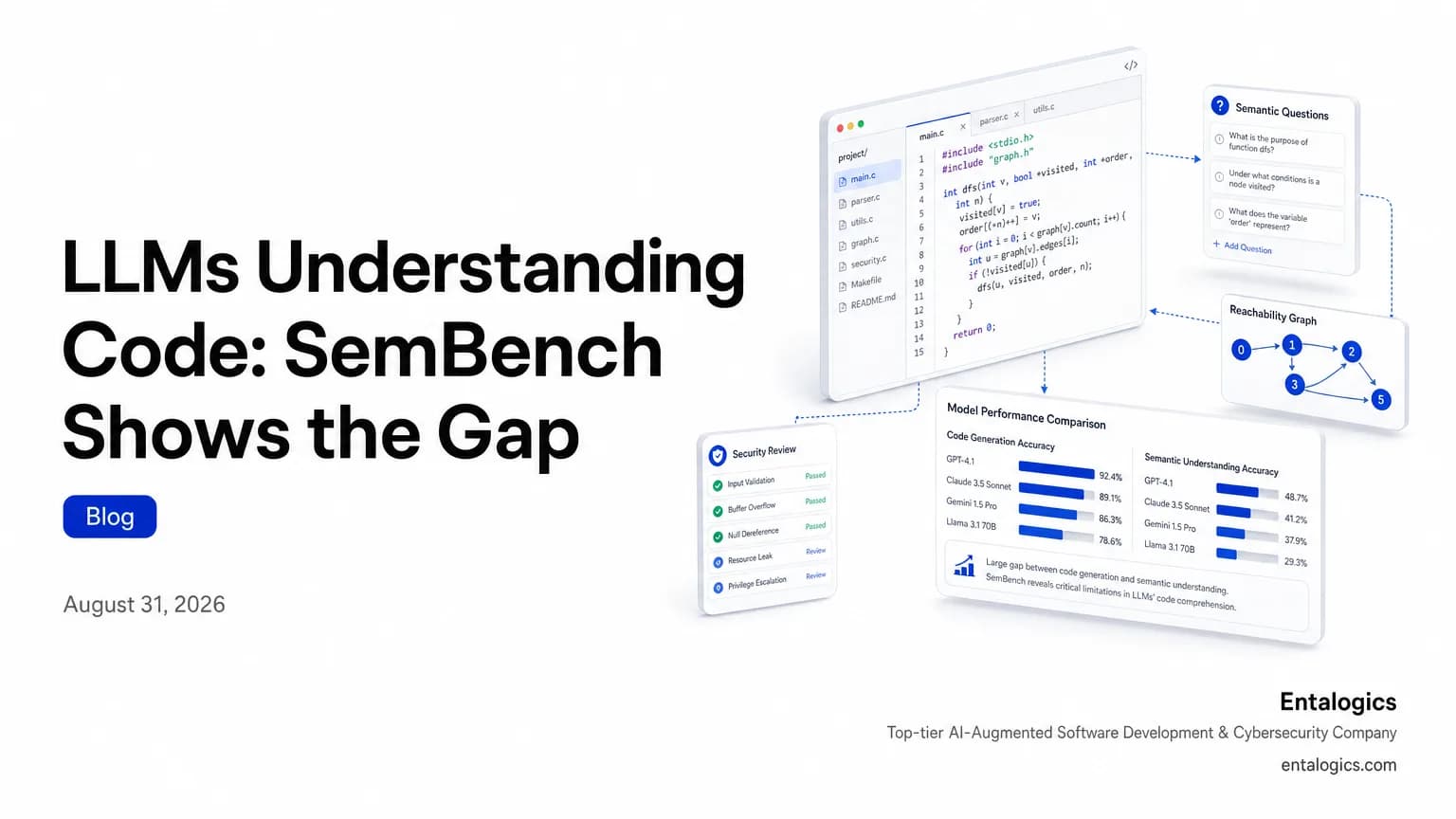
SemBench Shows a Real Gap in LLM Code Understanding
The best model in a Nature Communications study reached 80.42% accuracy on SemBench. That sounds decent until you compare it with 93.4% pass@1 on HumanEval and MBPP in the same paper. The message is simple: code generation and code understanding are not the same skill.
SemBench is built from 1,000 programs and 15,404 questions spanning 6 properties. It tests whether models can reason about real code semantics, not just produce plausible-looking snippets.
The strongest model still missed 19.58% of SemBench questions.
For teams that use LLMs in code review, refactoring, or agentic development, that gap matters. A model can generate a clean function and still fail on whether a variable is live, whether a block is dead, or whether one call reaches another. Those are not edge cases. They are the stuff bugs are made of.
What SemBench Actually Measures
SemBench is not another short-answer coding quiz. The benchmark uses 1,000 diverse C programs sourced from the CodeParrot GitHub-code dataset and gives them file-level context from 3–3756 lines. That matters because many benchmarks isolate a tiny function and strip away the surrounding program structure.
The authors built 15,404 semantic questions around six core properties: dead code-statement, data dependency, function reachability, dominator, dead code-loop, and liveness. In other words, the benchmark asks whether the model understands what the code means, not just what it looks like.
That distinction is important for security work. Static analysis, taint tracking, and vulnerability triage all depend on semantics. If a model cannot track whether a value reaches a sink, it can miss the exact path that matters in an SSRF, injection, or auth bypass review. If that is the problem you are trying to solve, compare this paper with our earlier breakdown of AI coding tools and AppSec risk.
That weak alignment is the core warning. A model that ranks well on generation benchmarks does not automatically rank well on semantic reasoning.
LLM Code Understanding vs Code Generation
The paper evaluates 16 models across 7 families. The result is not a collapse across the board. Some tasks are much easier than others.
For simpler semantics, the strongest model gets close to the right answer more often. On dead code-statement, it reaches 91.15% accuracy. But on liveness, performance drops to 64.38% accuracy. That is not a small dip. It is a sign that the model struggles when it has to track how values flow and remain relevant across a program.
The authors also report that larger or instruction-tuned models perform better, but scaling alone did not bridge the semantic gap. That point matters because many teams assume the next model release will erase the problem. This study says otherwise.
If you are already adopting models in production workflows, treat this as a signal to separate code generation from code reasoning. A model may be useful for boilerplate, summaries, and quick drafts. It is still much less reliable when the task depends on precise semantic interpretation.
Ship faster with senior engineers
Direct collaboration, AI-augmented delivery, and no agency markup.
Get in touchWhy This Matters for Security and AppSec
Security review depends on context. A model that misses a function boundary, a live variable, or a dead path can miss a bug or invent one. That makes semantic reasoning especially important for code search, vulnerability explanation, and patch validation.
The paper’s comparison is useful because it shows where current LLMs are strong and where they are not. The same models that do well on code generation still show a clear gap on semantic understanding. That means you should not treat an LLM’s code output as proof that it understood the program.
For teams building internal review tools, that leads to a practical rule: use LLMs to assist, not to decide. Let them summarize diffs, suggest candidate fixes, and map possible data flow. Then verify the result with tests, static analyzers, and human review.
If you want a structured way to check where those assumptions break in your own stack, our AI Code Security Audit page explains how teams validate model-assisted development workflows before they reach production.
What Developers Should Do Now
Start with the tasks that need exact semantics.
Use LLMs for first-pass triage, not final judgment.
Keep tests and static analysis in the loop for anything that depends on reachability, liveness, or data dependency.
Review model output more aggressively when the code touches auth, input handling, file paths, or network calls.
And do not assume a better code-gen score means better reasoning. In this study, the benchmark gap stayed visible even when the same models looked strong elsewhere.
For teams shipping AI-assisted development tools, the takeaway is not “stop using LLMs.” It is “bound what they can be trusted to do.” The paper shows that current models can write useful code and still fail at understanding the code they write. That is exactly where production bugs hide.
Use models where they are helpful. Verify them where semantics matter. Build your review process around the gap, not around the demo.