
AUGUST 21, 2026
AI Coding Agents Modernize Science Software
OpenAI’s field report on AI coding agents covers 8 scientific software projects, where verification stayed the bottleneck and gains were real.

By Asad, Senior Content Writer at Entalogics · Artificial Intelligence
What OpenAI Found in 8 Scientific Computing Projects
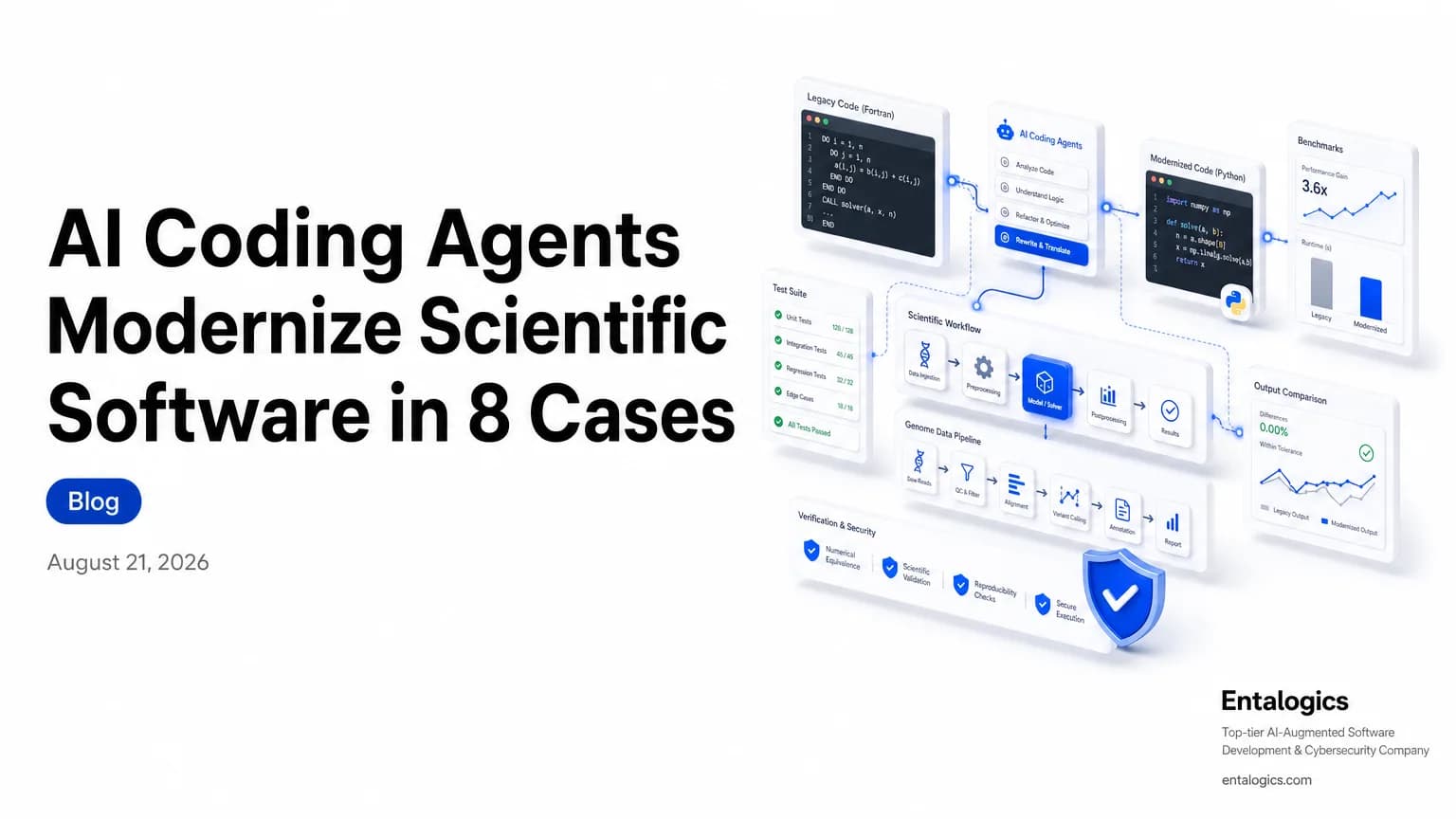
OpenAI’s field report covers 8 case studies from scientific computing, mostly in the life sciences. The projects were not run under a common protocol. They were collected after the work was already done, so this is not a lab-controlled benchmark. It is a real-world snapshot of how teams used coding agents when the code already mattered and the scientific output had to hold up.
The headline is simple: the agents helped. But they did not replace judgment. In 7 of 8 cases, contributor effort shifted to task definition, verification, and higher-level decisions. The report says that is where the work now lives. The model writes more of the code. People spend more time proving that the code is right.
In all but one case, contributor effort focused on task definition, verification, and higher-level judgments.
That pattern matters because scientific software is not a normal app stack. A bad output can waste compute, corrupt analysis, or make a result hard to reproduce. The report’s strongest claim is not that coding agents can write more code. It is that they are most effective when the expected result can be checked against an external reference, such as byte-identical output, an existing implementation, released statistical models, or test suites.
How AI Coding Agents Modernize Scientific Software
The report groups the work into 6 project forms, with scope ranging from small patches to full rewrites. That spread is important. It shows that teams did not use agents only for boilerplate or only for greenfield work. They used them across maintenance, portability work, algorithm changes, and performance rewrites.
The report says the projects ranged from lightweight maintenance to wholesale, performance-driven rewrites in a different language. That is a meaningful shift for scientific codebases, which often accumulate years of specialized logic and brittle dependencies. In one case, the cost of reimplementation had dropped to a few days. In another, the first pass took days, but refining the code to output parity took a further 1 month. The machine could move fast. The last mile still needed humans.
One concrete example is the migration that shipped as MHCflurry version 2.2.0. The report says it was the first stable release on a PyTorch backend and was adopted without friction downstream. That sounds small until you remember what it means in practice: a modernization project can land in a real ecosystem, not just in a demo branch.
Another case pushed training throughput much further. The most intensive training step was cut from about 1 week to about 1 hour on 8xA100. That kind of gain changes what teams can iterate on in a single day. It also changes what “good enough” means for a scientific library that has to be maintained by humans after the agent is gone.
If you want a broader framing of where this sits in the software lifecycle, our piece on what is AI-augmented software development covers the shift from assisted coding to agent-driven implementation. For teams asking where risk enters the pipeline, AI Coding Tools and AppSec Risk: What to Audit Now is the better companion read.
Verification Was Still the Bottleneck
OpenAI’s report does not claim that coding agents solved scientific software engineering. It says the current bottleneck remains verification and validation. That line is the center of the report.
The current bottleneck remains verification and validation.
That fits the rest of the findings. The report says coding agents were most effective when results could be checked against an external reference. It also says users were broadly eager about the tools and found them to be a net positive, but they still faced an open question about how to communicate and collaborate with the original maintainers of the tool in question. In other words, the bottleneck is not just technical. It is also social and procedural.
The clearest example is the RustQC reimplementation. The report says the cost of reimplementation had dropped to a few days, which made a large fraction of the original functionality feasible to reproduce. But the later stage was still expensive. Refining the code to output parity took a further 1 month, and heavy human oversight was essential to keep the tool faithful across edge cases.
That same theme appears in another case study with extensive validation work. The report says rank histograms were checked across 500 to 1,000 replications per model. That is not the kind of work you hand off and forget. It is exactly where agents can accelerate implementation while humans stay responsible for statistical correctness.
For readers who work on internal review processes, this is the key question: can you verify the change against something external, or are you asking the agent to invent the standard as well as the code? If your answer is the second one, you have already found the hard part.
Ship faster with senior engineers
Direct collaboration, AI-augmented delivery, and no agency markup.
Get in touchWhere the Biggest Performance Gains Showed Up
The report includes several numbers that make the upside concrete.
One genome-processing pipeline ran in 14 minutes 54 seconds versus 15 hours 34 minutes for the original tools. That is the kind of difference that changes whether a pipeline is interactive or overnight. It also changes how often scientists can inspect intermediate results before the next step runs.
Another case says throughput on 8 H200 GPUs reached an effective 3.6 seconds per 10Mb file. The same case projects that a synthetic whole genome would take about 2.3 hours on 1 H200 or 19 minutes on 8 H200s. The corresponding CPU-path runtime is about 5.8 days per genome. Those are not abstract efficiency claims. They are operational differences that affect queue time, cloud spend, and how much data a team can process before a deadline.
The report also estimates that replacing legacy tooling with RustQC would reduce QC-related compute-hours by roughly 1.2–3.7 million CPU-hours per year for ENA submissions, assuming all submitted RNA-seq runs undergo basic QC. That is a broad system-level estimate, not a promise from one repo. But it shows why maintainers may care even when the modernization work itself is painful.
The same logic appears in maintenance-heavy projects too. For one package, there were 326 merged pull requests with MAINT in the title in 2025. Using a conservative assumption of two hours saved per change, the report estimates about 650 maintainer-hours per year saved. It also translates that to roughly $49,000–$98,000 at a fully loaded labor cost of $75–$150 per hour. Those are the economics that can justify a migration project even before you count developer frustration, backlog pressure, or downstream user impact.
None of these figures mean agents are magic. They mean the economic case is real when the work is repetitive, checkable, and already bounded by tests or reference outputs.
What This Means for Scientific Software Teams
The report’s strongest operational lesson is not “use agents everywhere.” It is “use agents where you can verify.” That sounds obvious until you watch a team apply an agent to a domain where the output cannot be checked quickly. Then the review cost becomes the work.
The report says the projects span roughly 6 project forms. That tells you the most useful mental model is not a single pattern like “generate code” or “fix bugs.” The useful model is a workflow shift: agents draft, humans define scope, humans verify, humans decide whether the output meets the scientific bar.
That is why the best candidates are often:
- maintenance work with a clear before-and-after state
- language migrations with an existing reference implementation
- performance rewrites with benchmarkable outputs
- statistical or scientific pipelines with known tests
- cases where parity can be checked against released models or existing suites
This is also where security teams should pay attention. Modernization work often touches dependencies, build systems, packaging, and data pipelines all at once. If you are introducing agents into that process, you need review gates that look at provenance, diffs, and release artifacts, not just syntax.
If that is the operational question you are asking, the next step is not another general AI policy memo. It is a focused audit of where agents can create unreviewed change. Our AI Code Security Audit service is designed for that exact question: where does the code path stop being trustworthy?
The report’s own language supports that caution. The projects were retrospective and not under a common protocol. That means the evidence is useful, but it is not a blanket standard. It is a set of field notes from teams already pushing the limits of scientific infrastructure.
The practical takeaway is clear: use coding agents for scientific software modernization when you can verify against a reference, lock review around the outputs that matter, and keep humans responsible for parity, validation, and release decisions. That is where the gains are real. That is also where the risk stays manageable.