
SEPTEMBER 17, 2026
2026 State of AI Agents: What the Data Shows
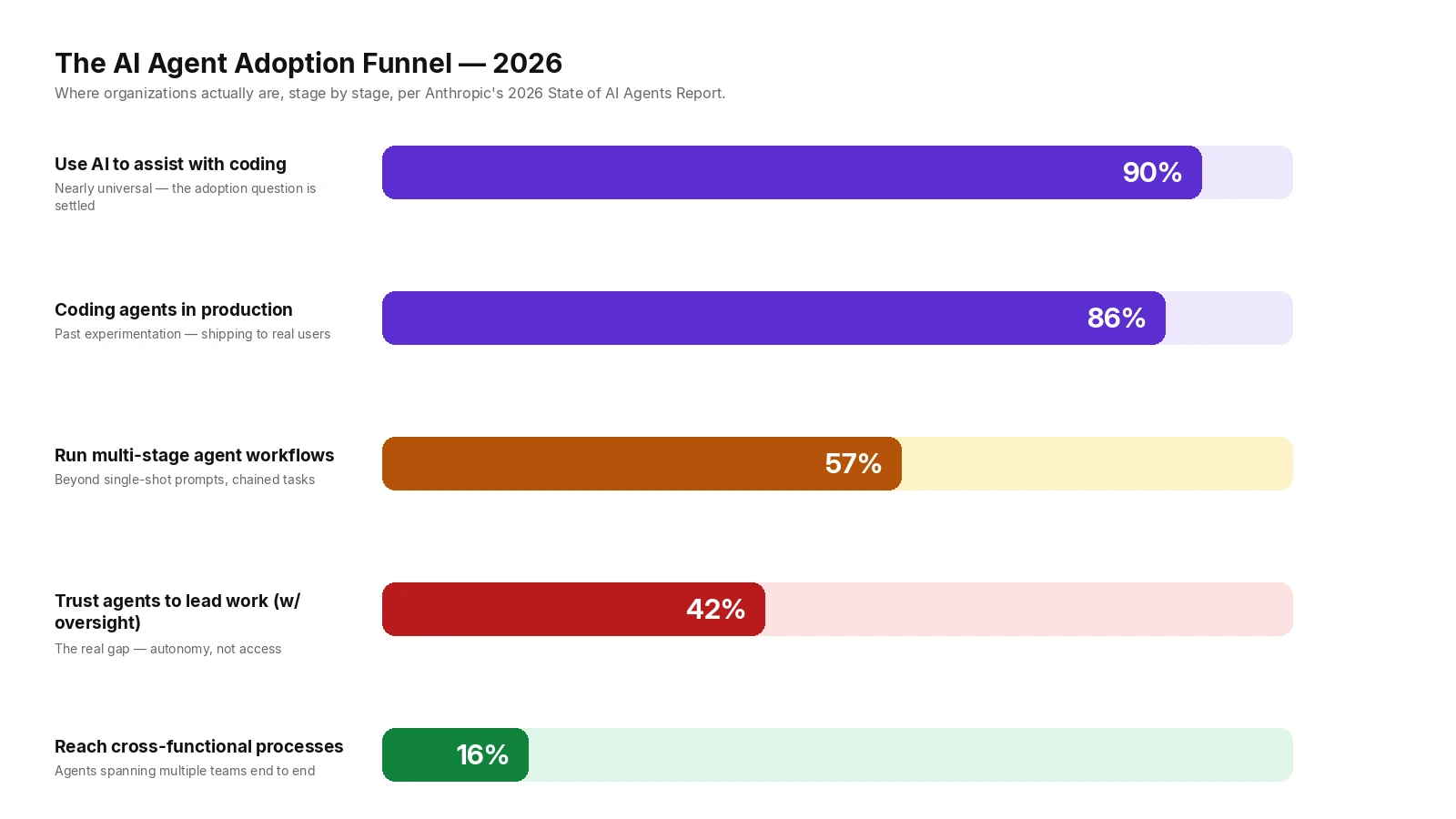
Anthropic's 2026 State of AI Agents Report says 90% of organizations now use AI to help write code, and 86% have moved that past experiments into production. The adoption question is basically settled — the report shows the real fight is over how much of the work gets handed off.

By Umar Abdullah · Artificial Intelligence

Short answer: Anthropic's 2026 State of AI Agents Report puts coding-agent adoption at nearly 90% of organizations, with 86% of those already running agent-generated code in production rather than just piloting it. That part of the debate is over. What the report actually measures now is autonomy — only 42% of organizations trust agents to lead development work even with a human checking the output, and the gap between "we use this" and "we let this run unsupervised" is where the real decisions are happening in 2026. If you're deciding how much to hand off, that gap is the number to plan around, not the adoption headline.
The report, and why the source matters
This isn't a vendor survey dressed up as research. Anthropic's 2026 State of AI Agents Report is a first-party look at how organizations are actually deploying agents, not a marketing deck built to justify a product launch — the numbers below come directly from it, cited so you can check them yourself rather than take a blog's word for it.
The headline finding: 57% of organizations already deploy agents for multi-stage workflows, not single-shot prompts, and 16% have pushed that further into cross-functional processes that span multiple teams. Another 81% say they plan to take on more complex use cases in 2026. Read together, that's not a market still deciding whether to try AI agents — it's a market that already decided and is now arguing about scope.
Adoption crossed 90%. Trust didn't follow at the same speed
Here's the split that actually matters if you're running an engineering org right now.
Coding-agent use is close to universal. Nearly 90% of organizations use AI to assist with coding, and 86% of those have moved past experimentation into production code deployment — meaning agent-touched code is shipping to real users, not sitting in a sandbox branch. Enterprises are slightly ahead of smaller companies here: 91% of enterprises deploy AI coding agents versus 83% of small and mid-sized businesses, a gap that's smaller than you'd expect given how much more budget and infrastructure enterprises typically have for this kind of rollout.
Trust to operate without a human in the loop is a different number entirely. Only 42% of organizations trust agents to lead development work, and even that trust comes with human oversight attached — not full autonomy. That's the real finding. Adoption answers "do you use this." Trust answers "how much of the judgment call have you actually handed over." Those two numbers used to move together. In 2026's data, they've split, and the size of that split is basically a map of where engineering leaders still think they need a human making the final call.
This mirrors a pattern last year's DORA report also found — high adoption paired with real distrust of the output. The difference a year later isn't that trust caught up. It's that adoption kept climbing anyway, which means teams have decided the productivity gain is worth shipping with guardrails rather than waiting for full confidence first.
Where the actual time savings show up
The report breaks out time gains by task category, and the pattern is more even than most people assume — this isn't just "agents write boilerplate faster."
Code generation shows measurable time gains for 59% of organizations. Documentation ties it at 59%. Code review and testing also land at 59%. Planning and ideation come in close behind at 58%. That evenness is the interesting part: the gain isn't concentrated in the task people think of first (writing new code) — it's spread almost identically across the whole development lifecycle, including the parts that are traditionally hardest to speed up, like review and planning.
Outside of coding specifically, 60% of organizations cite data analysis and report generation as high-impact use cases, and 48% point to internal process automation. Expected 2026 impact by function puts software development highest at 57%, ahead of customer service (55%), marketing and sales (46%), and supply chain and operations (44%) — engineering is still the function agents are changing the most, which tracks with why this report matters more to a dev team than a general "AI at work" survey would.
On the money side: 80% of organizations already report measurable economic returns from agent deployment, and 88% expect those returns to continue or increase. That's a strong signal, but it's worth reading next to the barriers below — returns being real doesn't mean the rollout was easy.
What's actually slowing teams down
The barriers the report lists aren't about the agents being unreliable. They're organizational.
Integration with existing systems is the top blocker, cited by 46% of organizations — agents that work great in isolation still have to plug into whatever CI pipeline, ticketing system, or internal tooling a team already runs, and that wiring is where projects stall. Data quality requirements come in close behind at 42%, and implementation costs at 43%. For small and mid-sized businesses specifically, change management is the sharper problem — 51% name it as a struggle, well above the integration and cost numbers, which suggests the SMB bottleneck is less "can we afford this" and more "can we get the team to actually change how it works."
That lines up with something we see directly in client engagements: the technical capability to deploy an agent almost never arrives after the org is ready to change its process around it. It usually arrives first, and the process catches up later or doesn't.
Ship faster with senior engineers
Direct collaboration, AI-augmented delivery, and no agency markup.
Get in touchHow organizations are actually building this
The report also breaks down build-vs-buy, and it's less lopsided than the "everyone's just wiring up an API" narrative suggests.
| Approach | Share of organizations | What it means |
|---|---|---|
| Hybrid (off-the-shelf + custom) | 47% | Pre-built agent tooling extended with custom components for org-specific workflows |
| Fully off-the-shelf | 21% | Pre-built agents used as-is, no custom build layer |
| Fully custom | 20% | Built in-house using APIs or open-source models, no pre-built product |
| Enterprise coding-agent adoption | 91% | vs. 83% for small/mid-sized businesses |
The hybrid approach being the plurality choice (47%) is the practical answer for most teams: pure off-the-shelf rarely fits an existing codebase and review process exactly, and building fully custom is a real engineering investment most teams don't need to make just to get an agent into their pipeline.
What this means if you're deciding how much to hand off
The report also has a real employee-impact number worth sitting with: 66% of organizations report employees shifting toward more strategic work as agents absorb routine tasks, 60% report a shift toward relationship-building work, and 70% report increased focus on skill development. That's the argument for treating this as a capacity shift, not a headcount argument — the 42% trust number says most orgs still want a person making the final call, which means the job is moving toward review, architecture, and judgment rather than disappearing.
As Alex Holt of Accenture put it in the report: "2026 will separate enterprises that deployed AI agents from those that transformed around them." Deploying the tool and changing how the team works around it are two different projects, and the barriers data above — integration, data quality, change management — is exactly the list of things that separate one from the other.
If your team is past the "should we use this" question and into "how do we do this without breaking our review process," that's the harder, more useful question, and it's usually a systems problem before it's a tooling problem.
Straight answers
Does this mean AI agents are writing most production code now? No — 86% of organizations have moved coding-agent use into production, but that means agent-assisted code is shipping, not that agents are unsupervised or writing the majority of code without review. The 42% trust-to-lead number is the more accurate read on how much judgment has actually been handed off.
Is the SMB adoption gap (83% vs. 91%) something to worry about? Not really — an 8-point gap between small/mid-sized businesses and enterprises is smaller than the resource gap between those two groups would predict. The bigger SMB problem the report flags is change management (51%), not access to the tools themselves.
Should we build a custom agent or buy an off-the-shelf one? The report shows hybrid is the most common answer (47%), not a forced choice between the two. Most teams get further extending existing agent tooling with custom pieces for their specific workflow than trying to build the whole thing from scratch or forcing an off-the-shelf tool to fit as-is.
Is the productivity gain real, or is this hype cycle optimism? 80% of organizations already report measurable economic returns, which is a stronger claim than "we expect this to pay off eventually." Combined with 88% expecting continued or increased returns, the data points toward realized gains, not just projected ones — though "measurable" doesn't mean every org has rigorously audited how they're measuring it, which is worth asking about internally before repeating the number externally.
What should a team actually do with this data? Treat integration and process readiness as the real project, not the agent deployment itself. The barriers data (integration 46%, implementation cost 43%, data quality 42%) says the hard part isn't turning an agent on — it's making it fit into a pipeline and review process that already exists.
Deciding how much of your development workflow to hand to AI agents, and how to keep review and judgment in the loop while you do it? Our AI app development team builds agent-integrated workflows without skipping the process work the report flags as the real bottleneck — if you'd rather bring in people who already do this, hire AI/ML developers who work inside exactly this kind of build.
Sources: The 2026 State of AI Agents Report, Anthropic, 2026. All adoption, trust, ROI, and barrier statistics cited above are drawn directly from that report.